Several years ago, the inimitable Linda Koons sent me a book: Travel Light by Naomi Mitchison. It's a short, sharp tale, a Norse fairy tale, rubbing up against allegory in a way that reminds me of The Little Prince, but the unrelenting, marvelous Norseness of Travel Light also means it is nothing at all like The Little Prince. It's been years since I read Travel Light, and it's on my campus bookshelf, so I can't really turn to it now and dig you up a quote or anything like a proper review, and that's not what I'm doing here this morning, anyway. It's simply that I'm on my way to the airport quite soon and I was thinking of it and I wanted to say so. It's a beautiful little book, hard around the edges, the way stories of its kind are, and it's also a wind-bitten, incredibly sunny November morning. How can I avoid thinking of it?
And I am thinking of practical details. I'll be in Corpus Christi from Wednesday until Sunday, and I'll be attending the National Learning Communities Conference. As a new Learning Communities program director, this conference is an excellent opportunity to learn a great deal, and, having looked at the schedule, I fully anticipate shuttling from session to session for three days straight. This is a very good thing. But I'll also be in four different airports, twice, on six flights all together, and there are mornings and evenings and stray bits of time between events, and it's hard to know what to bring.
Writing wise, it seems I've never been better equipped: I have a few dozen small projects to work on. But because this wouldn't be a post on my blog without me whinging about my novel, there's that, too. There's always that, looming (and companionable) in the back of my mind, and it's ridiculous to even think about traveling light. (That Corpus Christi also requires me to add a rain jacket to my suitcase, too, adds a material dimension.)
...Middlemarch is also going with me. The edition I'm reading is a Norton Critical, which means it weighs more than it should because there are so many of those onionskin pages jammed between its covers.
I want, very badly, to take knitting along. The best project for it, though, is getting too large, and it's something that requires multiple colors of yarn, which means multiple balls, taking up more space, and I am dedicated to a) not checking luggage on a trip like this b) actually respecting the dimensions allowed for carry-on items. I also am not-taking the knitting because it's an excuse. It is always an excellent excuse: I can neither read nor write while knitting, and I know myself. During my five-hour layover in Houston, when I could probably finish a draft of a short story or finally get to the back cover of Middlemarch, I would knit (and listen to hockey). And it isn't that I don't love knitting; it's that it's always too easy to love.
And that weighs on me. (Every breathing moment I am not writing or reading weighs on me. I intended to write this morning. Instead, I cleaned some things because I'm going to be gone for four days and I went to buy toothpaste because I didn't have a TSA-approved size in the cupboard and I had a bunch of angst about how I did those things instead of writing.)
And that's ridiculous.
It's a constant struggle to balance good discipline (which leads to good craft) and masochism for the sake of it. Ten minutes ago, I decided that I'd rather be the person in a suit carrying a be-patched and be-buttoned backpack because it's just a lot more useful to hold my stuff than the laptop bag I have for work. And that's going to be fine. There's more room, for one. There's a pocket expressly for my indispensable, unspillable travel mug.
And because there are a few minutes until I have to leave, I reserve the right to change my mind about the knitting.
Travel light.
It's an excellent book. I still take everything too literally.

06 November 2013

02 November 2013
now what?: on writing I don't know how to share
On Wednesday, October 30, at 10:15 a.m., I received the new issue of The Classical Magazine (issue six) in my inbox (as a PDF because the only iDevice I own is an iPod so old that it can sing along with most of the music on it). The premise of this issue is econo, short pieces of prose and poetry and the things between, and it is full of work by writers I enjoy and admire. But I haven't read any of it yet.
I have work in this issue, too, a short nonfiction piece called "First Star," my first published hockey-writing, a piece woven around Sidney Crosby's broken jaw, a Predators-Avalanche game I went to last season, and Lokomotiv Yaroslavl. A piece hinging, in many ways, on Semyon Varlamov and his play with both Colorado and Yaroslavl. I wrote the piece in the first third of October, about events from last season.
On Wednesday night, I was having a Twitter conversation about Varlamov, his kickass season so far, his apparently affable nature. Half an hour after that, the news broke that Varlamov had turned himself in to Denver police and was arrested on domestic violence and kidnapping charges. I turned my attention to the Penguins' game in-progress, I circled social media warily, I tried to focus on new writing tasks. Mostly, I felt sick to my stomach. Mostly, I didn't want to read anything, anywhere, at all.
It's been a few days since then. I don't want to think he's guilty, but I also refuse to assume he's not because already the crows are calling the alleged victim a liar. (Women are just like that, lying about terrifying and humiliating things for money and attention.) Already the heads are shaking and saying that it's just not possible that Varlamov could do such a thing. (Everyone knows nice guys don't do bad things.) Avalanche head coach Patrick Roy gave Varlamov the start last night in Dallas because he didn't see any reason not to. Varlamov has yet to be officially charged with any crime; he posted his bail; he is, legally, quite free to play. The slow unfurling of legal procedures proceeds apace, and it's unfair of me to assume guilt or innocence in any direction until that process is completed if I believe in this legal system.
I do. And I don't.
As someone who wants everyone, under all circumstances, to have the right to real due process, not just torches and pitchforks, I must believe in this legal system. As a general optimist and person who attaches affection easily to people, places, and things, I cling to that benefit of the doubt. I want this goalie whose play I appreciate and whose career took a path I found conveniently symbolic to be innocent. And I mean squeaky-clean, photographic-and-eye-witness-evidence-plus-retinal-scan-that-the-accused-was-instead-volunteering-at-a-trick-or-treating-event-for-at-risk-youth-at-the-time-of-the-events, evil-impostor-committing-crimes-in-my-stead innocent. Except not exactly that either because I also do not want, at any time, for anyone to be guilty of domestic violence. Of violent crime of any kind. Because I don't want people to commit acts of violence. Ever.
I want desperately for the system to work, too. If he's guilty, I want every possible book thrown at him, preferably by Aroldis Chapman (metaphorically, of course: the weight of guilt should feel like that fastball in the unprotected ribs).
As a human being who's walking around this world with eyes open, too, I know that the system often doesn't work. I know that many cases like this (domestic violence cases, cases involving high-profile, wealthy persons) don't reach trial stage. They can be settled out of court, charges can be dropped (and not because they were invented but because of a host of larger, frightening reasons), and the very idea of the system can be collapsed before one even gets to the part I think of as that proper due process. I know that due process doesn't necessarily lead to justice, either, and that more people want to believe that the victim is lying than to deal with the wages of a culture that excuses and masks violence.
I want an impossibility: I want Semyon Varlamov to be innocent and I want Evgenia Vavinyuk to be telling the truth.
This post was never anything I ever wanted to write, but I also couldn't say nothing, even if no one even noticed the connection: "Hey, you wrote that thing praising that guy who might have assaulted his girlfriend." It's most of what I've been thinking about since Wednesday, and even as it strikes me as egotistical that I am in fact thinking what about my writing? in this context, we are inextricably tied to our work. Better to acknowledge that than not.
I loved writing "First Star." I loved that Predators/Avalanche game I went to. How I feel about that piece of writing now--I don't know. Rereading it doesn't make it more clear. What is clear is this: I don't know how the rest of this story plays out, and I know that it will absolutely matter to me when it does. I also don't know how to compartmentalize--hockey here, humanity there. There are enough talented and skillful people in this world that I don't think it's too much to ask that we be good at what we do and also simply good. Decent.
And if I'm feeling uncomfortable about my own work in the new issue, there's no reason that I should feel that way about the rest of Issue Six. So I'm going to go read that, and enjoy it, and wait.
I have work in this issue, too, a short nonfiction piece called "First Star," my first published hockey-writing, a piece woven around Sidney Crosby's broken jaw, a Predators-Avalanche game I went to last season, and Lokomotiv Yaroslavl. A piece hinging, in many ways, on Semyon Varlamov and his play with both Colorado and Yaroslavl. I wrote the piece in the first third of October, about events from last season.
On Wednesday night, I was having a Twitter conversation about Varlamov, his kickass season so far, his apparently affable nature. Half an hour after that, the news broke that Varlamov had turned himself in to Denver police and was arrested on domestic violence and kidnapping charges. I turned my attention to the Penguins' game in-progress, I circled social media warily, I tried to focus on new writing tasks. Mostly, I felt sick to my stomach. Mostly, I didn't want to read anything, anywhere, at all.
***
I do. And I don't.
As someone who wants everyone, under all circumstances, to have the right to real due process, not just torches and pitchforks, I must believe in this legal system. As a general optimist and person who attaches affection easily to people, places, and things, I cling to that benefit of the doubt. I want this goalie whose play I appreciate and whose career took a path I found conveniently symbolic to be innocent. And I mean squeaky-clean, photographic-and-eye-witness-evidence-plus-retinal-scan-that-the-accused-was-instead-volunteering-at-a-trick-or-treating-event-for-at-risk-youth-at-the-time-of-the-events, evil-impostor-committing-crimes-in-my-stead innocent. Except not exactly that either because I also do not want, at any time, for anyone to be guilty of domestic violence. Of violent crime of any kind. Because I don't want people to commit acts of violence. Ever.
I want desperately for the system to work, too. If he's guilty, I want every possible book thrown at him, preferably by Aroldis Chapman (metaphorically, of course: the weight of guilt should feel like that fastball in the unprotected ribs).
As a human being who's walking around this world with eyes open, too, I know that the system often doesn't work. I know that many cases like this (domestic violence cases, cases involving high-profile, wealthy persons) don't reach trial stage. They can be settled out of court, charges can be dropped (and not because they were invented but because of a host of larger, frightening reasons), and the very idea of the system can be collapsed before one even gets to the part I think of as that proper due process. I know that due process doesn't necessarily lead to justice, either, and that more people want to believe that the victim is lying than to deal with the wages of a culture that excuses and masks violence.
I want an impossibility: I want Semyon Varlamov to be innocent and I want Evgenia Vavinyuk to be telling the truth.
***
I loved writing "First Star." I loved that Predators/Avalanche game I went to. How I feel about that piece of writing now--I don't know. Rereading it doesn't make it more clear. What is clear is this: I don't know how the rest of this story plays out, and I know that it will absolutely matter to me when it does. I also don't know how to compartmentalize--hockey here, humanity there. There are enough talented and skillful people in this world that I don't think it's too much to ask that we be good at what we do and also simply good. Decent.
And if I'm feeling uncomfortable about my own work in the new issue, there's no reason that I should feel that way about the rest of Issue Six. So I'm going to go read that, and enjoy it, and wait.
01 November 2013
another not-NaNoWriMo post
It's the six a.m. hour, and I've decided that the short piece I drafted at the beginning of the week is finished. So before I had a second cup of tea, I submitted it to two places, and it doesn't feel as unwise as maybe it should. (Of course, I trust my decision-making at this time of the morning far better than I trust it at two in the afternoon.)
At the same time, all over the world, NaNo'ers are leaping into beginnings, including my friend and colleague Jill. She came to dinner last night with notebook in hand, and it made me so happy to see that. Last night, at midnight (when I'd been soundly asleep for two hours), a local writing group had a NaNoWriMo kickoff write-in. I envy them. I envy their fresh starts sorely. I have never done NaNo, not in any way that is "correct," though I have made attempts of varying kinds to keep in the spirit. There is a buzz in the air about it, and anything that spurs one forward in any writerly way is a marvelous thing.
This, I suppose, is another of those keeping-in-the-spirit posts, though the last thing I can/should do this month is start anything new. My goal is more now in line with my 2010 November: do something that I need to do as a writer every day. Sure, that means sending out work, but more importantly, it means finishing.
I have folders of unfinished things, fully drafted short stories that don't quite work; half-written things that I'd forgotten I'd even thought of, let alone written; two-and-three word ideas that still blister and crackle no matter that I tossed them into a file years ago. I have kernels of pieces that can only become poems. I have a novel to be written, all furled potential; I have a full, old, old draft of another whose re-vision I'm starting to be able to see. More importantly, I have the novel I'm still working on, the manuscript I keep thinking is finished and keep understanding is not and the only right thing to do by that book that I love, the book that made me completely forget that there was a November last year, is keep working until it's right. Until it's as good as it deserves to be. And that is terrifying. It takes a kind of patience I don't have, that I have to make, and maybe I'm doing that kind of stepping back that Michael P. Nye wrote about earlier this week. I know good work takes time. I spent big chunks of my summer taking that time, considering things, and the revision I did in August did leave me with a better book than I had in July. I'm now understanding that "better" is no substitute for "right."
It's not right yet. I'm not sure what "right" is for it yet, but I know it deserves to be right.
So I will try to be patient and listen and if I can't do either of those things gracefully and contentedly (and I can't), I'll finish smaller works. They've been waiting longer still, and they deserve to at least get where they were going. I won't set another artificial deadline to finish another revision by a date or a time: I understand that my problem is not getting myself to work. It's not about spurring forward this time.
I do want it to be, though. I want to be part of the dash. I'm good at the dash--even elementary school gym class showed me that.
I loved gym class. The period was never more than forty minutes long, and in forty minutes, there was never enough time to get into the things I couldn't do. The longest we ever ran was a mile and a quarter. More often we sprinted. More often we dove after a ball, the goals quite clear, the scores clearer.
Novel writing is not gym class. Even my own process is not the one-size-fits-all yellow mesh pinnie, appropriate for all activities, no matter how much I want it to be. But there's something to learn from thinking about gym class--about exertion, in particular, because what is writing except exertion of one kind or another--no matter what shape I'm in, no matter what shape this novel or those drafted stories or those little poem seeds are in, I can do something. And so I must.
29 October 2013
How many times?
At this time of the year, every year, at least twice a week, I have the same conversation with myself. After the litany of cold cold cold miserable cold death despair hibernation cold I wish I was dragon runs its course, I wonder how many times I have to fall off the wagon before I learn to hold on tight. It makes me quote Pirates of the Caribbean at myself because this year has proven again that the answer is this:

"How many times must I tell you to(Nevermind that I'm far less Elizabeth Swann or Will Turner and far more Ragetti, trying to make myself an eyeball out of wood and then wondering why I can't see.)call me Elizabethget your ish together?
"At least once more, Miss Swann."

(And also, I'm quoting Pirates of the Caribbean at myself, so maybe I deserve what I get.)
The wagon remains as the wagon always was: wake up early, write every day, eat real food, go to the gym. None of those things are particularly difficult in their own right, particularly not if I switch to an actual alarm clock that I have to get out of bed to turn off. I did that five days ago.
The real kick in the pajamas was a piece from Pacific Standard about the folly of the snooze button. I'd been setting my alarm on my phone, conveniently on my bedside table, for 5 a.m.-ish every day and then manipulating it in various ways until I was waking up around 6:45, which is pretty much the weekday threshold for mornings around here. I'd been doing that all summer, too, in various countries and timezones. And that was also not awesome. (All the places I was were awesome. My habits, less so.) Waking up at that time doesn't leave me time to write before school, and it doesn't leave me feeling motivated to make anything particularly interesting for lunch, which inevitably leads to afternoon horror show of despair and low blood sugar and no desire to go work out. (It all sounds very dramatic. It all feels very dramatic. It's really not. Just very...sad and dull and unfulfilling.)
I have been writing, working on a variety of things, but the timing is wrong. I've been doing a lot because I have to--the semester is busy--but nothing feels quite right.
So I changed my alarm set-up. I've had to give up my clever custom wake-up tunes that my phone allows and that my 1999 clock-radio does not, and I've moved it well past the foot of the bed. In the pre-dawn blackness, I confess that I will actually mouth the words, Just keep swimming, just keep swimming, to keep me walking out of the bedroom, up the stairs. I have to make it past the most comfortable sofa in the world (salvaged from Bill's grandparents' basement) then, too, but by then, it's become okay. My eyes open and adjust to the dark. I turn on the electric kettle. In the shower, I plan the morning's writing, and therefore every morning starts well.
I've been up appropriately early since Friday. I've done a lot of work in those morning hours, only about 90 minutes a morning (except Saturday and Sunday when I undertook a pretty gigantic academic revision task), including drafting a complete piece of flash fiction that's under 700 words between Monday morning and today. The last time I wrote a complete piece of short fiction--brand new, start to finish--was in March, when I wrote "Jonah, The Whale." I have a stack of short stories that I've been working on much longer than it took to draft my novel. Some of the reason for that, of course, is that I spent last year almost exclusively working on the novel. And I wrote that novel in those morning hours, some of the happiest I've ever spent, writing.
The story shorter still: the process works for me. Why do I insist on stopping working for the process?
Time to start again. In this case, too, with writing, doing the same old thing continues to create new things. It requires little from me. So I can do that much.
18 October 2013
dispatches from the shadow of the Tetons
I spent last weekend in Jackson, Wyoming, for the annual Wyoming Arts Conference. There's something terribly intimidating about attending a conference in the shadow of the Grand Tetons, which are visible from most parts of town. Right now, with the aspens all bright gold and the foothills and fields still their muddy Wyoming green-brown, the mountains don't look real. They are, of course, quite real--perhaps more real still because they were forbidden while I was there, the National Parks closed because of the government shut-down.
I wasn't sure what I expected in terms of what that would look like; I didn't expect white-and-orange striped sawhorses with stapled-on laminated signs barring entrance to half a dozen small side roads. I wonder what percentage of people I passed were stymied vacationers, how many of them were supposed to be hiking in Yellowstone right then, but if that was the case, it's not very apparent. Everything seemed to be business as usual, which includes a lot of people drifting here and there in search of a fresh coffee, which I did, too, between sessions. Downtown Jackson has a lot of good options for good coffee, and good food, and I took shameless advantage of that.
I didn't take advantage of the chance to take pictures while I was driving in, though, and I'm kicking myself because the drive home was done under a shroud of squalling snow, all the way from Jackson to Casper, and the trees were a sad, smeary mustard color, and the Tetons had simply disappeared from view.
Missed opportunities.
But having a hotel room to myself and a dislike for television and not much access to my usual evening inundation of sports meant the opportunity to actually do some more reading, which means, right now, Middlemarch.
It's on the list of Books I Am Ashamed At Having Not Read Before As An English Major, and it's so much a winter book, the kind for reading inside a blanket, and not simply because of the weather: if I'm wrapped in a blanket, or actually bundled up in bed, I'm not doing anything else. I don't have my laptop or my phone near. I'm reading. A book like Middlemarch requires full attention, and not simply because there are a fair lot of characters with not-so-dissimilar-names whose relationships hinge on a word or gesture in that incredibly nineteenth century way. Rather, Middlemarch demands and commands that attention because I want to pay attention at the smallest point of the sentence.
George Eliot is funny. I mean, honestly:
This book reminds me of some of the best parts of my graduate school experience, the dense and self-aware arc of the evolution of the novel. I loved those books. (I also hated them a little, but that's part of graduate school.) And this one, because I'm reading it for fun, I can simply enjoy.
(Which is good because there's still a lot of book left.)
I wasn't sure what I expected in terms of what that would look like; I didn't expect white-and-orange striped sawhorses with stapled-on laminated signs barring entrance to half a dozen small side roads. I wonder what percentage of people I passed were stymied vacationers, how many of them were supposed to be hiking in Yellowstone right then, but if that was the case, it's not very apparent. Everything seemed to be business as usual, which includes a lot of people drifting here and there in search of a fresh coffee, which I did, too, between sessions. Downtown Jackson has a lot of good options for good coffee, and good food, and I took shameless advantage of that.
I didn't take advantage of the chance to take pictures while I was driving in, though, and I'm kicking myself because the drive home was done under a shroud of squalling snow, all the way from Jackson to Casper, and the trees were a sad, smeary mustard color, and the Tetons had simply disappeared from view.
Missed opportunities.
But having a hotel room to myself and a dislike for television and not much access to my usual evening inundation of sports meant the opportunity to actually do some more reading, which means, right now, Middlemarch.
It's on the list of Books I Am Ashamed At Having Not Read Before As An English Major, and it's so much a winter book, the kind for reading inside a blanket, and not simply because of the weather: if I'm wrapped in a blanket, or actually bundled up in bed, I'm not doing anything else. I don't have my laptop or my phone near. I'm reading. A book like Middlemarch requires full attention, and not simply because there are a fair lot of characters with not-so-dissimilar-names whose relationships hinge on a word or gesture in that incredibly nineteenth century way. Rather, Middlemarch demands and commands that attention because I want to pay attention at the smallest point of the sentence.
George Eliot is funny. I mean, honestly:
She pinched Celia's chin, being in the mood now to think her very winning and lovely--fit hereafter to be an eternal cherub, and if it were not doctrinally wrong to say so, hardly more in need of salvation than a squirrel.I do, of course, have to reserve judgement on the whole--I'm not that deep into the book, and the fact that it requires all of my attention means that I don't pick it up as often as I would like. But it's good to have that reminder: I can't skip on to the page's end. I find myself doing that too often when I read, impatient and diving ahead for full paragraphs, only to remember--obviously--that I needed the middle of the page, and going back.
This book reminds me of some of the best parts of my graduate school experience, the dense and self-aware arc of the evolution of the novel. I loved those books. (I also hated them a little, but that's part of graduate school.) And this one, because I'm reading it for fun, I can simply enjoy.
(Which is good because there's still a lot of book left.)
25 September 2013
read and recommended: Kingdom Animalia by Aracelis Girmay
I've been trying to read more, which is to say making time to read more, because finding time to read more will never, in fact, happen. But also, if I've read something and loved it, it feels wrong not to share it. I often do that on Twitter, but that's not like really digging into a work and pointing out why it's loved. Here's one. I intend more to follow.
Kingdom Animalia by Aracelis Girmay
First, a note on the press: I love BOA Editions. They make beautiful, interesting books that are written by artists I like a lot. They also run a few contests, so if you write, check them out.
So, this poetry collection. I discovered Girmay's work through the Tuesday Poem blog because friend and BOA poet Sean Thomas Dougherty shared it on Facebook near the end of August.
The Tuesday Poem & work Sean posted was "For Patrick Rosal Who Wore a Green Dress & Said."
And before I even looked at the poem I wanted to look at it because Patrick Rosal was mentioned. Rosal read at an AWP off-site reading I was at with Drunken Boat one year, and I teach his essay "Improvisations: Everything I Know About Pianos" every chance I get. (He also wrote an essay about kettlebells that I absolutely need to re-read, especially as we're approaching a new Olympic year.)
And then I read Aracelis Girmay's poem and I bought the book before the sun set on the thought because the poem is so vibrant, so much of everything I want to see everywhere: color and joy and snap.
That poem did not prepare me one whit for this collection. "For Patrick Rosal..." is, even, in my memory of the book (completed five days ago), an outlier. What remains with me from the collection as a whole is mortality. I don't mean to suggest that the book is depressing, but there's a feeling of the grave about it, exploratorily so, investigatively so. I've never read a poetry collection like it.
Girmay opens with earth, closing the first poem, the title poem, with this:
That's what Girmay does, over and over: she shows us the rich points of overlap, overlap of life and death, the skin of lovers, the place one is and the place one is going and the place one has been. History and representation. The image of the swan and its fading away.
There are a number of portrait poems in the collection, too, some proclaimed self-portraits, some identified as portraits of others, but they all approach their subject obliquely, or as though done from one fragment of a fractured mirror--they don't seek the whole, but instead capture the particular with startling precision. "Portrait of the Woman as a Skein" does this by lines, each a new revelation of possibility. The poem's address to the second person, always seemingly a new conception (not a new person, a new idea of the same person), is a constant re-engagement:
There are poems in this collection about large tragedies and small, and again, that constant feeling of grave dust on the pages (dry, honest dirt, dirt we have to admire and respect), but nothing in this collection hit me like "Praise Song for the Donkey."
At first, I thought of Christopher Smart's "Jubilate Agno" and his treatise on his cat, Jeoffry. And that's a little odd--Smart's poem is so mannered in its eighteenth century way--but it's a list of things that charm me about an animal, written by someone who notices because he cherishes. But that's what Girmay poem does: it notices because the poet cherishes:
How can I keep from celebrating these poems, now that I know them?
Kingdom Animalia by Aracelis Girmay
First, a note on the press: I love BOA Editions. They make beautiful, interesting books that are written by artists I like a lot. They also run a few contests, so if you write, check them out.
So, this poetry collection. I discovered Girmay's work through the Tuesday Poem blog because friend and BOA poet Sean Thomas Dougherty shared it on Facebook near the end of August.
The Tuesday Poem & work Sean posted was "For Patrick Rosal Who Wore a Green Dress & Said."
And before I even looked at the poem I wanted to look at it because Patrick Rosal was mentioned. Rosal read at an AWP off-site reading I was at with Drunken Boat one year, and I teach his essay "Improvisations: Everything I Know About Pianos" every chance I get. (He also wrote an essay about kettlebells that I absolutely need to re-read, especially as we're approaching a new Olympic year.)
And then I read Aracelis Girmay's poem and I bought the book before the sun set on the thought because the poem is so vibrant, so much of everything I want to see everywhere: color and joy and snap.
That poem did not prepare me one whit for this collection. "For Patrick Rosal..." is, even, in my memory of the book (completed five days ago), an outlier. What remains with me from the collection as a whole is mortality. I don't mean to suggest that the book is depressing, but there's a feeling of the grave about it, exploratorily so, investigatively so. I've never read a poetry collection like it.
Girmay opens with earth, closing the first poem, the title poem, with this:
Whole years will be spent, underneath these impossible stars,The feeling lingers, soft and tender but curiously (appropriately) cool; so many of the poems work as memento mori of one kind or another, but seldom do anything so expected as outright mourning (and where maybe the poems do mourn, like in "Abuelo, Mi Muerto," they're also celebratory; they're finely detailed; they're so sharp I can't think of feeling sad). Instead, the focus is on "[t]he kingdom of touching; / the touches of the disappearing, things."
when dirt's the only animal who will sleep with you
& touch you with
its mouth.
That's what Girmay does, over and over: she shows us the rich points of overlap, overlap of life and death, the skin of lovers, the place one is and the place one is going and the place one has been. History and representation. The image of the swan and its fading away.
There are a number of portrait poems in the collection, too, some proclaimed self-portraits, some identified as portraits of others, but they all approach their subject obliquely, or as though done from one fragment of a fractured mirror--they don't seek the whole, but instead capture the particular with startling precision. "Portrait of the Woman as a Skein" does this by lines, each a new revelation of possibility. The poem's address to the second person, always seemingly a new conception (not a new person, a new idea of the same person), is a constant re-engagement:
Sometimes, it is true, you are like Lake Sovetskaya.Sometimes it is true. Sometimes it is not.
Buried underneath an arctic ice sheet:
________________________________________
( ).
There are poems in this collection about large tragedies and small, and again, that constant feeling of grave dust on the pages (dry, honest dirt, dirt we have to admire and respect), but nothing in this collection hit me like "Praise Song for the Donkey."
At first, I thought of Christopher Smart's "Jubilate Agno" and his treatise on his cat, Jeoffry. And that's a little odd--Smart's poem is so mannered in its eighteenth century way--but it's a list of things that charm me about an animal, written by someone who notices because he cherishes. But that's what Girmay poem does: it notices because the poet cherishes:
Praise the Mohawk roofThere is no way not to love this donkey with that mane. There is no way not to grieve this donkey because this donkey, like nearly everything else in Girmay's collection, knows death. That the poem is written after a real event--a bombing in Gaza in 2009--gives it context, yes, but it's the donkey that becomes real here at line one, all fresh, bristled words, and it's because of the donkey my heart breaks because Aracelis Girmay makes the reader know the donkey. And how can I keep from grieving the donkey once I know her?
of the donkey's good and gray head, praise
its dangerous mane hollering out.
How can I keep from celebrating these poems, now that I know them?
12 September 2013
Geno best.
Malkin spoke about the gay athlete/Russia controversy. Handled it well. Asked if he would mind having a gay teammate: "No. No problem."
— Josh Yohe (@JoshYohe_Trib) September 12, 2013
YES.
08 September 2013
long walks
I've taken some longish walks lately, and the photos turned out all right. Because it's officially September, that also means I've entered official mourning for summer, but the scenery's lovely and I'm trying to focus on that instead of how spine-crushingly depressing I find fall to be.
 |
| Aspens on Casper Mountain, showing the frightful start of autumnal leaf-gilding |
 |
| The view from Casper Mountain's Bridle Trail |
On Labor Day weekend, we went to Denver to collect my parents and brother, who visited for the week, and we made a very brief stop at Rocky Mountain National Park, taking a six-mile round-trip hike to Jewel Lake. That's the source of the rest of these.
 |
| This chipmunk--just scritching away, a foot from my shoe. |
 |
| Another tree, turning its colors. |
 |
| Just before Mill Lake, Longs Peak in the distance. (I want there to be an apostrophe in there, but it seems there isn't one.) |
What I can do is keep busy. My intention has been, with the start of the semester, to start the next novel, and I worked on it the first two mornings. But the old book is still in readers' hands, still waiting a bit, and I'm still tweaking it in my head. Those characters are still absolutely omnipresent. So I'm going to try, instead, to finish up some old business. I have essay bits hanging around, a few short stories that need a good hatchet-job. I spent a big chunk of today cleaning out my office so I have a place to work again. (While my family visited, it became the room where I threw everything I didn't have a place for, everything I usually put on the edge of the upstairs sofa or piled in my papasan chair.)
Every end-of-summer, I end up writing a post a lot like this--this is the academic's New Year. But the last year wasn't like all of my other old years, so this one feels a bit different because of all of my time away. I wouldn't trade my travel this summer for anything (and to be perfectly honest, I wish it were still going because obviously), but it changed the rhythm of the summer on me.
I bought more new music this year than I've done since the middle-school days of the Columbia Record Club, and a lot of it is, even by my own standards, a little ridiculous. (For perspective, my favorite band that isn't The Clash has an album called Polka's Not Dead, and I admit to curating a love of peculiar music.) But this year, I bought things I heard on the radio (Canadian radio, out of Vancouver & Ottawa, but still). I bought things I should have heard twenty years ago but didn't because the nineties didn't actually get to my hometown until I graduated and went to college. (I also bought t.A.T.u.'s greatest hits album. I bet you didn't even know they had a greatest hits album. But they do, twenty songs, and I can sing all of it now, so, so badly.) It turns out I will forgive music almost anything if it takes me to a narrative place, and that's a chicken and egg: does everything I listen to now become narrative--important to my characters or illustrative of something in my writing or amusing to my characters who have opinions about every.damn.thing.--because that's what I'm thinking about ninety-seven percent of the time? I'm guessing that's the truth, and I absolutely don't mind. I will listen to all of that Imagine Dragons album with ears that I'm apparently sharing.
And that's been fun.
So this is me, trying again with autumn, to do what I did with some of that music: shut up. Sink in. See where it takes me.
...and hockey starts soon. So there's that.
27 August 2013
confessional mode: fear
Today was the first day of the new semester, the first day of my new year. (I have no truck with January. Mid-winter isn't a good time for me to start anything.)
Maybe it's because of that newness, the ripple of uncertainty over and under everything--and today was so very much that--but today feels like a good--not good, but fitting--day to face front. So I'm turning this, which was, until five minutes ago, an e-mail to a very close friend, into a post, for better or worse.
What am I afraid of, right now?
In ways that have nothing to do with my usual pile of writerly insecurities, I am afraid of when the media finally gets to Evgeni Malkin and asks him about what he thinks about the Russian anti-gay propaganda law that's turned the run-up to the Olympics into even more of a gut-twisting spectacle than before (before the inevitable human rights violations had a name and number and legal code). After Ilya Kovalchuk's response today, I tread the internet carefully, but today's news about Evgeni Malkin is this marvelously affable spectacle. Still, so far, 2/3 of the Russian stars asked what they thought have said they're in favor of the statute, to one degree or another. The third, Alexander Ovechkin, chose the only other option, which is to say "I'd rather talk about hockey" and evade the matter altogether. (Several good reads on the general subject are here, here, here, and here, and many, many more, of course, are out there.)
I understand that there's no particularly good option for the players on the Russian national team who might actually stand with GLBTQ rights or at least with the stance of the NHL/NHLPA/You Can Play partnership. Under the dictates of the law, actually saying anything other than the above two options could be found in violation of said law. I also know that Russian culture is what it is, and we're all products of our culture to some degree. The law is popular in Russia. I should have no expectations that my favorite hockey player should be any different than the significant majority of his country.
But I do. Maybe I blame American exceptionalism--even my chosen-favorite-beloved-wearer-of-a-coordinated-shirt-and-shorts ensemble should be different, superlative, heroic against overwhelming odds. Maybe I blame escapism: if I dealt better with the actual world, sports and the people who play them wouldn't mean so much to me. Maybe I blame my own selfish worry: what if my favorite player says, "No, I don't think you are deserving of the same freedoms and rights of expression everyone else has"? It's personal. The personal is political is personal. I don't have to have met someone for that to be true because ideology and philosophy have very real, very tangible effects. (This is news to no one.)
Other fans have already had to deal with this--not just in this particular historical moment, but every time a public figure falls from grace and we have to make the decision: stay or go? That's not a choice I want to make, but I know what I'd choose, and there's that selfishness again: I'm broken up over what it would cost me. My fandom, my laundry, my favorite too-expensive, named-and-numbered sweater. But I'd always rather give up pleasure than self-respect, which includes voting with my esteem, my attention, and ultimately my money. Even if no one else notices or cares, I do.
I'm a wreck over hypotheticals. That's not fair to some professional athlete whose real job is to be good at hockey. And I'm an optimistic person--I want to believe the best about people, particularly about those I admire, no matter the reason. I want to think, however Pollyannaish it may be, that human beings will default to being generous with each other. I think, also, though, of Sherlock Holmes: if I've painted over things with too rosy a brush, I've set up my own disappointment, and I have no right to expect otherwise.
A ray of hope I have is a tweet from the You Can Play Project which says they've had support from some Russian NHLers who have not been able to support the initiative publicly for a variety of reasons (their own legal protection and consideration for their families likely included, which are good reasons). It saddens me to think that what I'm hoping for most (in an attempt to actually be realistic) is silence, no comment, let's talk about hockey, from a whole slew of Russian players and athletes. It troubles me to think what kind of meaning I'd imbue that with, too, but this is hope against hope. This is back to wishing, always, for what is kindest, and expecting that, even to the point of seeing it where it isn't. It's a disservice to everyone.
***
I'm not entirely sure what I hoped to achieve with this post. Usually I have some idea. Tonight, all I can think is that if I name the fear and whatever reasons I have for it, it will go away. I know, however, that's never actually true for me. Saying it out loud doesn't help. There aren't many cases where I feel better for having shared. But maybe someone else is having the same worry, and at least we can feel fearful and ridiculous together.
I don't know.
I don't know.
14 August 2013
Re-entry
My Jentel residency has come to an end, and the upcoming days are my re-entry into the usual world. Given the presence of the Perseid meteor shower and that we spent our final two nights at Jentel sitting on folding chairs in the driveway, heads tipped back as we watched these clusters of dust and ice immolate in atmosphere, the idea of re-entry feels appropriate. It's been a summer of overwhelming good fortune, but there's no getting away from the overwhelming part; it's hard to really understand the imminence of the semester and so on.
Just a few days into our time together, we thought it was a good idea to take a 4-mile round trip hike to a fire tower none of us had been to on a trail that is not marked at all. (No one will be surprised that it was my idea. I wanted to research something. How hard could it be?) The hike had its challenges (including a need to be a little inclined toward mountain goatishness to get to the actual lookout), but it was worth that much and more. And we stopped to get ice cream together on the way home. That's how you know you've bonded: passing around your order to let five people you just met taste the chocolate malt or rootbeer float or butter pecan milkshake.
I had four weekends in the greater Sheridan area. I went to four polo matches, and that was an experience that will get its own writing project of some sort. In the meantime, visit Flying H Polo and Big Horn Polo Club. Also, read Alyson Hagy's spare, beautiful novel, Boleto. I read Boleto last summer, actually, in Montreal, and I will read it again, now, knowing a little more about the backdrop to Hagy's fiction.
Before the meteor shower, too, the summer sky shed its usual measure of stars. It’s not that I’ve been particularly attentive to that—I tend to be asleep well before the interesting astronomical features take place—but there’s so much sky, so much night that even I can’t miss it all.
That’s been the feeling over the whole month: there’s so much good here that some of it must stick, well past the end of our tenure at Jentel. The work was good, the scenery was good, my lovely, lovely fellow residents were more than good, and this is all following in the Jentel tradition of understatement.
Have some pictures:
 |
| Like it says on the sign. |
 |
| Shadow portrait of the residents, Big Horn Mountains in the distance. |
 |
| And in Big Horn, Wyoming, Holly discovered she loves watching polo. Because everyone expects polo in northern Wyoming, right? |
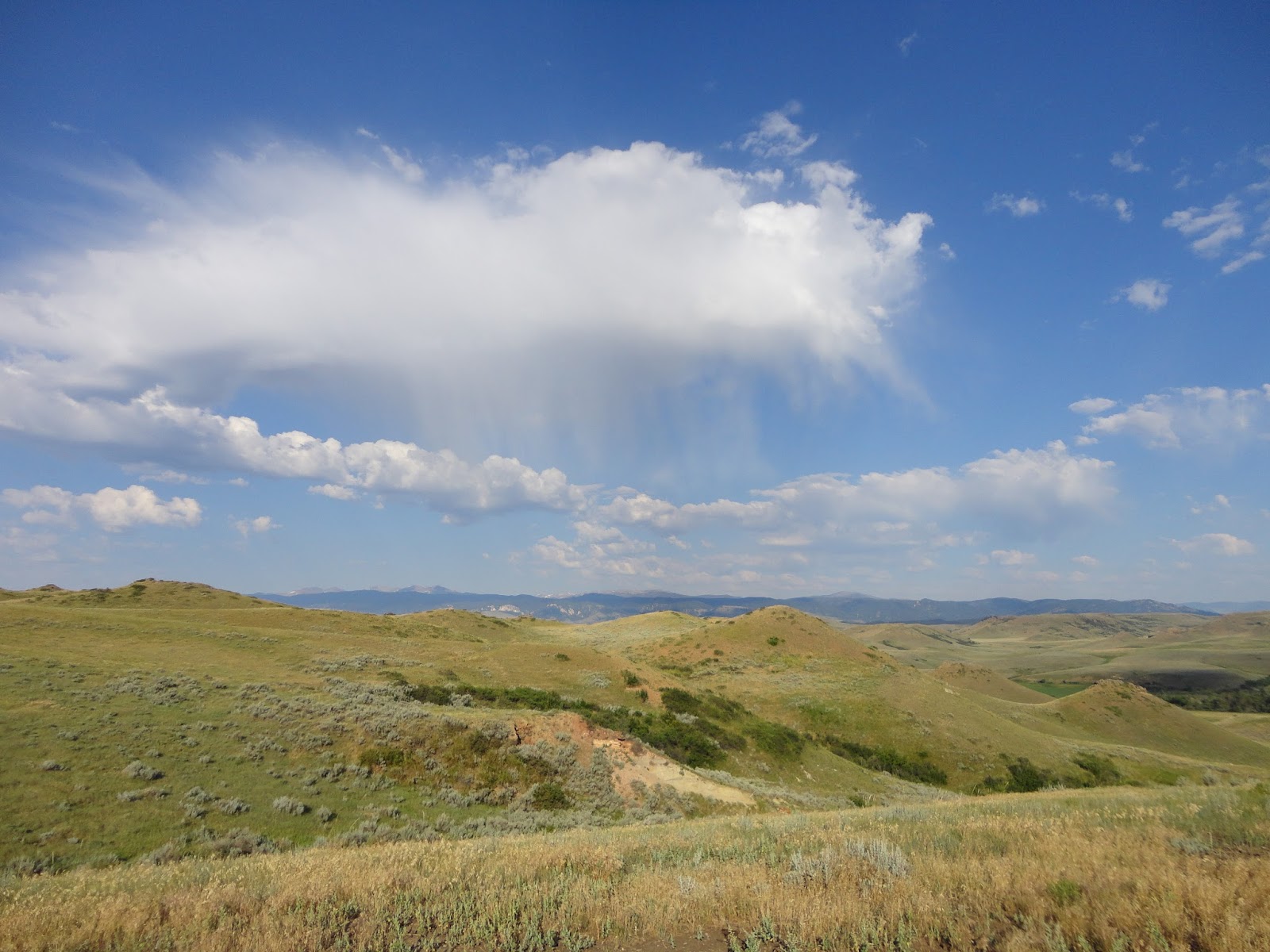 |
| This sky, you know? |
 |
| Wyoming sunsets. They're all right. |
A thousand thanks to the Jentel Foundation. A word I kept using while I wrote postcards to folks was transformative, and it's true. This residency changed the way I think about my work (in some very practical, tangible ways and some not-so-tangible ways) and about myself. At Jentel, where art and the artists that make it are so clearly valued and honored, there was so much burning brightly, sky and self. I'm taking that with me.
Subscribe to:
Posts (Atom)