Showing posts with label art is why I get up in the morning. Show all posts

02 March 2015

Spring Breaking and Spring Mending

The academic calendar tells me this is spring break. The all-day snow yesterday suggests that the "spring" modifier is perhaps a little ahead of itself, but the break from my everyday schedule is as advertised.

As is the case with most academics, there's not much "break" in my break, in the sense of vacation, but it is something different for a few days, and on the heels of a frigid February, that'll do. My plans for the week involve writing two conference papers and putting together my AWP presentation. Planning and writing new scholarly papers is a task both daunting and refreshing, and when I can put the intimidated feeling on the back-burner, I am reminded of this oft-quoted sentiment from Brenda Ueland:
“I learned that you should feel when writing, not like Lord Byron on a mountain top, but like a child stringing beads in kindergarten—happy, absorbed and quietly putting one bead on after another. ”
~from If You Want to Write
I feel that way much more with scholarly writing than with my novel. That's likely because my scholarly writing must start with some defined line of inquiry; the conference abstract has already been submitted, so I'd better go on writing the paper around the idea I submitted. Perhaps it's my particular area of research—Anglo-Saxon studies, which is well-loved and well-studied, particularly with regard to the texts I love most—but I don't feel like I'm "discovering" anything. If anything, the bead metaphor is more apt still: I'm sitting beside the same box of beads as everyone else, threading them together in a hopefully pleasing pattern. Hopefully no one else is stringing together the exact same colors in the exact same sequence, but at the end of the day, the beads will be recognizable as beads, even if I've managed to find some bits of bone and shell to add, too.

This is not to categorize all scholarly writing in this way—just my own. I know I've read scholarship that felt like Byron on the mountaintop, and I'm grateful to it. My own process simply seems quieter than that. Maybe it's because of the contrast I feel when I shift between genres, from scholarship to novel and back. With the novel, even one with a historical timeline and a significant number of pre-set events, it doesn't feel like beads most of the time. Sometimes it does, mornings of quiet productivity where the manuscript is somehow two thousand words longer than it was the day before, and the scene has transitioned, and everything proceeds apace.

More often, though, it feels like making the beads—drilling through bone and shell and glass with nothing but a pen-tip—or chasing each glittering seed as it bounces across the floor (right for the dark space under the stove or refrigerator—or stringing them with eyes closed because I'm not sure how it's all going to look together. I like that feeling, too.

***

I was smart enough not to plan a slew of grading for the week, but I had to provide another wrinkle: home inspections for a casa we would like to buy. On Thursday afternoon, think good thoughts for me while I'm hanging outside with the home inspector and trying to pretend I'm not freezing to death.

***

Here are some cool things:

52 Habits: My grad school friend and digital rhetor/Writing Center Director/poet Julie Platt is embarking on a completely ambitious, wholly inspiring, year-long project of cultivating new, positive habits, and her friend Dalyn is also participating. I've been leeching motivation and great ideas from this jawn since January. Check it out.

Every Game A Story: A new series from The Classical. I've joined the editorial staff at The Classical, and here on the brink of baseball season, we're looking for some baseball-centric work. Check out the  new general guidelines, too. Send us some stuff.

31 December 2014

year-end clearance

I spent December digesting what I learned from my November, my mini-NaNoWriMo. In that month, I wrote around 25,000 words, which is only half of the true NaNo goal, but that was fine because I said, quite truthfully, it wasn't my aim to get the full fifty. But I plugged away, and with a correct sort of dedication, and I thought I was really getting somewhere.

In true keeping with my process, what I understood at the month's end was that I'd written most of that chunk simply in order to find the starting place I really needed. From what I'd done in November, I kept some broad strokes—conceptual, plot-based things—and bundled the rest safely into a holding pen with the rest of the false starts.

I've spent this second half of December restarting, again. I want to say that this, this is the correct starting point, but that will only jinx me.

***

At the end of November and into the beginning of December, just as the semester's end was approaching in its whirlwind wind-up-cool-down push-pull that it always is, I read Eleanor Catton's The Luminaries and was saved, as I have been before, by reading the exact right book at the exact right time. I set one of those reading goals on Goodreads last year, a target number of books to read, and I didn't make it. I don't know if I'll set a target number this year, but I think I will finally settle back down with The Greenlanders because Catton gave me back that thirst for good, big books.

***

I will probably end up making some manner of resolutions post sooner rather than later, because I like that kind of thing, even when it's predictably ineffective. The hope is sustaining, for a little while, and I've learned that I can talk myself into recreating it again, usually in mid-February, and again toward the end of April, and so on. It's cyclical in my life, the energy for positive change, and I'm starting to recognize that wheel better. (It's a bit ironic that it's taken me this long, being a medievalist and being well-acquainted with Fortune's Wheel and all that, but, well, forests, trees, visually obstructive noses, and so forth.) 

Some of the upswing is mandatory: the spring semester begins in slightly less than two weeks, and there's much to be done between now and then. The resolution game, the cycle, is also part of a scheme to use well the time that I have. My spring usually includes two conferences, the all-absorbing AWP and the smaller, quieter CEA, both of which give me opportunities to present my creative and pedagogical work, to test things out with an audience of comfortable peers. Due to an overabundance of enthusiasm in the fall, I'm also adding NeMLA and the Kalamazoo Medieval Congress to present some new Anglo-Saxon scholarship. All four of these events take place in a six-week span, which overlaps with the last five weeks of the spring semester. The timing isn't exactly ideal, but it's exciting (and a little terrifying) and I will start the rituals for good weather then right now.

***

Tonight, we're celebrating the turn of the New Year pretty quietly at home, though I am going to make lamb chops for the first time, and individual chocolate cakes with dulce de leche because David Lebovitz has never steered me wrong.

09 November 2014

achieving some greater better

Earlier this week, my commute-music shuffle dropped Southeast Engine's "Try" on me, and so I'm stealing their lyrics for a title and a jumping off point here.

Because I graduated from Ohio University in 2005, it wasn't possible even for me to miss that Southeast Engine existed, and I saw them play live, I think at Casa Nueva. More importantly, I left Athens with one of their CDs, Coming to Terms with Gravity, and though I haven't really kept up with them since, I'm always glad to hear them (like on NPR's Mountain Stage). 

While I was driving, it was misty, as so many of this autumn's mornings have been, and I thought a bit on my time in Athens, where the fog rolled in off the Hocking in similar white waves. As an M.A. student, I definitely did my work and kept my head down. While there, I certainly had some great classes and professors and some marvelous colleagues, some of whom are still among my favorite people, but I stuck to my comfort zone, wrote the short stories my workshops expected. Despite having the opportunity to take workshops in creative non-fiction and poetry, I just couldn't take the chance at doing so. What if I was terrible? I'd written essays and poems as an undergraduate, had gone through rather rigorous workshops with exacting and inspiring professors, but I definitely didn't identify as an essayist or as a poet, and so I couldn't gather up the bravery to make the leap. I was only there for two years; what right did I have to encroach on another genre's territory?

When I got to my Ph.D. program in Binghamton, I did stretch myself at least so far as to take a poetry workshop, but it was largely generative, rather than with an intense critique component. So I wrote poems, and I shared them aloud, and when the semester was over, I put them away and didn't think about them again. 

Then I got a job in Wyoming, and maybe because I was teaching multiple genres of writing to my students, maybe because I didn't have to answer to a workshop anymore, maybe because no one was going to grade my attempts, maybe because of the high altitude—whatever the reason, I wrote a few poems. I wrote some essays. I found the guts to pitch a few essays, and then to simply submit, and someone even asked me to write a piece

And so I've gone along, up to my elbows in two novel manuscripts (one finished, one not), and still sometimes writing other things, while the novel percolates, while a draft rests, or when I simply can't not write the somethings else. 

In the past several days, it's been the somethings else that have brought the most exciting news. 

A poem I wrote while at the American Antiquarian Society was selected as the Writer's Block Poetry Contest winner. The judge was Rebecca Morgan Frank, founder and editor of Memorious, and I'm just so pleased about it. The poem will appear in a future issue of Memorious. In the meantime, you can read an interview about the poem at the Louisville Literary Arts/Writer's Block blog.

An essay I'd been working on for more than a year, too, was published at The Rumpus. "Leaving Early" was churned out of an experience I had while actually gathering material for my Brandon Nimmo/Sand Gnats piece. The essay is about baseball, sort of, though it's more about fear and living in the world. "Leaving Early" also makes use of something I read while I was at Ohio University in David Lazar's History of the Essay course, which seems strangely fitting, given my own cowardice when it came to actually signing up for one of David's essay workshops.

I'm still pretty peeved with myself for not taking better advantage of those other writing experiences I might have had when I was younger, simply because I didn't want to fail, didn't want to risk a B on my transcript. But I don't have to be myself at twenty-two or twenty-five anymore, and I'm glad I sent this work into the world. I'm glad it's getting easier to simply write without worrying about what it means that I have written X or Y or Z. I'm glad it's easier to simply write. I'm glad, too, that these things found homes. I'm starting to feel the same. 

02 November 2014

time warp!

This week seems like a good time to post about my own daily time warping, given the overnight clock shenanigans.

Around midday on Tuesday, I was finishing up class prep for my English Literature I class and I'd just done some reading for a conference paper I'm working on. Early that morning, I'd spent my writing time on my novel, and it was very much an ordinary type of Tuesday, a good Tuesday, one in which I'd felt I used my time wisely and well, on the whole. Still, there was something big and breathless-feeling in my brain, everything just trying to catch up—to what, I wasn't sure.

It took longer than I'd like to admit to figure it out: it was just trying to get settled in crossing eight hundred years of historical context and detail in the space of six hours. My novel is set in the early eighteenth century, and the process is immersive, drawing on the huge body of research I collected at the American Antiquarian Society this summer, and I've been mentally hanging out there for a good long while now. When I got to my office, before the building really started buzzing with activity, I settled in with a volume of conference proceedings on eleventh-century Archbishop Wulfstan. I spent about two hours switching my brain over to Old English and the niceties of transition between Æthelred and Canute, as well as the particular language of academe. (I tend to think medievalists avoid some of the worst lit-crit buzzword bingo offenses, but as I'm not a professionally trained linguist, I bring my own set of challenges to this kind of reading. Luckily, I also bring my OED.) After that, I put together class notes for our first day discussing Shakespeare's Twelfth Night, easily my favorite play, and though those came together rather quickly and happily, there was that final gasping feeling.

I wrote a quick e-mail to a friend, essentially making a joke about the temporal whiplash I was feeling. It's not new for me—my teaching responsibilities have always meant switching between time periods and subject matter, and working both as a creative writer and a literary scholar demands that, too—but I don't think I've ever been doing work so tightly pinpointed and demanding in such diverse periods before. My last novel project was contemporary; while I definitely did some research, I felt pretty well qualified in describing clothing and hair and food in twenty-first century America. When I dabbled in medieval studies, that was the only leap I was making at the time, and that certainly fed into the medieval lit course I was teaching at the time. The novel before that, my dissertation, was set in the same period as my scholarship: more Anglo-Saxon England, but that was half a decade ago, and I wasn't confronting a whole new set of texts.

Still, despite the strange flurry in my brain most of the time, the interplay of times and topics is helpful to me, particularly to my teaching, because this particular cocktail of timelines keeps me very mindful of the connections between history and literature and the evolution thereof. And, for better or worse, they're sparking other connections, especially in my creative writing. The next-novel queue is a firm four texts deep, and I'm actively adding to their Evernote catch-all files whenever I encounter something helpful.

Earlier today, I was making fun of myself and my inability to sort interesting things into just one box because I'd found a somewhat snarky response to Wulfstan from Ælfric. It might be useful for my scholarly project, but I was more interested in it as a dramatized moment, and I filed it away because it might be particularly relevant to Second-Novel-in-the-Queue. Still, it's easy for me to overwhelm myself.


Having a good system to hold onto those diverse pieces helps. I use Evernote. I also have physical notebooks for certain projects, and I make a point to transfer whatever handwritten bits and pieces end up in my daily everything journal to some electronic source because I spent way too much time during the last move dutifully typing up hundreds of scraps. (Though laborious, it was better than the prospect of hauling another box of paper up to a third floor apartment.)

What do you use to keep track of these things? Do you follow the Joan Didion admonition to keep a notebook, even if it's digital? Or do you trust that the most important things will stick in memory, that if they're really the lightning flash they feel like at first, they'll stay burned in the brain?

26 October 2014

a work in progress

By the week's end, it will be November. Writers the world around are gathering themselves for National Novel Writing Month, and I, like I've done for years, am circling it. I've already started my new novel, and it doesn't fit into the 50,000-word template. I know my own process well enough to know that trying to bash through beginning to end in thirty days isn't going to work. I write big, then pare down, and that takes time. The National Novel Writing Month frenzy isn't about writing big—it's about finishing a draft. I'm not worried anymore about not finishing. 

But, like I've said before, I'm a huge fan of getting high off everyone else's NaNoWriMo fumes, and I'm always in favor of energy turned toward writing.

The novel I'm working on now was revolutionized during my time at the American Antiquarian Society, and I've spent a good bit of the writing time since my residency re-envisioning it. Some of that is in my mind: having to think of a novel with a different opening and some different central premises than those it's had for two years is difficult, and having so much more—and better—research in the balance is having similar effects. Some of it is quite literal: I'm setting up this project in Scrivener because of the sheer amount of research I gathered and because Scrivener allows me to see all of the pieces that I need to see at once. I can also hide things when I don't need to see them, and I can do it all without the kind of window-swapping rage inducement Word causes me. (Also, my last manuscript in Word started to take nearly twenty seconds for each save, during which I couldn't continue working. Yes, it was long, but just a pile of perfectly plain text should never require so much fuss. Thus far, with more than a hundred pages of notes and so on, I've had no such issues with Scrivener.)

Apologies for the software commercial, but this project is quite different from my last. The cast of characters is still gargantuan, but the timeline is a challenge, and since the work is historical, making sure I don't get things flat-out wrong is important to me. But the real reason I'm sharing this now, on the edge of the NaNo bubble, is that the energy devoted to that novel-in-a-month project does get at something I've been thinking about a lot with this project: consistency. Presence. And I think of Annie Dillard and one of my favorite passages from The Writing Life:

A work in progress quickly becomes feral. It reverts to a wild state overnight. It is barely domesticated, a mustang on which you one day fastened a halter, but which now you cannot catch. It is a lion you cage in your study. As the work grows, it gets harder to control; it is a lion growing in strength. You must visit it every day and reassert your mastery over it. If you skip a day, you are, quite rightly, afraid to open the door to its room. You enter its room with bravura, holding a chair at the thing and shouting, "Simba!"
A project like this really does go feral overnight. I've already found that to be true, even when the time away from the actual writing part was productive (actually giving the work time and thought to reconsider its structure) and necessary (packing, moving, starting a new job). The details drift away, and the details, for me, are everything. The every day necessity of NaNo, the staying-in-the-room, helps to keep that wildness in check.

It's also much more difficult to be scared of or intimidated by a large project if I'm seeing it every day. A week into it, the sense of even writing a novel fades away. It's simply spending time with people I like. I can see the work growing, and the work becomes its own living thing, a plant to water, rather than a finish line to reach. Yes, the NaNo push is toward a very definitive finish line of fifty thousand words and a full draft, but the writer who can hang onto the NaNo habit even after reaching that line (or despite not reaching it) will be able to keep the project in hand.

In the coming weeks, use the ambient writing push to help you. You don't have to sign up. You don't have to be a novelist. You don't have to do fifty thousand words of anything. But show up to your keyboard or notebook or recorder. The thrill's in the air. Breathe.


06 October 2014

give me stitches

I have the luxury of being able to write this from the sweatpants-clad comfort of fall break. For two days, students are (theoretically) able to study and prepare for the mid-term onslaught, and professors are (theoretically) able to grade and prepare for the same. I've been doing my part, trundling pretty happily through English literature exams and Beowulf papers and composition papers predicated on students arguing for which single track to include on a Golden Record single. (The idea for that paper came after reading Elena Passarello's essay "Space Oddity," in Let Me Clear My Throat.) It's good reading, especially when I get to learn about new music, and extra-especially in these occasions:
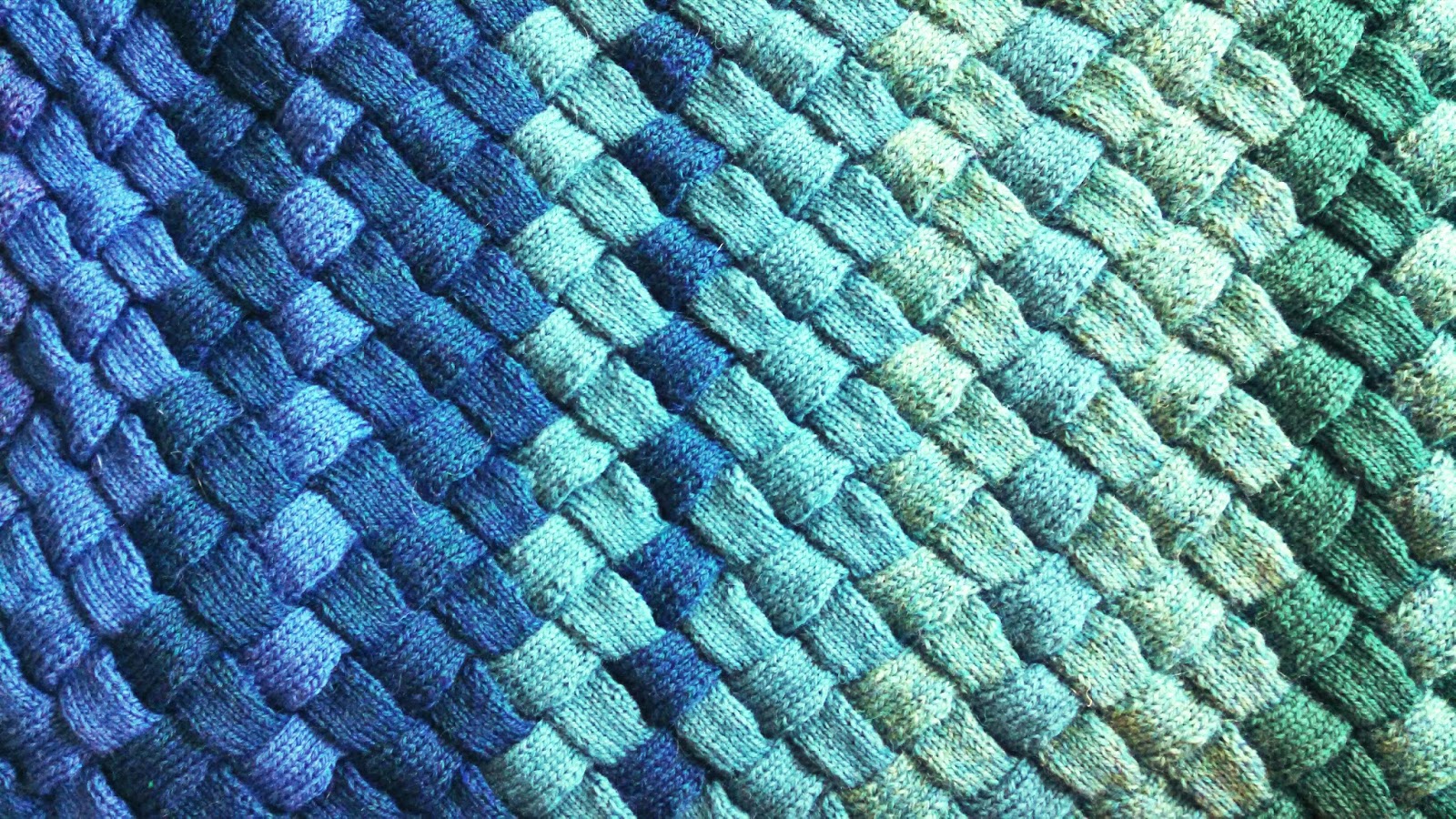
In the in-between, I've slept more than I usually do, and I've watched as much baseball as I can, and I've knit. I'm reaching the point on a project I've been working on for more than a year where it is actually becoming itself. For all of my various organizational obsessions, I'm a poorly organized knitter. I don't plan yarn purchases for specific projects. I have a Ravelry queue of more than a hundred patterns, and I can safely say I'm not really intending to knit most of them. So when I began the Virelai Ancien wrap, it was mostly an experiment in ridiculousness, and I more or less accepted that it was going to pattern on in shifting shades of blue and green forever. But I've finally reached the end of the colors I had put aside for it, and I'm very nearly ready to begin the border. I'm still trying to decide on what I'll do around the edge—surely black—but it's reaching that point where the edging is becoming a reality. It's something I'll need to do soon. And like the process of finishing a novel draft, once the end came into sight, I felt this barreling feeling. I couldn't stop.

an entrelac blanket in various shades of blue and green
Entrelac. All of the entrelac.
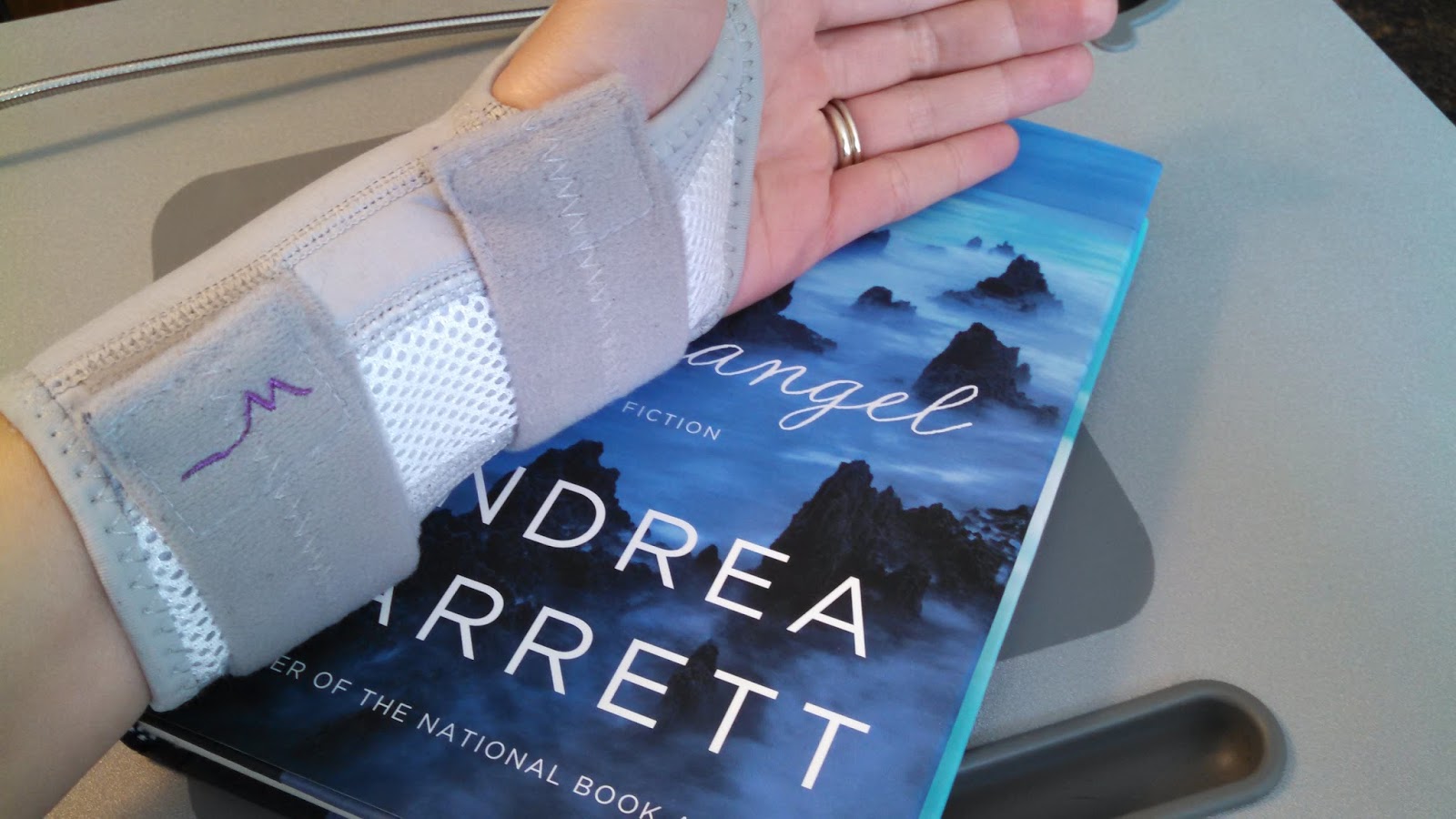
Which meant that I've probably spent something close to thirty hours knitting since I came home on Friday, which is roughly 1000% more knitting than I usually do in a given three-day span. Which has precipitated me needing to dig out the wrist braces I bought back in the dissertation days.

hand in a wrist brace atop a book
Andrea Barrett's story collection, Archangel, is pretty great, though.
I'm wearing them now, and I wore them as I graded this morning, fully anticipating that I will spend all of the night's MLB playoff action knitting. I will do that even though I know it's going to hurt—
(Read this by Kyle Beachy wherein he talks about pain and acknowledgement far more gracefully and pointedly than I do here.)
—and tomorrow, when I have another morning of typing and grading ahead of me. At night, I will put my hand under my pillow because the weight of my head holds my wrist flat, and the eventual warmth will feel good. And I will probably knit more tomorrow because I'm close to the end and I'm excited, and the project isn't of such a complex nature that I'd screw it up by continuing to work on it.

The barreling feeling gets me in trouble at the end of writing projects. I finished a draft of a short story today, and I wasn't even out of the shower before I figured out that I'd rushed the ending. I made myself spend longer on breakfast, making a Fancy Coffee in my own kitchen (because leftover salted caramel and some frothed milk never hurt anyone) and eating my toast before I went back to the computer. I fixed it then, and there was still that heady little buzz of finished finished! when I closed the file and got on with today's grading.

The story is short by my usual standards, just over 3,000 words, and I'm doing my best to wait at least a day before looking at it again. Wisdom says I should wait longer. If a story is a small wound—and for me, they usually are, painful in so many ways—I should let the whole thing heal, wait for the work's edges to become whole before I look again. Then I'll see what's gone right and what might need to be opened again, where the stitches went awry.


26 September 2014

in good company


For a good part of the time I was in Casper, I was lucky to have knitting friends, and friends who didn't knit but who liked to get together with good food and conversation who weren't bothered by the constant twitch of yarn and needles. Still, I did—and do—most of my yarn-based pursuits in private, usually in my living room, while watching baseball and hockey. It's something to do with my hands that simultaneously justifies the act of watching and is a pleasure in and of itself. I don't knit a whole lot in public, though, and while I love to talk about it, I don't tend to do so unless I know I have a like-minded conversation partner.

On Saturday, I attended a meeting of the Cocoa Area Fiber Enthusiasts at the Hershey Public Library, where I had the distinct pleasure to spend nearly three hours in the company of people who are not only knitters but also spinners, dyers, felters, weavers, crocheters, and so on. Many of the participants also expressed interest in other creative pursuits: paper-making, historical crafting practices, dichroic glass-making, quilting, and on and on. Through the midday, we worked on our projects and talked pretty exclusively about similar creative pursuits, showing off current projects and older ones.

06 July 2014

of the nature and use of maps

I spent another month churning miles under my tires, and in two more weeks, I'll do it again. The first leg of my into-June journey was, of course, arriving at the American Antiquarian Society (preceded by a quick tour of apartments in the Hershey area so we have a place to sleep when we head east at July's end). And, since no fellowship lasts forever, I had to leave Massachusetts and go into the west (but only for a little while). I spent a long time agonizing about my route back to Casper. Because the trip east at the end of May and the trip east again at the end of July need to be the most efficient versions (the first for available time and the second because my two cats will be miserable enough in the car), I wanted to see something I hadn't seen before, and so I buzzed north into Canada, skirting Georgian Bay and the western edge of Lake Huron. I drove through Whitby, Ontario the morning after James Neal had been traded to Nashville, and I thought about Nealer, and I hope(d) that some day he'll mature into the human being his hair deserves. If he (and Nashville, mostly because of Pekka Rinne and completely despite Laviolette) do good this season, I'll be happy about it. 

Mostly, though, as I drove north by roads slightly less traveled, I thought I should have gotten a map. I wrote down my directions dutifully before I left Massachusetts, as my phone GPS wouldn't help me in Canada, but I only wrote down the distances between turns when they were really tight. As a result, I spent most of my time on ON-12N being certain I'd missed something, but I hadn't, and then I passed Lake Simcoe, which was so beautiful in the late afternoon sunlight, all blue sky and glitter, that I actually swore at it. (With love, Canada, so much love.)


title page of A Short Account of the Nature and Use of Maps
The title page to William Ailingham's 1703 A Short Account of the Nature and Use of Maps. The red ink is just fantastic.
In my route through Ontario, I didn't get into any new provinces, which made me sad. My first choice for my route to Worcester was actually to go north through Fargo and Winnipeg and finally have a good reason to drive through Manitoba, but that was before I knew I was going to be moving. That route is about fifty hours of driving, all told, and as much as I wanted to, I couldn't really justify adding at least two more days to my travel time when I'd already been gone for almost six weeks and there was everything to pack. Since last summer and the perfect days on the Gaspé Peninsula, I wanted to see more of Canada, particularly the parts I wouldn't necessarily have other reason to see. Several people told me there was no real point in taking the route I'd taken, that there wasn't much there to see.

mention of a report of an exploration of Gaspe
Even the 1714 Calendar of State Papers attests that Gaspé is a draw.
If you judge from my camera roll, I didn't see anything. I didn't take any photos–I was driving solo and trying to make good time with my persistence since I'm not much for making good time with speed. By most standards, too, I didn't see anything "special"–no particular landmarks, as I remember (save a sign informing me that Orillia is the hometown of Glenn Gould). But I saw lake after lake, pool after pool stretching out on either side of the highway, shadowed here and there by trees. All the way up ON-400, cairns of small stones peppered the roadside cliffs, marking the presence of adventurous and climbsome visitors. I saw a place I wanted to come back to, and the tricks of sunshine and my mosquito-free cockpit probably painted a rosier picture than the reality, but that doesn't particularly matter. New places are always more inviting for their newness, for the greens and golds and granite grays that are never quite like those I left.

small sketch of a sailing ship
A small ship sketch on a 1688 map of exactly this part of the world, though a bit out of currently known proportions. Never has anything made me want a tattoo more than this map and its small ships.
During my time at the AAS, I looked at a lot of maps, inked on three-hundred-year-old paper and folded down into tidy, in-volume references that could spring into another level of detail for the accounts they contained, and I looked at one rather large French map, from 1688, that was lovingly hand-detailed, the interior margins of waterways inked a pale blue. Little ships, like the one above, sailed in the little-known parchment seas.

Marbled end-papers of John Oldmixon's 1708 British Empire in America.
The history of these maps and books and what they contain, recorded and elided, is more often violent and heartbreaking than not, because those are the wages of colonialism, and wonder is frequently coupled with disgust or fear. It's impossible to forget that. Most of my research saw me elbows-deep in the various ways human beings can be wretched to each other, wittingly and unwittingly, and I spent a lot of time, I think, investing myself in the objects of study as a way to maintain some distance and maybe, maybe, to find some hope. These small sketched ships, the marbled end-papers–these I read like those cairns, small and perhaps unspectacular and not quite secret, but still as invitations to notice, to step a little further in.

16 June 2014

connecte(d)isconnected

I think I watched six minutes of Game Four of the Stanley Cup Final, and that was the balance of the end of hockey for me. And that hurts me, somewhere in my hockey heart (damaged goods at the moment, thanks to Pittsburgh's fizzled season and off-season travail).  It's unsettling, too, that I can't quite remember what I've seen. I know, at the end of May, I watched some of Kings-Blackhawks because I was in a small, dark, Dickensianly damp hotel room for a week, but I know also that I fell asleep before any of the games were over. It's all half-memory, scores and highlights and Twitter reactions and forgetting what is first-hand and what is second. It's the same with baseball, though it's a long season and what I'm missing isn't the last firework burst for months.

But I have been seeing a lot. With two weeks of my fellowship now complete, I can say I don't lack for what Annie Dillard calls eye-food. The days are all about diving deep, about filling both lungs with air and fixing a light on the brain, between the eyes, and plunging. Coming up for breath at the end of the day has actually been difficult; the first week, I couldn't. After the archive closed at five (eight p.m. on Wednesdays), I spent nights reading PDFs, something both charming and uncanny in electronic versions of documents three hundred years old. (And painstaking: I discovered that I would much rather turn physical pages than execute the several clicks it requires to advance to the next page and size it to readability, even if that means re-typing large passages of notes instead of digitally highlights or annotating them.)

There have been books, too:

This book, Seamanship, Both in Theory and Practice, has been immensely valuable (not to mention immensely beautiful).

The diagrams are consistently excellent, including this primer on knots (one of several), and it includes written explanations both of the physics of sailing (why sail A on mast X drives the ship in N direction when the wind strikes from Q direction at H force) and how to execute specific maneuvers on-board (like the very particular process of dropping the anchor on a ship of any particular size). If you are going to be time-traveling and expect you may end up in the Age of Sail, or if you are the sort of person who may be marooned on an island where an eighteenth century ship is moored, take David Steel's book with you.

I am very much adrift in the contemporary world right now. There are some lunchtime snippets of World Cup, and President Obama spoke here in Worcester last week and that precipitated some conversation about this city on that particular day, but there is otherwise little talk of here, of now. But everything in this project I am researching feels anchored well, encompassing, whole. It is hard to cope with that sometimes--there are many conversations happening in the places I usually spend my time (both online and in Wyoming and in Pennsylvania) that I know I'm missing and feel I shouldn't--but there are also many conversations here (with actual human beings and texts and the funny writerly place inside my skull) that I would not miss for the world.

***

And a little plug: my short essay, Final Mica and Final Mare, is the second piece in Narratively's Tales from the Pitch folio in The Beautiful Game feature, in which I wrote about an intercollegiate soccer tournament in Sibiu, Romania.

02 June 2014

Panic early and often.

I've done that thing where I get incredibly precious about posting and thus do not post for months. Working on it. Feeling like I've got something to actually share helps, and all at once, I'm brimming with things.

One, let's start with some excellent, conflicting, perfectly apt advice I've received today. Exhibit A:
"Panic early and often."
Exhibit A was given to me this morning during orientation at the American Antiquarian Society. The person who delivered it was spot on: fellows have an entire month to research; fellows have only a month to research. (The archive, of course, isn't going anywhere, but the point is to do what needs doing now.) That means that one has to be well-organized and pro-active. Don't wait to wade into something--you may need to go deeper than you think. "Panic" here reads as urgency: don't wait. Look now. 

In true and marvelous Madame Clairevoyant fashion, though, my favorite purveyor of horoscopes (and the only one I read because they always contain something I need to hear) offered up Exhibit B: 
Aries: It’s going to be easy to feel like everything is urgent, this week. It’s going to be easy to feel rushed. The world will pick up its pace around you, maybe, and it’s going to require a specific kind of bravery, a strange quiet kind of courage, to move at your own speed, to move slowly and intentionally through even the strangest of days. Try not to let the world chase you off your own path. Try not to let the world make you panic. There’s plenty of time, there’s so much time, there’s all the time you need. ~The Rumpus 
I don't believe in horoscopes in the sense of expecting anything in them to actually come true, but Madame Clairevoyant's whimsical and lovely work strikes the ideal advice-giving balance between koan and fortune cookie: the brush is broad enough, soft enough, to fill in the background behind whatever I'm doing.

And this one is just right. Everything is urgent--but it's up to me to control the rush of it. Nothing has to be rushed. Nothing, dear hobbits, need be hasty. But there is so much: there's this marvelous, overwhelming, exciting residency I've really just begun. I'm working on The Pirate Novel while at the American Antiquarian Society, and there's just so wonderfully much to dive into. But my process is well-organized. The librarians/curators/staff/archive genies/microfilm fae/periodical wizards/map magi are rockstars. All will be well.

And all will be well in time to move. Because I am moving in July, back to green Pennsylvania, to Lebanon Valley College, where I've accepted a position as Assistant Professor of English. It's slightly old news if you follow me anywhere else online, but that's adding to the urgency: I've come to the residency directly from a week spent looking for a place to live in Pennsylvania, and I will leave the residency to finish packing and then do an about-face and drive across the country again. 

There's so much happening--so much good--and everything's so green. There's time.


Lebanon Valley College's McGill Field.

09 March 2014

I Learn All My Best Lessons From Baseball: Revision Edition

A year ago, I was on my way to Scottsdale, AZ, to spend my one-week spring break watching baseball and finishing a revision of my novel. It was a week of heaven.
groundskeepers getting the infield ready
I'm here in my mind.
This spring break, I'm still watching baseball, but it's from my desk, and I'm still working on that novel. This morning, I sketched out all of the things I have to finish this week. The list includes an academic paper revision, a review I promised to do, two grant applications for the Equality State Book Festival, and innumerable small tasks related to said Book Festival. There are other things (remembering how to cook actual food, finishing reading any of the six books I am halfway through, finishing some gifts I am in the process of knitting) that I would certainly like to do, but the others are non-negotiable. March 16 cannot slip past without the first set complete because this life is full of deadlines and some of them actually matter.

This morning, too, I took something off of that list, something that had been on my Spring-Break-Absolutes since last fall. I took "finish the novel revision" off of that list. It's the same novel I was working on last spring break, though it's changed a lot since then (for the better), and idealistic me thought that I'd surely be done with it by now (wherein done means "ready to send it out," really, really ready, not only kind-of-ready like I was last spring and still tried three times, stupidly).

I didn't take it off the list because I don't want to work on it. The opposite is true. I've spent most mornings since January sitting with the manuscript, re-reading, re-considering, understanding the big changes that I've been avoiding. I am getting closer to really understanding it. And I've revised it on self-imposed deadlines twice before. Rushing it at the end is not the thing this book needs. It only took a year to understand that, but understanding it doesn't make it easier to swallow.

Back in February, when I was certainly at the height of the now now now feeling this novel has been causing, someone on Twitter linked a post by Sonya Huber that begins
Your book is taking a long time to write. You see updates on social media about the release of other books, and you get a racing hopeless feeling inside, as if your little book with its million little legs were trying to climb up a mudslide. You have been through this draft so many times. You have been asked how many drafts it takes you to write a book, and you want to say that the answer is really the number of times you thought you were finished, plus one. (read more)
Huber's post gets at what I've been feeling for a year. It's agonizing, feeling like I'm very close to being done, but not being done, and realizing more and more with each revisiting of the manuscript that it deserves better than hurrying. There's a piece of feedback that I need, and there's a slowness that the book needs, a consideration and a deep thinking. Neither of those are going to appear according to a schedule. The week since AWP drove that home.

On Monday morning, I woke up and spent my writing hours organizing my notes and my revision plan. I was doing that in preparation of this week: my plan of attack. How would I approach the revision in a way that would let me get it finished while also finishing the necessary tasks I mentioned earlier? What happened was that, while I was puttering about in Evernote, making checkboxes beside planned edits (so when I made them I could put that little mark in the box--it is so incredibly satisfying and so indicative of why my scheduled process has its pitfalls), I figured out something I hadn't figured out yet about the ending. I did the same thing on Tuesday, just slowly puttering and shifting notes from one file to another, and I understood something else. It happened again on Wednesday. In two hours of slow thinking--not even writing at all--I made more real progress than I had in the two weeks before, at least as far as substantial work goes. Sure, I line-edited and tweaked, but I hadn't learned anything. When I had three mornings to think about the project, clarity came. When I had long days in airports and that post-AWP muteness that makes it hard to say anything, I could hear it. (And I could hear the answer to the hard question I've been asking about a chapter for eighteen months. I've known the answer for six, but I didn't want to listen.)

Writing this novel has taught me more about writing than I was ready to learn, most notably that my process has always been about drafting. I'm only now understanding that my process has to change when it comes to revision. Being goal-oriented is great--when it's time to get the draft out, when the point is to make the words happen in the first place--but it's not the answer for finishing anything.

So maybe, actually, it's good to have last year's trip to Scottsdale on my mind.
Peoria ballpark outfield grass
It wasn't possible to stress out during those games.
Sit in the grass. Take a nap. It's just a game.
Everything about the baseball on that trip was about taking time, seeing how it goes. Yes, there's an end to Spring Training and hard decisions have to be made, but they can't be made before we understand what we have. Don't rush this: it's going somewhere. Watch. Wait. That's part of the process, too.

01 November 2013

another not-NaNoWriMo post

It's the six a.m. hour, and I've decided that the short piece I drafted at the beginning of the week is finished. So before I had a second cup of tea, I submitted it to two places, and it doesn't feel as unwise as maybe it should. (Of course, I trust my decision-making at this time of the morning far better than I trust it at two in the afternoon.)

At the same time, all over the world, NaNo'ers are leaping into beginnings, including my friend and colleague Jill. She came to dinner last night with notebook in hand, and it made me so happy to see that. Last night, at midnight (when I'd been soundly asleep for two hours), a local writing group had a NaNoWriMo kickoff write-in. I envy them. I envy their fresh starts sorely. I have never done NaNo, not in any way that is "correct," though I have made attempts of varying kinds to keep in the spirit. There is a buzz in the air about it, and anything that spurs one forward in any writerly way is a marvelous thing.

This, I suppose, is another of those keeping-in-the-spirit posts, though the last thing I can/should do this month is start anything new. My goal is more now in line with my 2010 November: do something that I need to do as a writer every day. Sure, that means sending out work, but more importantly, it means finishing.

I have folders of unfinished things, fully drafted short stories that don't quite work; half-written things that I'd forgotten I'd even thought of, let alone written; two-and-three word ideas that still blister and crackle no matter that I tossed them into a file years ago. I have kernels of pieces that can only become poems. I have a novel to be written, all furled potential; I have a full, old, old draft of another whose re-vision I'm starting to be able to see. More importantly, I have the novel I'm still working on, the manuscript I keep thinking is finished and keep understanding is not and the only right thing to do by that book that I love, the book that made me completely forget that there was a November last year, is keep working until it's right. Until it's as good as it deserves to be. And that is terrifying. It takes a kind of patience I don't have, that I have to make, and maybe I'm doing that kind of stepping back that Michael P. Nye wrote about earlier this week. I know good work takes time. I spent big chunks of my summer taking that time, considering things, and the revision I did in August did leave me with a better book than I had in July. I'm now understanding that "better" is no substitute for "right."

It's not right yet. I'm not sure what "right" is for it yet, but I know it deserves to be right.

So I will try to be patient and listen and if I can't do either of those things gracefully and contentedly (and I can't), I'll finish smaller works. They've been waiting longer still, and they deserve to at least get where they were going. I won't set another artificial deadline to finish another revision by a date or a time: I understand that my problem is not getting myself to work. It's not about spurring forward this time.

I do want it to be, though. I want to be part of the dash. I'm good at the dash--even elementary school gym class showed me that.

I loved gym class. The period was never more than forty minutes long, and in forty minutes, there was never enough time to get into the things I couldn't do. The longest we ever ran was a mile and a quarter. More often we sprinted. More often we dove after a ball, the goals quite clear, the scores clearer.

Novel writing is not gym class. Even my own process is not the one-size-fits-all yellow mesh pinnie, appropriate for all activities, no matter how much I want it to be. But there's something to learn from thinking about gym class--about exertion, in particular, because what is writing except exertion of one kind or another--no matter what shape I'm in, no matter what shape this novel or those drafted stories or those little poem seeds are in, I can do something. And so I must.


14 August 2013

Re-entry

My Jentel residency has come to an end, and the upcoming days are my re-entry into the usual world. Given the presence of the Perseid meteor shower and that we spent our final two nights at Jentel sitting on folding chairs in the driveway, heads tipped back as we watched these clusters of dust and ice immolate in atmosphere, the idea of re-entry feels appropriate. It's been a summer of overwhelming good fortune, but there's no getting away from the overwhelming part; it's hard to really understand the imminence of the semester and so on.

Before the meteor shower, too, the summer sky shed its usual measure of stars. It’s not that I’ve been particularly attentive to that—I tend to be asleep well before the interesting astronomical features take place—but there’s so much sky, so much night that even I can’t miss it all. 
 
That’s been the feeling over the whole month: there’s so much good here that some of it must stick, well past the end of our tenure at Jentel. The work was good, the scenery was good, my lovely, lovely fellow residents were more than good, and this is all following in the Jentel tradition of understatement.

Have some pictures:
Like it says on the sign. 
Just a few days into our time together, we thought it was a good idea to take a 4-mile round trip hike to a fire tower none of us had been to on a trail that is not marked at all. (No one will be surprised that it was my idea. I wanted to research something. How hard could it be?) The hike had its challenges (including a need to be a little inclined toward mountain goatishness to get to the actual lookout), but it was worth that much and more. And we stopped to get ice cream together on the way home. That's how you know you've bonded: passing around your order to let five people you just met taste the chocolate malt or rootbeer float or butter pecan milkshake. 

Shadow portrait of the residents, Big Horn Mountains in the distance.

And in Big Horn, Wyoming, Holly discovered she loves watching polo. Because everyone expects polo in northern Wyoming, right?
I had four weekends in the greater Sheridan area. I went to four polo matches, and that was an experience that will get its own writing project of some sort. In the meantime, visit Flying H Polo and Big Horn Polo Club. Also, read Alyson Hagy's spare, beautiful novel, Boleto. I read Boleto last summer, actually, in Montreal, and I will read it again, now, knowing a little more about the backdrop to Hagy's fiction. 

This sky, you know?
Wyoming sunsets. They're all right.
A thousand thanks to the Jentel Foundation. A word I kept using while I wrote postcards to folks was transformative, and it's true. This residency changed the way I think about my work (in some very practical, tangible ways and some not-so-tangible ways) and about myself. At Jentel, where art and the artists that make it are so clearly valued and honored, there was so much burning brightly, sky and self. I'm taking that with me.

01 July 2013

space and time

The second and third legs of my travels, which took me to the Maritimes & Quebec and San Diego, respectively, have come to a close. Have a few photos of some of the highlights from the first few days of the east coast excursion:
Waves at Acadia National Park, Maine
Bowsprit of the Tall Ship Mar, Halifax, NS
The lighthouse on Cap Gaspe, Forillon National Park, QC
Another view of Cap Gaspe, from the Mont Saint-Alban lookout tower
There are quite literally hundreds more photos from everywhere that I've been in the past six weeks and thousands of miles (also literal: my friend Heather & I put more than three thousand miles on her car in our New England/Canadian adventure). I'm looking forward to sifting through them more carefully in the future. Just now, I'd like to pause a moment on how strangely productive all of this travel has been. 

I certainly don't mean in terms of production, any finished project. I've been a shameless and capricious dilettante, starting a dozen different pieces in three genres and finishing none of them since I set out on May 16. I blame some of this on the fact that I was working almost exclusively in my notebook, with a pen, and it's much easier to do the big organizing/re-writing/overhauling that I need with a keyboard than without, so instead of crashing things out, I took notes and then moved on to whatever was next, returning to make more notes as necessary. (I will say that Evernote may be revolutionizing that annotation process in a really easy and useful way, and it was incredibly helpful even when I didn't have actual network or wireless access with my phone, which was incredibly often through the Maritimes and the Gaspe Peninsula.) But while I still have my many, many pages of notes and scraps and snippets to actually type up and organize, the overarching sense of it all is that much of what I started deserves finishing. I don't often feel that way, and my folders are a hive of the unfinished. But all of these things feel quietly, calmly alive in a way that says Take your time. We will be here when you're ready. This is good. This is important. Because there's no way, of course, to finish all of these things at once, and it's madness to try. It's madness enough to be still at work on a novel's revisions (more on that in a moment), preparing to start drafting the next, and having some non-fiction planned that really does need to be finished. But this is good madness (I think). At least the back of my writing brain thinks so. It must think so because it's finally let me think some useful things about the novel I "finished" over spring break. 

That was the first substantial revision. It was a revision that needed to happen, but when I put the files away for the end of the semester, I knew there were some things that weren't quite right, and, in early May, trying to think about those things made me feel frantic, panicked, and riddled with failure, even though I know that excellent novels do not come about on one-and-a-half drafts. A novel is work, but, in May, it didn't feel like work, which is familiar, which is what one does, which is strangely comforting in its way. In May, it felt like just one more thing I couldn't get right. 

So, an ocean, then most of a continent, then the spine of the Rockies and wide deserts between me and it. Up to nine timezones. More than a dozen new students and a host of wonderful new people and a wealth of new landscapes and climates and a lot of delicious food and miles passed beneath my sneaker-soles. A jumble of new ideas. The constant smell of sugar in the air in Sibiu, the pine freshness of Gaspe, everywhere marine salt from Maine to Montreal and then in San Diego. All this distance, all this stimulus. And in small, quiet moments--under the rain-wet tent in Maine, on a silent, red beach on Prince Edward Island, on yet another lookout over Gaspe Bay, with coffee in hand in the Quarter of Spectacles in Montreal--things became clearer. Some small changes, adjustments to scenes and moods, and some cuts, of course, and then, last night, as the last flight started its descent into Casper, the thing I probably needed to know most about the book crept in. I had to write my notes on my actual boarding pass, given the timing, and there are scrawls in all of the white spaces, in the bigger block of white following my name, in the smaller white rectangle beneath the large DEN-CPR, on the back around the advertisement for United's Mileage Plus credit card. The ideas filled themselves in, wherever there was space. All I had to do was find that space. 

In fourteen days, I leave for my residency at the Jentel Foundation. I'll have four weeks of space, too, to listen and to work, thanks to the fantastic people at Jentel. In the meantime, there are smaller things to manage, a semester to prepare for, and some finishing to do. But I know where I stand, and the footing is good, and for now, the listening is easy.

10 April 2013

Spring Training: The Point is to Learn Things (and Maybe I Did)

The baseball season has officially started. Amen.

This post has been a long time brewing, and it's only a little about baseball, but baseball is in the margins. At this time of year, baseball is always in the margins.

When I was in Scottsdale, I had the privilege of having four really extraordinary meals, and one of those was extraordinary for several reasons not only related to the food. Thanks to Keith Law's excellent dining guides for the greater Phoenix area, I happily, happily recommend you visit Barrio Queen and Hillside Spot immediately if you find yourself there. I also had great food at Nourish, which I hunted down on my own.

The famed pulled pork sandwich at Hillside Spot. What a bloody perfect sandwich.
But at Il Bosco, I had a fig and goat cheese pizza that was easily one of the best things I've ever eaten, and I liked their house-brined olives so much I bought a jar to take home.
Olives. Man. These olives.

(I didn't think I even liked olives, generally, before. In the gamut of delicious food-stuffs often served with olives, I'd never turn down bread or cheese in order to pursue the eating of olives. Clearly, I had not had the right olives.)

Still, I'd been prepared for the food to be superlative (and I planned for that--I definitely ate an entire pizza by myself that night). The more unexpected thing, though, was how marvelous the staff (and the proprietor, I think) were. I'm not talking about quality service (though that was certainly part of my experience): I'm talking about how welcome I felt, as cliche as that sounds.

I'm not someone who often feels welcome because I don't necessarily desire it. There's a clean, crisp impersonal hospitality that I tend to seek out both at home and abroad (which sometimes makes going out in Casper difficult because I have students who work everywhere and they generally rock but it's hard to go anywhere and disappear). Usually, if I'm alone, I've brought work of some kind with me--there's always writing to do, and if there's writing to do, I admit to being that jackass mostly buried in pages. It's also a way to say I'm fine--you don't need to entertain me. I'm not particularly social, and I have a loathing of rote small-talk that I can't explain and feel horribly guilty about.


But that week was a suspended paradise, a whole collection of Things I (Have) Never Do(ne), and when I arrived at the restaurant (nothing fancy--wood-oven pizza in a small dining room and a slightly larger patio) at four, too early for the actual dinner crowd, I was the only patron there. I felt obtrusive, but at least I wouldn't have to rush out on my dinner to catch the Team USA vs. Colorado exhibition game I was heading to. I could eat my whole pizza in leisure while editing: perfect.

When the server seated me, her demeanor was friendly and maybe glad at having something to do--even though I was there for more than an hour, only one other family came in, and even then, very near to five. After she left me with the menu, after she came back with water and olives, after she came back in yet another trip with my drink, she fiddled with the already wrapped silverware bundles, straightened menus just at the edge of the empty bar. With every trip, I received a little burst of language: about the water, about the olives, about how the pizza I ordered was her favorite thing on the menu. Though pleasant, none of these things are strange or surprising or special, or even particularly reaching for connection. But I'd spent the previous four days nearly mute. I'd had some short and enthusiastic exchanges with ballpark volunteers (God love you, Peoria volunteers, and the Jobing.com arena usher who commented on my Malkin jersey and got my I'm visiting former Penguins speech), but even my communications with friends and family were via text message. Maybe it was a cumulative effect--I usually spend fifty percent of my days doing public speaking in a classroom, after all--and maybe it was because the server seemed interested and I wasn't keeping her from anyone else and maybe it was because she asked questions she didn't have to ask.

She didn't have to ask any questions, of course, but I had some of the usual markers of being a traveler: a Phillies hat on my head (no denizens of the Cactus League they); a backpack full of books and notebooks and camera (and the bag-searcher at Peoria cheerfully forbade me to do work while I was there); aloneness. The conversation is already created: what are you doing here?

I had a three-fold answer. I could say that I was there (at the restaurant) because of Keith Law's recommendation, and that did later lead to the proprietor coming out and telling me more about the restaurant, which was really lovely. I could say that I was there to watch baseball and enjoy my spring break. I said both of these things, and both of these things were true. The last answer--that I was there to write--was the most important to me, and it is the one that I hadn't really mentioned to anyone in my admittedly few casual conversations of the week. (I did blog about it, but people choose to read that and I don't have to look them in the eye while they read it.) I made myself say it. She asked about everything.

As I was talking to her--about many things, including her trips to visit her sister in Colorado Springs, her late husband--I saw myself coming to the understanding that I didn't particularly feel like a fraud. For the first time, claiming myself as a writer, I didn't feel like an imposter. For all that I write about writing constantly, for the three degrees I have, for all the time I spend writing and teaching writing, I have never really convinced myself that I qualified for the monikker. At that moment, it felt like it applied, all at once, even though it's been a slow and gradual sojourn towards it over the last six months, and it's fitting that the understanding settled on me there, during Spring Training. Baseball has been one of the primary ways I've made meaning in my life, and in that place, at that time, I felt justified in saying that writing was the thing I was doing there, that writing was the reason I'd made the trip. A fair bit of that courage came from the fact that I had an actual writing task while I was there, a task that turned into this piece at The Classical, not just that I was revising.

The server asked, too, for a link to my blog, and there was a hit on it a few days later from Phoenix. I surely don't know if that was her. There are a lot of people in the greater Phoenix area. But if it was--if she visits again or visits ever--I thank her, for being there, for having a conversation because she wanted to, because it was possible. 

I am choosing to read this incident in the most positive and generous light because I have no reason to believe otherwise. I am choosing to read interest and kindness into that server's speech because this is about believing. Spring Training, I saw, is the very essence of believing. Opening Day, not two weeks ago, is the culmination of this. David Roth wrote about that at the Wall Street Journal, and Diana Moscovitz wrote a Pirates-specific paean on the hope against hope. The start of the baseball season is about thinking that this could, in fact, be the year.

Fingers crossed. It might.

This is the fig & goat cheese (and prosciutto & arugula) pizza from Il Bosco. It was life-changingly good. Maybe life-changing is a thing they specialize in. You should give it a shot. Worst-case scenario is that you get damn fine pizza.

15 March 2013

Making Things Up is Decidedly Easier

Recently, my first piece of published non-fiction* entered the world, and non-fiction is a genre I adore, so I'm particularly grateful to see my writing in the field housed in a good home like The Rumpus.

I have to say, though: Oh, I find making things up so much easier.

When reading fiction, a reader can be bored or dislike something and put the work down, but, barring really egregious research fail, it's hard for the fiction writer to be wrong. The suspension of disbelief is embedded in the art of fiction; readers are more inclined to give the benefit of the doubt until given specific reason to do otherwise.

In non-fiction, which purports to represent reality at least to some measure, one can be wrong so much more easily, I think. I'm not talking specifically about facts, though that's certainly the most immediate and recognizable incorrect, but rather that the assumption is then, if non-fiction deals with reality, then the writer and the reader are approaching the subject matter from the same locus. That makes it easier to assess--and sometimes easier to engage in and identify with, and that's one of the great pleasures of non-fiction. Readers know reality; we're all in it. You know, theoretically.

I often worry that I fall more into that "theoretically" category than is probably healthy. I'm not sure I have the strongest grip on reality, in that fiction has always felt more real to me. I can categorically say I spend more time thinking about fiction(fictional worlds, people, and situations, well above and beyond the actual fiction I am or have been writing) than about my own experiences. I apply narrative to things that have no entrenched, absolute narrative (often in sports and music, where narrative may be suggested but not definitive). It's not a particularly conscious act on my part; it's simply how it's been.

I also question reality because it's become quite clear that people do not see the world in the same way. There are mounds of evidence culled from massively important social, religious, and emotional spheres to illustrate this, but the one that makes it stick is a memory from a graduate school fiction workshop. The professor brought to class an ashtray, a fairly conventional-looking, deep indigo blue ceramic ashtray. He asked the workshop to write about it, to describe it, and he gave us ten minutes. We wrote, we shared, and at the end of the exercise, he slapped the table.

"None of you got the color right. None of you. It's the exact shade of Minnesota Vikings purple. The exact shade of their helmets."

I tell you, reader, that ashtray could no more be called purple than the Vikings' helmets could be called blue.

But the moment drove home an important point: in that very talented writer and professor's eyes, the ashtray was not only capable of being classified as purple, but as a most pure and saturated purple. My father had a navy blue minivan for a while (so very definitively navy that it was described so on the from-the-dealer tag), and that van was called purple by many. As a lover of color-related words, I was (am) a little mental over this phenomenon, particularly with regard to my own dad, who can differentiate between a dozen dozen shades of brown to locate the particular hue of a whitetail deer in autumn.

But color must be as all things are: subjective, to a certain point. Linguistically, the differences in various languages for expressing the colors blue and green seem particularly fraught and complex. Left with time to percolate, this understanding that my eyes do not process color in the same way as someone else's (and colorblindness is a wholly different issue) has seeped into a lot of other areas. I wonder about the real version. I'm not often so full of hubris that I assume my own version is the most true (though it is really, really hard when I'm naming colors), which leads me to questioning everything.

At its most basic, it's lead to me being angry about situations that necessitate wearing sunglasses because sunglasses distort and cool and shade (which is their function, yes, but I dislike it--I want the "most real" version, eye fatigue and all). At its most ridiculous, it leads me to wondering whether I'm the only one seeing the traffic signal turn green. What if it's still actually red? After a pretty terrifying bit of driving outside of Flagstaff as I returned from Arizona, it had me actually considering whether I might have already died. My mind turned the morning into a film cliche: the ghost that doesn't know it's dead. As I crept along in four inches of wet, heavy snow, looking at other cars that had slid from the road, spinning circles into the median, and holding my breath every time a tractor trailer passed me because the slush-spray threw an impenetrable white blindness over the whole car, I was really starting to consider it possible. Or inevitable.

By the time I emerged from the worst of the snow, I decided that at least my half-baked grip on reality was entertaining if I was going to spend the next eighteen hours in the car, alone. I am never bored.

The drive ended well enough (and late/early enough), and despite the very concrete physical evidence of it all (like how much it hurt and lessened yet other hurts when I peeled myself from the driver's seat for the last time), it still didn't feel like what must be someone else's version of real. What does a haze of snowflakes look like at three in the morning? The weather became a wholly different thing when I turned on my high beams. In lower light, in the final hundred miles, one snowflake hit the windshield once in a while, not even enough to make me turn the wipers on. In brighter--which I used whenever I could because my eyes staged pronghorn ready to spring at every mile marker--it looked like heading into warp space, a thousand thousand white speckles approaching from the deep because the storm was coming from the west to the east, and I was driving toward it. The light caught each flake, turning it into one of those small stretched lights, like this was the U.S.S. Enterprise. Back to low-beams? Six white dots in lazy distance, an afterthought. Again to high? A deluge of powder.

But I didn't see a single pronghorn--in fact, not a single creature in the trip--because wild things are smart enough to hunker down in the face of bad weather. They did their moving before the wind changed. Ungulates, too, are mostly crepuscular, not nocturnal, and I know that. And yet, there they were, in the reflector-glint at the roadside, eyes in every discarded aluminum can. Both caution and exhaustion create these phantoms, which revealed their mile-marker or litter-based nature as I passed, but I want to know, empirically, which is the more real: the way my mind did make those shapes and the way I saw that heavy slanting snow; or the concrete knowledge that there were no pronghorn beside the road?

I know that there are principles of velocity that give reason to the snow's appearance. I know there are neurochemical explanations for the imagined animals. I'm asking the wrong question in wanting one or the other, and perhaps that's what non-fiction does: it lets the writer and the reader contemplate that intersection. It's still an anxious place, though, for me as a writer. When I write fiction, I know what constitutes that imagined real. It is finite and it is absolute because it's mine. If I've done my job at the sentence level, there isn't that same intersection of maybe blue, maybe purple. If it is deep indigo blue, it is that. The same holds true at the sentence level in non-fiction, too, of course; the writer still has to choose the words carefully to arrive at whatever version of true or correct or real is being represented. But in fiction, I am certain of that version. Fiction is one of the few things in this world about which I am certain.

When I walked to my front door that night, at three-thirty in the morning, all I can say is that it was snowing hard, and still there was no trace of it on the ground.


* I'm going to use non-fiction instead of creative non-fiction in this, though I have to say that I really mean the same thing by both terms as I apply it to my own work: writing grounded in truth. Essay--but essay, in my mind, connotes more breadth, depth, and length than my own pieces I'm referring to here, none of which are over two thousand words. Creative non-fiction--but that connotes a less pre-determined course in the actual act of writing, and the pieces I've linked here were done with quite concrete goals and final purposes in mind. So...wibbly-wobbly lingo-bingo writey-blighty stuff.