Showing posts with label books. Show all posts

31 December 2014

year-end clearance

I spent December digesting what I learned from my November, my mini-NaNoWriMo. In that month, I wrote around 25,000 words, which is only half of the true NaNo goal, but that was fine because I said, quite truthfully, it wasn't my aim to get the full fifty. But I plugged away, and with a correct sort of dedication, and I thought I was really getting somewhere.

In true keeping with my process, what I understood at the month's end was that I'd written most of that chunk simply in order to find the starting place I really needed. From what I'd done in November, I kept some broad strokes—conceptual, plot-based things—and bundled the rest safely into a holding pen with the rest of the false starts.

I've spent this second half of December restarting, again. I want to say that this, this is the correct starting point, but that will only jinx me.

***

At the end of November and into the beginning of December, just as the semester's end was approaching in its whirlwind wind-up-cool-down push-pull that it always is, I read Eleanor Catton's The Luminaries and was saved, as I have been before, by reading the exact right book at the exact right time. I set one of those reading goals on Goodreads last year, a target number of books to read, and I didn't make it. I don't know if I'll set a target number this year, but I think I will finally settle back down with The Greenlanders because Catton gave me back that thirst for good, big books.

***

I will probably end up making some manner of resolutions post sooner rather than later, because I like that kind of thing, even when it's predictably ineffective. The hope is sustaining, for a little while, and I've learned that I can talk myself into recreating it again, usually in mid-February, and again toward the end of April, and so on. It's cyclical in my life, the energy for positive change, and I'm starting to recognize that wheel better. (It's a bit ironic that it's taken me this long, being a medievalist and being well-acquainted with Fortune's Wheel and all that, but, well, forests, trees, visually obstructive noses, and so forth.) 

Some of the upswing is mandatory: the spring semester begins in slightly less than two weeks, and there's much to be done between now and then. The resolution game, the cycle, is also part of a scheme to use well the time that I have. My spring usually includes two conferences, the all-absorbing AWP and the smaller, quieter CEA, both of which give me opportunities to present my creative and pedagogical work, to test things out with an audience of comfortable peers. Due to an overabundance of enthusiasm in the fall, I'm also adding NeMLA and the Kalamazoo Medieval Congress to present some new Anglo-Saxon scholarship. All four of these events take place in a six-week span, which overlaps with the last five weeks of the spring semester. The timing isn't exactly ideal, but it's exciting (and a little terrifying) and I will start the rituals for good weather then right now.

***

Tonight, we're celebrating the turn of the New Year pretty quietly at home, though I am going to make lamb chops for the first time, and individual chocolate cakes with dulce de leche because David Lebovitz has never steered me wrong.

06 July 2014

of the nature and use of maps

I spent another month churning miles under my tires, and in two more weeks, I'll do it again. The first leg of my into-June journey was, of course, arriving at the American Antiquarian Society (preceded by a quick tour of apartments in the Hershey area so we have a place to sleep when we head east at July's end). And, since no fellowship lasts forever, I had to leave Massachusetts and go into the west (but only for a little while). I spent a long time agonizing about my route back to Casper. Because the trip east at the end of May and the trip east again at the end of July need to be the most efficient versions (the first for available time and the second because my two cats will be miserable enough in the car), I wanted to see something I hadn't seen before, and so I buzzed north into Canada, skirting Georgian Bay and the western edge of Lake Huron. I drove through Whitby, Ontario the morning after James Neal had been traded to Nashville, and I thought about Nealer, and I hope(d) that some day he'll mature into the human being his hair deserves. If he (and Nashville, mostly because of Pekka Rinne and completely despite Laviolette) do good this season, I'll be happy about it. 

Mostly, though, as I drove north by roads slightly less traveled, I thought I should have gotten a map. I wrote down my directions dutifully before I left Massachusetts, as my phone GPS wouldn't help me in Canada, but I only wrote down the distances between turns when they were really tight. As a result, I spent most of my time on ON-12N being certain I'd missed something, but I hadn't, and then I passed Lake Simcoe, which was so beautiful in the late afternoon sunlight, all blue sky and glitter, that I actually swore at it. (With love, Canada, so much love.)


title page of A Short Account of the Nature and Use of Maps
The title page to William Ailingham's 1703 A Short Account of the Nature and Use of Maps. The red ink is just fantastic.
In my route through Ontario, I didn't get into any new provinces, which made me sad. My first choice for my route to Worcester was actually to go north through Fargo and Winnipeg and finally have a good reason to drive through Manitoba, but that was before I knew I was going to be moving. That route is about fifty hours of driving, all told, and as much as I wanted to, I couldn't really justify adding at least two more days to my travel time when I'd already been gone for almost six weeks and there was everything to pack. Since last summer and the perfect days on the Gaspé Peninsula, I wanted to see more of Canada, particularly the parts I wouldn't necessarily have other reason to see. Several people told me there was no real point in taking the route I'd taken, that there wasn't much there to see.

mention of a report of an exploration of Gaspe
Even the 1714 Calendar of State Papers attests that Gaspé is a draw.
If you judge from my camera roll, I didn't see anything. I didn't take any photos–I was driving solo and trying to make good time with my persistence since I'm not much for making good time with speed. By most standards, too, I didn't see anything "special"–no particular landmarks, as I remember (save a sign informing me that Orillia is the hometown of Glenn Gould). But I saw lake after lake, pool after pool stretching out on either side of the highway, shadowed here and there by trees. All the way up ON-400, cairns of small stones peppered the roadside cliffs, marking the presence of adventurous and climbsome visitors. I saw a place I wanted to come back to, and the tricks of sunshine and my mosquito-free cockpit probably painted a rosier picture than the reality, but that doesn't particularly matter. New places are always more inviting for their newness, for the greens and golds and granite grays that are never quite like those I left.

small sketch of a sailing ship
A small ship sketch on a 1688 map of exactly this part of the world, though a bit out of currently known proportions. Never has anything made me want a tattoo more than this map and its small ships.
During my time at the AAS, I looked at a lot of maps, inked on three-hundred-year-old paper and folded down into tidy, in-volume references that could spring into another level of detail for the accounts they contained, and I looked at one rather large French map, from 1688, that was lovingly hand-detailed, the interior margins of waterways inked a pale blue. Little ships, like the one above, sailed in the little-known parchment seas.

Marbled end-papers of John Oldmixon's 1708 British Empire in America.
The history of these maps and books and what they contain, recorded and elided, is more often violent and heartbreaking than not, because those are the wages of colonialism, and wonder is frequently coupled with disgust or fear. It's impossible to forget that. Most of my research saw me elbows-deep in the various ways human beings can be wretched to each other, wittingly and unwittingly, and I spent a lot of time, I think, investing myself in the objects of study as a way to maintain some distance and maybe, maybe, to find some hope. These small sketched ships, the marbled end-papers–these I read like those cairns, small and perhaps unspectacular and not quite secret, but still as invitations to notice, to step a little further in.

16 June 2014

connecte(d)isconnected

I think I watched six minutes of Game Four of the Stanley Cup Final, and that was the balance of the end of hockey for me. And that hurts me, somewhere in my hockey heart (damaged goods at the moment, thanks to Pittsburgh's fizzled season and off-season travail).  It's unsettling, too, that I can't quite remember what I've seen. I know, at the end of May, I watched some of Kings-Blackhawks because I was in a small, dark, Dickensianly damp hotel room for a week, but I know also that I fell asleep before any of the games were over. It's all half-memory, scores and highlights and Twitter reactions and forgetting what is first-hand and what is second. It's the same with baseball, though it's a long season and what I'm missing isn't the last firework burst for months.

But I have been seeing a lot. With two weeks of my fellowship now complete, I can say I don't lack for what Annie Dillard calls eye-food. The days are all about diving deep, about filling both lungs with air and fixing a light on the brain, between the eyes, and plunging. Coming up for breath at the end of the day has actually been difficult; the first week, I couldn't. After the archive closed at five (eight p.m. on Wednesdays), I spent nights reading PDFs, something both charming and uncanny in electronic versions of documents three hundred years old. (And painstaking: I discovered that I would much rather turn physical pages than execute the several clicks it requires to advance to the next page and size it to readability, even if that means re-typing large passages of notes instead of digitally highlights or annotating them.)

There have been books, too:

This book, Seamanship, Both in Theory and Practice, has been immensely valuable (not to mention immensely beautiful).

The diagrams are consistently excellent, including this primer on knots (one of several), and it includes written explanations both of the physics of sailing (why sail A on mast X drives the ship in N direction when the wind strikes from Q direction at H force) and how to execute specific maneuvers on-board (like the very particular process of dropping the anchor on a ship of any particular size). If you are going to be time-traveling and expect you may end up in the Age of Sail, or if you are the sort of person who may be marooned on an island where an eighteenth century ship is moored, take David Steel's book with you.

I am very much adrift in the contemporary world right now. There are some lunchtime snippets of World Cup, and President Obama spoke here in Worcester last week and that precipitated some conversation about this city on that particular day, but there is otherwise little talk of here, of now. But everything in this project I am researching feels anchored well, encompassing, whole. It is hard to cope with that sometimes--there are many conversations happening in the places I usually spend my time (both online and in Wyoming and in Pennsylvania) that I know I'm missing and feel I shouldn't--but there are also many conversations here (with actual human beings and texts and the funny writerly place inside my skull) that I would not miss for the world.

***

And a little plug: my short essay, Final Mica and Final Mare, is the second piece in Narratively's Tales from the Pitch folio in The Beautiful Game feature, in which I wrote about an intercollegiate soccer tournament in Sibiu, Romania.

06 November 2013

Travel Light: A book recommendation & a November impossibility

Several years ago, the inimitable Linda Koons sent me a book: Travel Light by Naomi Mitchison. It's a short, sharp tale, a Norse fairy tale, rubbing up against allegory in a way that reminds me of The Little Prince, but the unrelenting, marvelous Norseness of Travel Light also means it is nothing at all like The Little Prince. It's been years since I read Travel Light, and it's on my campus bookshelf, so I can't really turn to it now and dig you up a quote or anything like a proper review, and that's not what I'm doing here this morning, anyway. It's simply that I'm on my way to the airport quite soon and I was thinking of it and I wanted to say so. It's a beautiful little book, hard around the edges, the way stories of its kind are, and it's also a wind-bitten, incredibly sunny November morning. How can I avoid thinking of it?

And I am thinking of practical details. I'll be in Corpus Christi from Wednesday until Sunday, and I'll be attending the National Learning Communities Conference. As a new Learning Communities program director, this conference is an excellent opportunity to learn a great deal, and, having looked at the schedule, I fully anticipate shuttling from session to session for three days straight. This is a very good thing. But I'll also be in four different airports, twice, on six flights all together, and there are mornings and evenings and stray bits of time between events, and it's hard to know what to bring.

Writing wise, it seems I've never been better equipped: I have a few dozen small projects to work on. But because this wouldn't be a post on my blog without me whinging about my novel, there's that, too. There's always that, looming (and companionable) in the back of my mind, and it's ridiculous to even think about traveling light. (That Corpus Christi also requires me to add a rain jacket to my suitcase, too, adds a material dimension.)

...Middlemarch is also going with me. The edition I'm reading is a Norton Critical, which means it weighs more than it should because there are so many of those onionskin pages jammed between its covers.

I want, very badly, to take knitting along. The best project for it, though, is getting too large, and it's something that requires multiple colors of yarn, which means multiple balls, taking up more space, and I am dedicated to a) not checking luggage on a trip like this b) actually respecting the dimensions allowed for carry-on items. I also am not-taking the knitting because it's an excuse. It is always an excellent excuse: I can neither read nor write while knitting, and I know myself. During my five-hour layover in Houston, when I could probably finish a draft of a short story or finally get to the back cover of Middlemarch, I would knit (and listen to hockey). And it isn't that I don't love knitting; it's that it's always too easy to love.

And that weighs on me. (Every breathing moment I am not writing or reading weighs on me. I intended to write this morning. Instead, I cleaned some things because I'm going to be gone for four days and I went to buy toothpaste because I didn't have a TSA-approved size in the cupboard and I had a bunch of angst about how I did those things instead of writing.)

And that's ridiculous.

It's a constant struggle to balance good discipline (which leads to good craft) and masochism for the sake of it. Ten minutes ago, I decided that I'd rather be the person in a suit carrying a be-patched and be-buttoned backpack because it's just a lot more useful to hold my stuff than the laptop bag I have for work. And that's going to be fine. There's more room, for one. There's a pocket expressly for my indispensable, unspillable travel mug.

And because there are a few minutes until I have to leave, I reserve the right to change my mind about the knitting.

Travel light.

It's an excellent book. I still take everything too literally.

18 October 2013

dispatches from the shadow of the Tetons

I spent last weekend in Jackson, Wyoming, for the annual Wyoming Arts Conference. There's something terribly intimidating about attending a conference in the shadow of the Grand Tetons, which are visible from most parts of town. Right now, with the aspens all bright gold and the foothills and fields still their muddy Wyoming green-brown, the mountains don't look real. They are, of course, quite real--perhaps more real still because they were forbidden while I was there, the National Parks closed because of the government shut-down.

I wasn't sure what I expected in terms of what that would look like; I didn't expect white-and-orange striped sawhorses with stapled-on laminated signs barring entrance to half a dozen small side roads. I wonder what percentage of people I passed were stymied vacationers, how many of them were supposed to be hiking in Yellowstone right then, but if that was the case, it's not very apparent. Everything seemed to be business as usual, which includes a lot of people drifting here and there in search of a fresh coffee, which I did, too, between sessions. Downtown Jackson has a lot of good options for good coffee, and good food, and I took shameless advantage of that.

I didn't take advantage of the chance to take pictures while I was driving in, though, and I'm kicking myself because the drive home was done under a shroud of squalling snow, all the way from Jackson to Casper, and the trees were a sad, smeary mustard color, and the Tetons had simply disappeared from view.

Missed opportunities.

But having a hotel room to myself and a dislike for television and not much access to my usual evening inundation of sports meant the opportunity to actually do some more reading, which means, right now, Middlemarch.

It's on the list of Books I Am Ashamed At Having Not Read Before As An English Major, and it's so much a winter book, the kind for reading inside a blanket, and not simply because of the weather: if I'm wrapped in a blanket, or actually bundled up in bed, I'm not doing anything else. I don't have my laptop or my phone near. I'm reading. A book like Middlemarch requires full attention, and not simply because there are a fair lot of characters with not-so-dissimilar-names whose relationships hinge on a word or gesture in that incredibly nineteenth century way. Rather, Middlemarch demands and commands that attention because I want to pay attention at the smallest point of the sentence.

George Eliot is funny. I mean, honestly:
She pinched Celia's chin, being in the mood now to think her very winning and lovely--fit hereafter to be an eternal cherub, and if it were not doctrinally wrong to say so, hardly more in need of salvation than a squirrel.
I do, of course, have to reserve judgement on the whole--I'm not that deep into the book, and the fact that it requires all of my attention means that I don't pick it up as often as I would like. But it's good to have that reminder: I can't skip on to the page's end. I find myself doing that too often when I read, impatient and diving ahead for full paragraphs, only to remember--obviously--that I needed the middle of the page, and going back.

This book reminds me of some of the best parts of my graduate school experience, the dense and self-aware arc of the evolution of the novel. I loved those books. (I also hated them a little, but that's part of graduate school.) And this one, because I'm reading it for fun, I can simply enjoy.

(Which is good because there's still a lot of book left.)


18 July 2013

it's dangerous to go alone--


I'm not Link, but if I were (and I kind of wish I were, because honestly), this is the point at which the old man offers me a wooden sword.


Instead, because I'm not a small, green-clad adventurer in an 8-bit RPG but rather a small, Crosby shirsey-clad writer in the fourth day of a writing residency at the utterly gorgeous Jentel Foundation, I've taken these:


They're as good as swords--or better, really, since I'm doing a lot more reading than slaying bats in caves--and they are excellent company (and my fellow residents are good company, as well). These are books and chapbooks and zines by people I know or that have been gifts from folks I know. In order, from left to right: Deborah Poe's the last will be stone, too, Vanessa Stauffer's Cosmology, Kim Barnes's Finding Caruso, Chris Collision's Queen City Fall, Sean Thomas Dougherty's Sunset by the Chain Link Fence & The Blue City, and shortandqueer #10, The reawakening of my baseball fandom. 

I've also brought a ton of reading for research purposes, some directly related to projects, some indirectly. If you want to carve yourself open while an author carves herself open on the page, pick up A. L. Kennedy's On Bullfighting. A. L. Kennedy is always brilliant in the fiction I've read & her regular column for The Guardian, but this book is hard and beautiful and bleak, and also contains one of the most powerful meditations on Lorca I've ever read. Melissa Montgomery, wherever you are, this was the conversation on duende that your Lycoming College honors project wanted.

Here at Jentel, I have a room of my own and a studio in which to work, as well as gorgeous common spaces for absolutely everything else.

My studio, before I decorated it with piles of books, three separate & full travel mugs, and a plush stegosaurus.
There's much to say about Virginia Woolf and rooms of one's own and that's something that I believe in desperately. Space is such a necessity and a privilege, and the Jentel Foundation has provided truly superlative space in the way everything has been planned. But to have this space as well--even with a first-night rainbow over these prairie swells, the not-quite-foothills of the Bighorns--is something particularly moving.

On Tuesday, in those hills, I also got to see my first rattlesnake in the wild. It was lying beneath a clump of sage I was intending to step past, and my preceding rustle gave us both twenty-four inches of warning. I didn't have a sword, but I didn't feel much of a need to have one, either. The snake moved slowly and silently in its direction (without shaking its tail--I'm a little disappointed not to have heard it, but glad too I didn't vex it to that point), and maybe I decided to change mine, but that's all right. I had friends waiting at my desk.

19 May 2011

If I had a hammer...

...an enchanted one, made of uru-metal, forged in the heart of a dying star, I'd use it to fly (or literally throw myself) to the UK tomorrow. But since I don't have one of those, and there's no Rainbow Bridge across the Atlantic, I have to settle for United Airlines.

In twenty-four hours, I'll have the first of tomorrow's four flights complete. (I like early, but the wake-up time for the first flight out of Casper is ludicrous.)

I'm off to Ireland and the UK for two weeks, one of which will be spent doing class prep (for future potential study abroad/travel courses), and the other will be spent actually teaching in Londinium. (Yes, I am sort of ridiculously amused by using the earlier historical names for places. We'll be spending a day in Yorvik, too. Have to show some love for the Danes, as well.)

I'm going to see the Beowulf manuscript.

I have scouted its location in the British Library. I have packed a handkerchief.

Also (all forces willing), I'll get to see some friends I haven't seen in years, which makes me so happy.

Carry-on, my wayward son...
And all of this fits (more or less) neatly into my one personal item, and the trip is being done with a carry-on only. I'm confining myself to one journal, but I am sneaking along a number of pens. There are currently six, though I might pare that down by two. (The Signos are fine and all, but I'm not in love, and I likely won't use the green and the blue that often, since I'm taking the Prera and some blue-black cartridges.)

I'm also borrowing the iPad you see in the back of the photo. It's currently loaded with George R.R. Martin's Game of Thrones because I haven't read any of that series yet and I probably ought to, as it, with the advent of the new television series, may become another one of those popular touchstones with my students. (Also, Sean Bean is in the series. So I'll watch it at some point.) I will try not to be a fantasy snob at it.

I've also taken advantage of some of the free e-editions: Sherlock Holmes, Frankenstein, Treasure Island, Passage to India. Yes, yes, I am aware that I am a perfectly shoddy English major with no right to my degrees for having those books on a to-read and not on a have-read list. But, honestly, for someone who loves the Anglo-Saxons so much, all of these novels are frankly new-fangled. They've not been out for a full two hundred years. So no spoilers, folks. No spoilers.

May manage an update or two as I go, but I'm not certain. Haven't attempted anything half so complex on the iPad, with which I have only a very shaky peace.

Book recommendations left for when I get back (when I'll have some proper "summer") would be ever-so-much appreciated.

09 January 2011

The proper place of things

I spent a big chunk of my Sunday adding books to my LibraryThing account. I had a basic account for a rather long time, promptly filled it with the allowable 200 books, and then let it lie dormant for a long while. Last week, I upgraded to a lifetime membership, and yesterday, I received a CueCat ISBN scanner from two brilliant folks--*waves at Laura and Linda*--so today, I dove in.

The awesome part is that I was able to log two and a half bookcases in around two hours. The less awesome part is that the other half-bookcase was made up of books that were too old to have ISBN barcodes, and so all of those needed to be logged by hand. So I gathered them up, two totebags at a time, and carried them downstairs where I could log books and watch football at the same time. 

(Yes, I am aware that my process is needlessly complicated.)

And that turned out to be rather pleasant, like visiting with old friends. You see, most of those books I had to log by hand had, at one time, belonged to a professor I had at Lycoming College: Dr. Emily Jensen. When she retired from teaching, she invited the campus's English majors to her office to empty her bookshelves because, she said, her best copies were at home. At the time, it was a bittersweet moment, of course: I was losing one of my favorite instructors, the one who'd really turned me on to Anglo-Saxon poetry, to Beowulf (hlaford of my heart), but there was also the excitement of getting an orange crate's worth of Old English grammar books and strange little treasures. As a nerdy wee undergrad, I was ecstatic: these weren't anthologies, these weren't "textbooks." These were the kinds of books that full-fledged scholars used, and it didn't matter at all that many of them were printed before my parents were even born. That was even a bonus: the alluring scent of yellowing pages and glue from far-off book binderies. 

Today, as I said, I spent time with those books. What stood out this time were the notes inside of them, the thin, pink-orange sheets torn off the cheapest of those old notepads covered in Dr. J's peculiar small handwriting. She wrote everything in a very upright cursive, and though her letters didn't slant back toward the left, there was always the suggestion of it, as though her hand was shaped by the Carolingian minuscule that comprised her subject areas of choice. I thought about taking a photo of her notes, but those still feel very much like hers, that they should stay between the pages where I found them. 

I'm going to spend a few more hours on my book-space tonight, too, and I will be in the best of company.

14 November 2010

Reading and also writing

I'm currently reading The Thousand Autumns of Jacob de Zoet by David Williams (yes, I know: me and everyone else on the planet). The link goes to the book's LibraryThing page. What a cracking novel. I'm only about a third of the way through it, and I am dazzled by the number of significant and interesting narrative threads Mitchell's braiding here. The one that I am most interested in (the most human of them, perhaps) is, of course, the one the reader gets least of, but rather than feeling slighted by the choice, it's easy to recognize a) the narrative necessity of that construction b) the practicality of how that thread may weave itself through the rest of the plot with consideration to the novel's reality. And, well, it's lovely enough to want to keep that one set of interactions rare and striking and not dull itself with too much familiarity.

All that said, though, if the last 200 pages of the book want to be nothing but Jacob and Aibagawa, I would surely not complain one bit.

Segue.

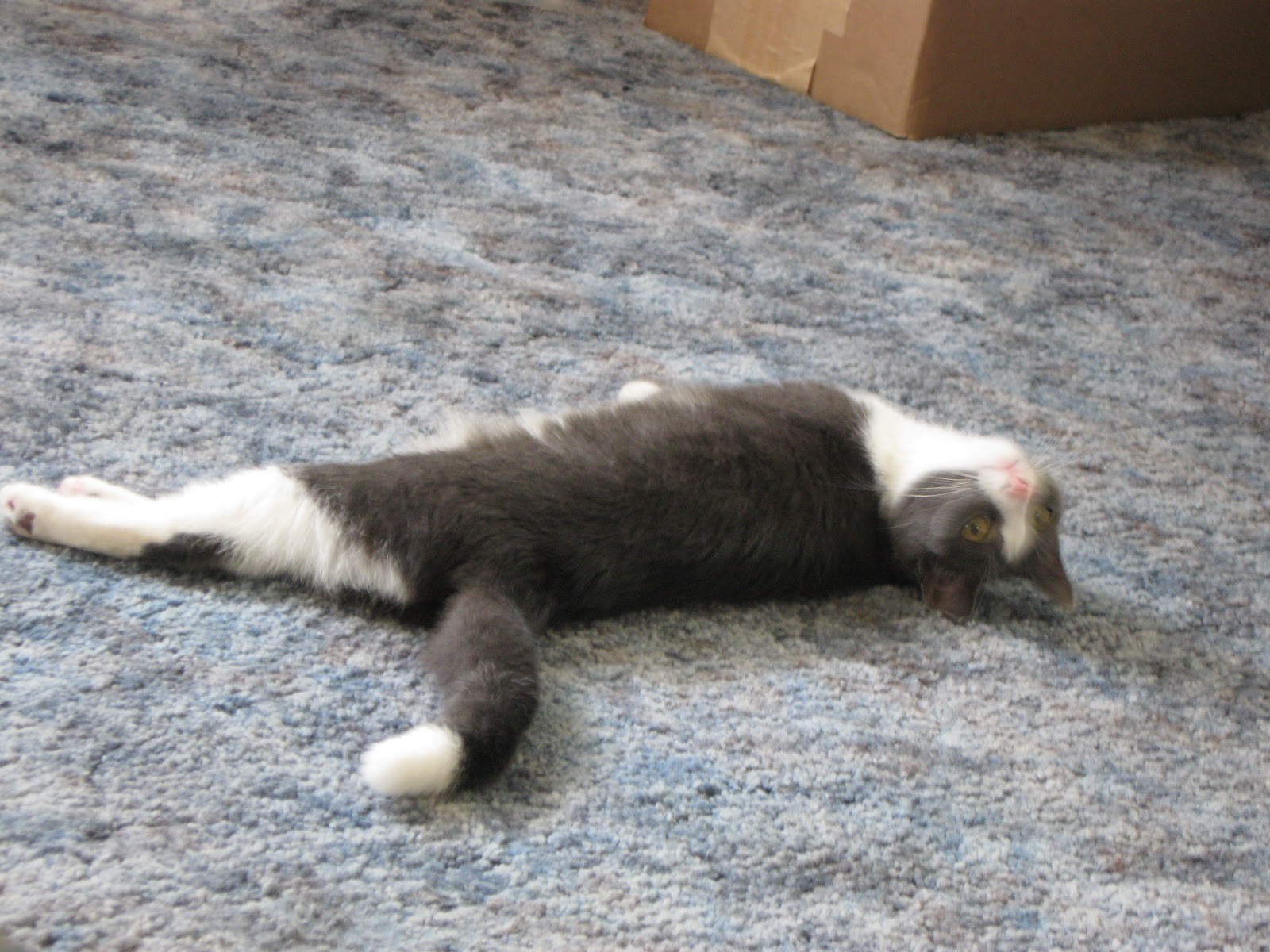
I am needing, in a very significant way, to get past a wall of inaction this weekend if I don't want to call my writing goals for the month a sham and a mockery. (And, lest anyone be confused, I surely do not wish to do this.) The most prudent way to approach this, of course, would be to open up the Word document the novel is in and start typing, But I have the attention span, of late, of a sparrow. Or of my cat, The Scoo. See photo.

And so I think that I'll turn to pen and paper this morning. And, for those of you who like that sort of thing, the choice will be my True Writer Water Lilies pen filled with Levenger Cocoa ink, and the paper is the Ecosystem notebook that has been dedicated to this single project. (Seriously--Ecosystem notebooks, available at your local B&N or on the interwebs, are brilliant things. No crankiness at all with fountain pen ink, and mine, which is roughly 8" by 5", has held up to much, much rough treatment. I first discovered this gem through the Letters and Journals stationary giveaway, which I was fortunate enough to win in July.)

Anyroad, it's time to get on with it.