There's lots of talk about Dragon Age: Inquisition this week, and while I don't anticipate playing that particular title, it did get me thinking about video games, and every time I think about video games, I think about the Final Fantasy series. It usually happens that I want to immerse myself in an RPG when the weather gets cold, and right now, I'm thinking of Final Fantasy XII. It's not a perfect game, mostly because SquareEnix made the choice to tell the story through another whiny teenage narrator (paging Tidus from FFX) instead of one of the real hearts of the story, but the trappings of it are still so full of imaginative potential that I'll forgive it most things.
It was, too, one of the games that I think wrung every drop of the PS2's graphics ability from the system, and it had a marvelously expansive world. Many people don't want to sink a hundred hours into a video game, but I definitely do, when I play. The difference may be that I don't play often (and I don't play often because I want that expansive, all-encompassing experience, which is completely incompatible with the semester-as-usual + writing a novel). But a well-envisioned world—complete with a thousand side-quests and a well-defined map—is something I will always love. (And, Square, if you're listening, I'd still go see the movie version, from the Fall of Landis all the way through the game's end, at least a dozen times, so you know. And Chris Hemsworth will soon be the right age to play Basch. Just saying.)
Maybe that's why I finally picked up Eleanor Catton's The Luminaries, which I got for Christmas last year. I'm not terribly far into it, but I'm already feeling the insulating fiction of it all wrapping around me. Quite a bit of that, I'm certain, is due to the really excellent deployment of an omniscient narrator that has effectively sold me on the 1866 setting. The omniscient narrator, too, has revealed itself as a we, the full identity of such we remaining to be seen. The world of the novel is unfolding slowly and deliciously, and even where some of the character dialogue is predicated on them drawing stories out of each other, it feels appropriate.
I feel awed so few pages in, and I hope the feeling continues.
I'm not sure it was a great idea to start a book of more than eight hundred pages when I've got a Thanksgiving break coming up with a very tall stack of grading in it coming up, but I've made worse decisions.

Showing posts with label fiction. Show all posts
Showing posts with label fiction. Show all posts
23 November 2014

26 October 2014
a work in progress
By the week's end, it will be November. Writers the world around are gathering themselves for National Novel Writing Month, and I, like I've done for years, am circling it. I've already started my new novel, and it doesn't fit into the 50,000-word template. I know my own process well enough to know that trying to bash through beginning to end in thirty days isn't going to work. I write big, then pare down, and that takes time. The National Novel Writing Month frenzy isn't about writing big—it's about finishing a draft. I'm not worried anymore about not finishing.
But, like I've said before, I'm a huge fan of getting high off everyone else's NaNoWriMo fumes, and I'm always in favor of energy turned toward writing.
The novel I'm working on now was revolutionized during my time at the American Antiquarian Society, and I've spent a good bit of the writing time since my residency re-envisioning it. Some of that is in my mind: having to think of a novel with a different opening and some different central premises than those it's had for two years is difficult, and having so much more—and better—research in the balance is having similar effects. Some of it is quite literal: I'm setting up this project in Scrivener because of the sheer amount of research I gathered and because Scrivener allows me to see all of the pieces that I need to see at once. I can also hide things when I don't need to see them, and I can do it all without the kind of window-swapping rage inducement Word causes me. (Also, my last manuscript in Word started to take nearly twenty seconds for each save, during which I couldn't continue working. Yes, it was long, but just a pile of perfectly plain text should never require so much fuss. Thus far, with more than a hundred pages of notes and so on, I've had no such issues with Scrivener.)
Apologies for the software commercial, but this project is quite different from my last. The cast of characters is still gargantuan, but the timeline is a challenge, and since the work is historical, making sure I don't get things flat-out wrong is important to me. But the real reason I'm sharing this now, on the edge of the NaNo bubble, is that the energy devoted to that novel-in-a-month project does get at something I've been thinking about a lot with this project: consistency. Presence. And I think of Annie Dillard and one of my favorite passages from The Writing Life:
It's also much more difficult to be scared of or intimidated by a large project if I'm seeing it every day. A week into it, the sense of even writing a novel fades away. It's simply spending time with people I like. I can see the work growing, and the work becomes its own living thing, a plant to water, rather than a finish line to reach. Yes, the NaNo push is toward a very definitive finish line of fifty thousand words and a full draft, but the writer who can hang onto the NaNo habit even after reaching that line (or despite not reaching it) will be able to keep the project in hand.
In the coming weeks, use the ambient writing push to help you. You don't have to sign up. You don't have to be a novelist. You don't have to do fifty thousand words of anything. But show up to your keyboard or notebook or recorder. The thrill's in the air. Breathe.
But, like I've said before, I'm a huge fan of getting high off everyone else's NaNoWriMo fumes, and I'm always in favor of energy turned toward writing.
The novel I'm working on now was revolutionized during my time at the American Antiquarian Society, and I've spent a good bit of the writing time since my residency re-envisioning it. Some of that is in my mind: having to think of a novel with a different opening and some different central premises than those it's had for two years is difficult, and having so much more—and better—research in the balance is having similar effects. Some of it is quite literal: I'm setting up this project in Scrivener because of the sheer amount of research I gathered and because Scrivener allows me to see all of the pieces that I need to see at once. I can also hide things when I don't need to see them, and I can do it all without the kind of window-swapping rage inducement Word causes me. (Also, my last manuscript in Word started to take nearly twenty seconds for each save, during which I couldn't continue working. Yes, it was long, but just a pile of perfectly plain text should never require so much fuss. Thus far, with more than a hundred pages of notes and so on, I've had no such issues with Scrivener.)
Apologies for the software commercial, but this project is quite different from my last. The cast of characters is still gargantuan, but the timeline is a challenge, and since the work is historical, making sure I don't get things flat-out wrong is important to me. But the real reason I'm sharing this now, on the edge of the NaNo bubble, is that the energy devoted to that novel-in-a-month project does get at something I've been thinking about a lot with this project: consistency. Presence. And I think of Annie Dillard and one of my favorite passages from The Writing Life:
A work in progress quickly becomes feral. It reverts to a wild state overnight. It is barely domesticated, a mustang on which you one day fastened a halter, but which now you cannot catch. It is a lion you cage in your study. As the work grows, it gets harder to control; it is a lion growing in strength. You must visit it every day and reassert your mastery over it. If you skip a day, you are, quite rightly, afraid to open the door to its room. You enter its room with bravura, holding a chair at the thing and shouting, "Simba!"A project like this really does go feral overnight. I've already found that to be true, even when the time away from the actual writing part was productive (actually giving the work time and thought to reconsider its structure) and necessary (packing, moving, starting a new job). The details drift away, and the details, for me, are everything. The every day necessity of NaNo, the staying-in-the-room, helps to keep that wildness in check.
It's also much more difficult to be scared of or intimidated by a large project if I'm seeing it every day. A week into it, the sense of even writing a novel fades away. It's simply spending time with people I like. I can see the work growing, and the work becomes its own living thing, a plant to water, rather than a finish line to reach. Yes, the NaNo push is toward a very definitive finish line of fifty thousand words and a full draft, but the writer who can hang onto the NaNo habit even after reaching that line (or despite not reaching it) will be able to keep the project in hand.
In the coming weeks, use the ambient writing push to help you. You don't have to sign up. You don't have to be a novelist. You don't have to do fifty thousand words of anything. But show up to your keyboard or notebook or recorder. The thrill's in the air. Breathe.
06 October 2014
give me stitches
I have the luxury of being able to write this from the sweatpants-clad comfort of fall break. For two days, students are (theoretically) able to study and prepare for the mid-term onslaught, and professors are (theoretically) able to grade and prepare for the same. I've been doing my part, trundling pretty happily through English literature exams and Beowulf papers and composition papers predicated on students arguing for which single track to include on a Golden Record single. (The idea for that paper came after reading Elena Passarello's essay "Space Oddity," in Let Me Clear My Throat.) It's good reading, especially when I get to learn about new music, and extra-especially in these occasions:
Which meant that I've probably spent something close to thirty hours knitting since I came home on Friday, which is roughly 1000% more knitting than I usually do in a given three-day span. Which has precipitated me needing to dig out the wrist braces I bought back in the dissertation days.
I'm wearing them now, and I wore them as I graded this morning, fully anticipating that I will spend all of the night's MLB playoff action knitting. I will do that even though I know it's going to hurt—
The barreling feeling gets me in trouble at the end of writing projects. I finished a draft of a short story today, and I wasn't even out of the shower before I figured out that I'd rushed the ending. I made myself spend longer on breakfast, making a Fancy Coffee in my own kitchen (because leftover salted caramel and some frothed milk never hurt anyone) and eating my toast before I went back to the computer. I fixed it then, and there was still that heady little buzz of finished finished! when I closed the file and got on with today's grading.
The story is short by my usual standards, just over 3,000 words, and I'm doing my best to wait at least a day before looking at it again. Wisdom says I should wait longer. If a story is a small wound—and for me, they usually are, painful in so many ways—I should let the whole thing heal, wait for the work's edges to become whole before I look again. Then I'll see what's gone right and what might need to be opened again, where the stitches went awry.
When I read that sentence in a student's Beowulf paper that is so impossibly perfect I have to make joyful flailing gestures at the paper.In the in-between, I've slept more than I usually do, and I've watched as much baseball as I can, and I've knit. I'm reaching the point on a project I've been working on for more than a year where it is actually becoming itself. For all of my various organizational obsessions, I'm a poorly organized knitter. I don't plan yarn purchases for specific projects. I have a Ravelry queue of more than a hundred patterns, and I can safely say I'm not really intending to knit most of them. So when I began the Virelai Ancien wrap, it was mostly an experiment in ridiculousness, and I more or less accepted that it was going to pattern on in shifting shades of blue and green forever. But I've finally reached the end of the colors I had put aside for it, and I'm very nearly ready to begin the border. I'm still trying to decide on what I'll do around the edge—surely black—but it's reaching that point where the edging is becoming a reality. It's something I'll need to do soon. And like the process of finishing a novel draft, once the end came into sight, I felt this barreling feeling. I couldn't stop.
— Holly M. Wendt (@geatland) October 5, 2014
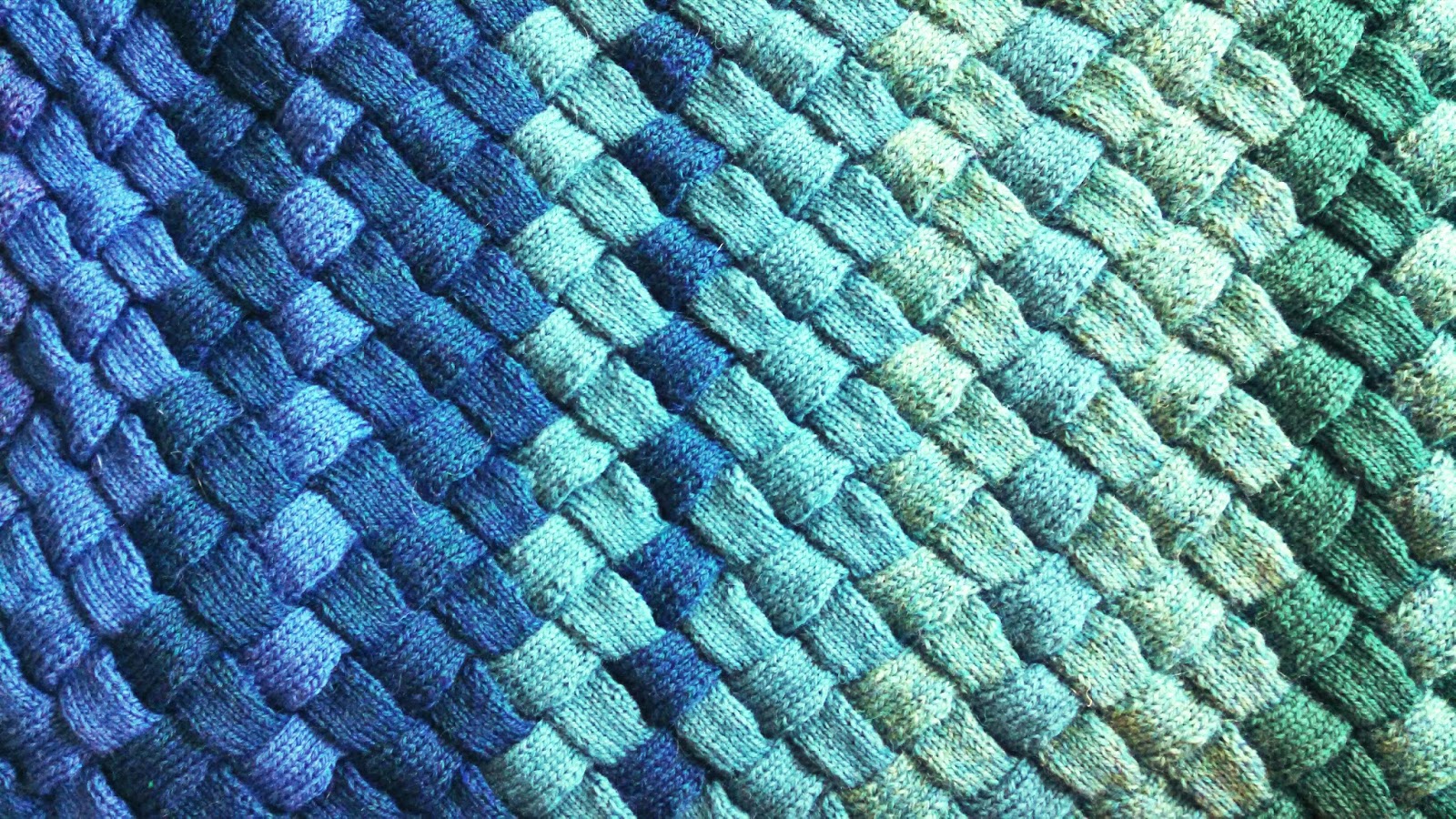 |
| Entrelac. All of the entrelac. |
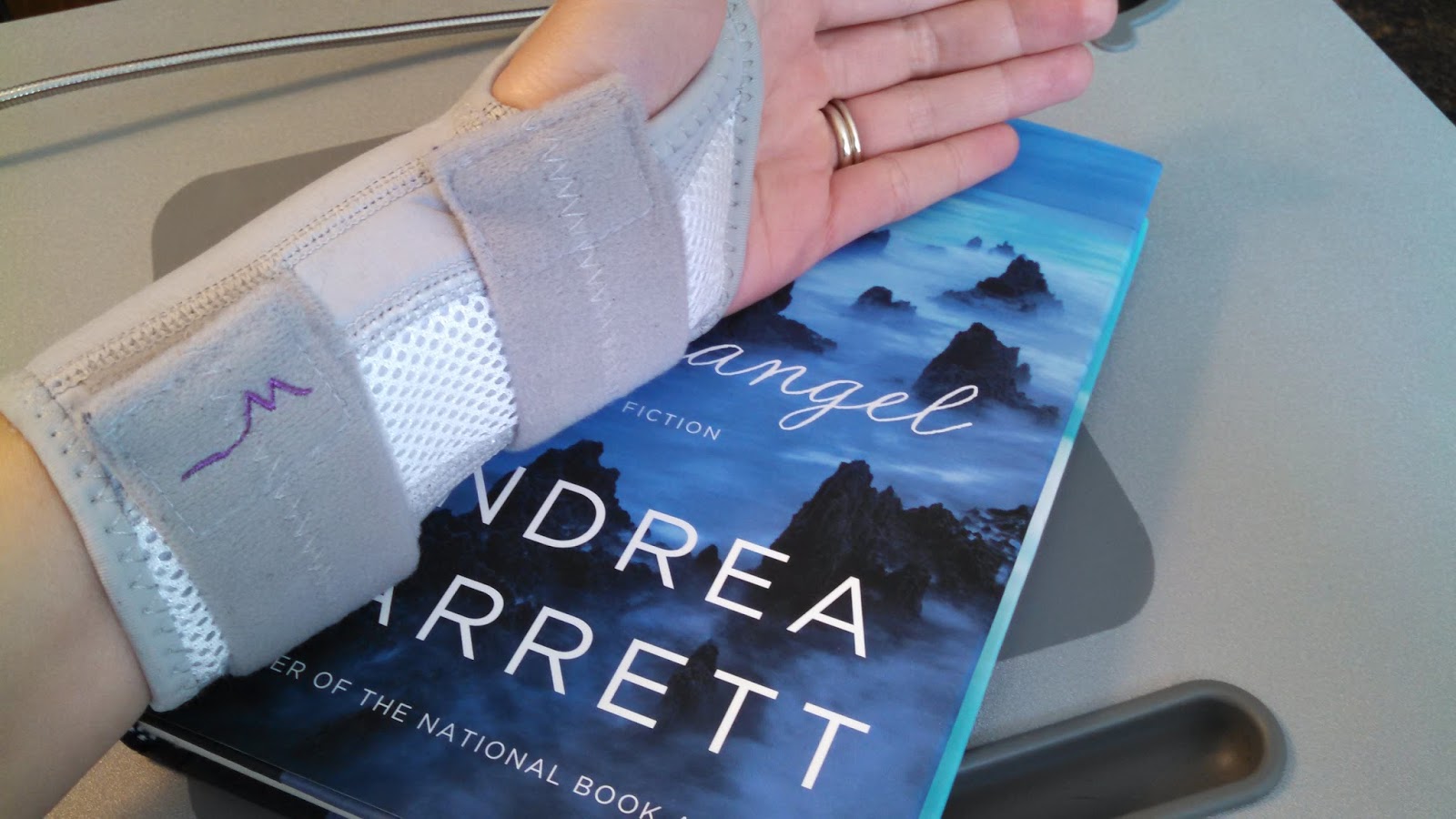 |
| Andrea Barrett's story collection, Archangel, is pretty great, though. |
(Read this by Kyle Beachy wherein he talks about pain and acknowledgement far more gracefully and pointedly than I do here.)—and tomorrow, when I have another morning of typing and grading ahead of me. At night, I will put my hand under my pillow because the weight of my head holds my wrist flat, and the eventual warmth will feel good. And I will probably knit more tomorrow because I'm close to the end and I'm excited, and the project isn't of such a complex nature that I'd screw it up by continuing to work on it.
The barreling feeling gets me in trouble at the end of writing projects. I finished a draft of a short story today, and I wasn't even out of the shower before I figured out that I'd rushed the ending. I made myself spend longer on breakfast, making a Fancy Coffee in my own kitchen (because leftover salted caramel and some frothed milk never hurt anyone) and eating my toast before I went back to the computer. I fixed it then, and there was still that heady little buzz of finished finished! when I closed the file and got on with today's grading.
The story is short by my usual standards, just over 3,000 words, and I'm doing my best to wait at least a day before looking at it again. Wisdom says I should wait longer. If a story is a small wound—and for me, they usually are, painful in so many ways—I should let the whole thing heal, wait for the work's edges to become whole before I look again. Then I'll see what's gone right and what might need to be opened again, where the stitches went awry.
16 June 2014
connecte(d)isconnected
I think I watched six minutes of Game Four of the Stanley Cup Final, and that was the balance of the end of hockey for me. And that hurts me, somewhere in my hockey heart (damaged goods at the moment, thanks to Pittsburgh's fizzled season and off-season travail). It's unsettling, too, that I can't quite remember what I've seen. I know, at the end of May, I watched some of Kings-Blackhawks because I was in a small, dark, Dickensianly damp hotel room for a week, but I know also that I fell asleep before any of the games were over. It's all half-memory, scores and highlights and Twitter reactions and forgetting what is first-hand and what is second. It's the same with baseball, though it's a long season and what I'm missing isn't the last firework burst for months.
But I have been seeing a lot. With two weeks of my fellowship now complete, I can say I don't lack for what Annie Dillard calls eye-food. The days are all about diving deep, about filling both lungs with air and fixing a light on the brain, between the eyes, and plunging. Coming up for breath at the end of the day has actually been difficult; the first week, I couldn't. After the archive closed at five (eight p.m. on Wednesdays), I spent nights reading PDFs, something both charming and uncanny in electronic versions of documents three hundred years old. (And painstaking: I discovered that I would much rather turn physical pages than execute the several clicks it requires to advance to the next page and size it to readability, even if that means re-typing large passages of notes instead of digitally highlights or annotating them.)
There have been books, too:

This book, Seamanship, Both in Theory and Practice, has been immensely valuable (not to mention immensely beautiful).

The diagrams are consistently excellent, including this primer on knots (one of several), and it includes written explanations both of the physics of sailing (why sail A on mast X drives the ship in N direction when the wind strikes from Q direction at H force) and how to execute specific maneuvers on-board (like the very particular process of dropping the anchor on a ship of any particular size). If you are going to be time-traveling and expect you may end up in the Age of Sail, or if you are the sort of person who may be marooned on an island where an eighteenth century ship is moored, take David Steel's book with you.
I am very much adrift in the contemporary world right now. There are some lunchtime snippets of World Cup, and President Obama spoke here in Worcester last week and that precipitated some conversation about this city on that particular day, but there is otherwise little talk of here, of now. But everything in this project I am researching feels anchored well, encompassing, whole. It is hard to cope with that sometimes--there are many conversations happening in the places I usually spend my time (both online and in Wyoming and in Pennsylvania) that I know I'm missing and feel I shouldn't--but there are also many conversations here (with actual human beings and texts and the funny writerly place inside my skull) that I would not miss for the world.
And a little plug: my short essay, Final Mica and Final Mare, is the second piece in Narratively's Tales from the Pitch folio in The Beautiful Game feature, in which I wrote about an intercollegiate soccer tournament in Sibiu, Romania.
But I have been seeing a lot. With two weeks of my fellowship now complete, I can say I don't lack for what Annie Dillard calls eye-food. The days are all about diving deep, about filling both lungs with air and fixing a light on the brain, between the eyes, and plunging. Coming up for breath at the end of the day has actually been difficult; the first week, I couldn't. After the archive closed at five (eight p.m. on Wednesdays), I spent nights reading PDFs, something both charming and uncanny in electronic versions of documents three hundred years old. (And painstaking: I discovered that I would much rather turn physical pages than execute the several clicks it requires to advance to the next page and size it to readability, even if that means re-typing large passages of notes instead of digitally highlights or annotating them.)
There have been books, too:
This book, Seamanship, Both in Theory and Practice, has been immensely valuable (not to mention immensely beautiful).
The diagrams are consistently excellent, including this primer on knots (one of several), and it includes written explanations both of the physics of sailing (why sail A on mast X drives the ship in N direction when the wind strikes from Q direction at H force) and how to execute specific maneuvers on-board (like the very particular process of dropping the anchor on a ship of any particular size). If you are going to be time-traveling and expect you may end up in the Age of Sail, or if you are the sort of person who may be marooned on an island where an eighteenth century ship is moored, take David Steel's book with you.
I am very much adrift in the contemporary world right now. There are some lunchtime snippets of World Cup, and President Obama spoke here in Worcester last week and that precipitated some conversation about this city on that particular day, but there is otherwise little talk of here, of now. But everything in this project I am researching feels anchored well, encompassing, whole. It is hard to cope with that sometimes--there are many conversations happening in the places I usually spend my time (both online and in Wyoming and in Pennsylvania) that I know I'm missing and feel I shouldn't--but there are also many conversations here (with actual human beings and texts and the funny writerly place inside my skull) that I would not miss for the world.
***
And a little plug: my short essay, Final Mica and Final Mare, is the second piece in Narratively's Tales from the Pitch folio in The Beautiful Game feature, in which I wrote about an intercollegiate soccer tournament in Sibiu, Romania.
21 January 2014
the start of another semester, plus some fiction
Today was the first day of classes for Casper College students, which means it's well nigh time to get back on all of the horses. Part of me protests I never got off the horse, didn't have much time out to pasture over the break, so to speak, because winter break is always a flurry of final grades and airports and preparing to tackle new things. This winter break, it was preparing to teach a compressed video/distance education course for the University of Wyoming. Teaching Middle English Literature using brand new technology in a brand new building is both peculiar and perfectly fitting. It also means slipping into old favorites and re-reading texts I haven't looked at since graduate school, and that reminds me so much of why I'm in this profession.
This afternoon, after from doing a little Beowulf prep (which mostly consists of me writing hard time limits on my class outline because I know myself), I settled down with Richard Waswo's article "The History That Literature Makes" (New Literary History 19.3). Waswo's article looks most particularly at the legendary history of Britain, its hunger for ties back to Troy and an older, more civilized civilization.
Aside from reminding me how much I simply enjoy this article, Waswo's work got me thinking about that reaching desire to see oneself as part of something larger, something older, something lasting. And of course I thought about writing, but also reading, and also American literature and culture, and I was again struck at the way my writing projects inevitably intersect:
One thing that happened while I was away from the blog was that I was awarded a Robert and Charlotte Baron Creative and Performing Artist Fellowship at the American Antiquarian Society. I'll be there in June, working on the pirate book. As a 18th century transatlantic narrative, seeking and also resisting ties--to religion, family, nation, and even narrative itself--are certainly at the forefront.
And because I just wrote that last sentence, which is unrelentingly academic, let me make it up to you with a baseball story: To the Wall, appeared in the inaugural issue of The Rappahannock Review in December, and it offers up rookie-level minor league baseball in Casper, Wyoming, with a side of painkiller addiction and Justice League references.
This post is not a great post, but it does serve some purposes, including making those two pointers about my own writing that I'm pretty excited about. But more importantly, it's pulling the Band-aid off on the blog-drought. I've been thinking about what kind of post I could make after more than two months that could justify the absence, and I didn't have one. I have this, which is a post, after which another can be written, more easily.
This afternoon, after from doing a little Beowulf prep (which mostly consists of me writing hard time limits on my class outline because I know myself), I settled down with Richard Waswo's article "The History That Literature Makes" (New Literary History 19.3). Waswo's article looks most particularly at the legendary history of Britain, its hunger for ties back to Troy and an older, more civilized civilization.
Aside from reminding me how much I simply enjoy this article, Waswo's work got me thinking about that reaching desire to see oneself as part of something larger, something older, something lasting. And of course I thought about writing, but also reading, and also American literature and culture, and I was again struck at the way my writing projects inevitably intersect:
One thing that happened while I was away from the blog was that I was awarded a Robert and Charlotte Baron Creative and Performing Artist Fellowship at the American Antiquarian Society. I'll be there in June, working on the pirate book. As a 18th century transatlantic narrative, seeking and also resisting ties--to religion, family, nation, and even narrative itself--are certainly at the forefront.
And because I just wrote that last sentence, which is unrelentingly academic, let me make it up to you with a baseball story: To the Wall, appeared in the inaugural issue of The Rappahannock Review in December, and it offers up rookie-level minor league baseball in Casper, Wyoming, with a side of painkiller addiction and Justice League references.
This post is not a great post, but it does serve some purposes, including making those two pointers about my own writing that I'm pretty excited about. But more importantly, it's pulling the Band-aid off on the blog-drought. I've been thinking about what kind of post I could make after more than two months that could justify the absence, and I didn't have one. I have this, which is a post, after which another can be written, more easily.
01 November 2013
another not-NaNoWriMo post
It's the six a.m. hour, and I've decided that the short piece I drafted at the beginning of the week is finished. So before I had a second cup of tea, I submitted it to two places, and it doesn't feel as unwise as maybe it should. (Of course, I trust my decision-making at this time of the morning far better than I trust it at two in the afternoon.)
At the same time, all over the world, NaNo'ers are leaping into beginnings, including my friend and colleague Jill. She came to dinner last night with notebook in hand, and it made me so happy to see that. Last night, at midnight (when I'd been soundly asleep for two hours), a local writing group had a NaNoWriMo kickoff write-in. I envy them. I envy their fresh starts sorely. I have never done NaNo, not in any way that is "correct," though I have made attempts of varying kinds to keep in the spirit. There is a buzz in the air about it, and anything that spurs one forward in any writerly way is a marvelous thing.
This, I suppose, is another of those keeping-in-the-spirit posts, though the last thing I can/should do this month is start anything new. My goal is more now in line with my 2010 November: do something that I need to do as a writer every day. Sure, that means sending out work, but more importantly, it means finishing.
I have folders of unfinished things, fully drafted short stories that don't quite work; half-written things that I'd forgotten I'd even thought of, let alone written; two-and-three word ideas that still blister and crackle no matter that I tossed them into a file years ago. I have kernels of pieces that can only become poems. I have a novel to be written, all furled potential; I have a full, old, old draft of another whose re-vision I'm starting to be able to see. More importantly, I have the novel I'm still working on, the manuscript I keep thinking is finished and keep understanding is not and the only right thing to do by that book that I love, the book that made me completely forget that there was a November last year, is keep working until it's right. Until it's as good as it deserves to be. And that is terrifying. It takes a kind of patience I don't have, that I have to make, and maybe I'm doing that kind of stepping back that Michael P. Nye wrote about earlier this week. I know good work takes time. I spent big chunks of my summer taking that time, considering things, and the revision I did in August did leave me with a better book than I had in July. I'm now understanding that "better" is no substitute for "right."
It's not right yet. I'm not sure what "right" is for it yet, but I know it deserves to be right.
So I will try to be patient and listen and if I can't do either of those things gracefully and contentedly (and I can't), I'll finish smaller works. They've been waiting longer still, and they deserve to at least get where they were going. I won't set another artificial deadline to finish another revision by a date or a time: I understand that my problem is not getting myself to work. It's not about spurring forward this time.
I do want it to be, though. I want to be part of the dash. I'm good at the dash--even elementary school gym class showed me that.
I loved gym class. The period was never more than forty minutes long, and in forty minutes, there was never enough time to get into the things I couldn't do. The longest we ever ran was a mile and a quarter. More often we sprinted. More often we dove after a ball, the goals quite clear, the scores clearer.
Novel writing is not gym class. Even my own process is not the one-size-fits-all yellow mesh pinnie, appropriate for all activities, no matter how much I want it to be. But there's something to learn from thinking about gym class--about exertion, in particular, because what is writing except exertion of one kind or another--no matter what shape I'm in, no matter what shape this novel or those drafted stories or those little poem seeds are in, I can do something. And so I must.
At the same time, all over the world, NaNo'ers are leaping into beginnings, including my friend and colleague Jill. She came to dinner last night with notebook in hand, and it made me so happy to see that. Last night, at midnight (when I'd been soundly asleep for two hours), a local writing group had a NaNoWriMo kickoff write-in. I envy them. I envy their fresh starts sorely. I have never done NaNo, not in any way that is "correct," though I have made attempts of varying kinds to keep in the spirit. There is a buzz in the air about it, and anything that spurs one forward in any writerly way is a marvelous thing.
This, I suppose, is another of those keeping-in-the-spirit posts, though the last thing I can/should do this month is start anything new. My goal is more now in line with my 2010 November: do something that I need to do as a writer every day. Sure, that means sending out work, but more importantly, it means finishing.
I have folders of unfinished things, fully drafted short stories that don't quite work; half-written things that I'd forgotten I'd even thought of, let alone written; two-and-three word ideas that still blister and crackle no matter that I tossed them into a file years ago. I have kernels of pieces that can only become poems. I have a novel to be written, all furled potential; I have a full, old, old draft of another whose re-vision I'm starting to be able to see. More importantly, I have the novel I'm still working on, the manuscript I keep thinking is finished and keep understanding is not and the only right thing to do by that book that I love, the book that made me completely forget that there was a November last year, is keep working until it's right. Until it's as good as it deserves to be. And that is terrifying. It takes a kind of patience I don't have, that I have to make, and maybe I'm doing that kind of stepping back that Michael P. Nye wrote about earlier this week. I know good work takes time. I spent big chunks of my summer taking that time, considering things, and the revision I did in August did leave me with a better book than I had in July. I'm now understanding that "better" is no substitute for "right."
It's not right yet. I'm not sure what "right" is for it yet, but I know it deserves to be right.
So I will try to be patient and listen and if I can't do either of those things gracefully and contentedly (and I can't), I'll finish smaller works. They've been waiting longer still, and they deserve to at least get where they were going. I won't set another artificial deadline to finish another revision by a date or a time: I understand that my problem is not getting myself to work. It's not about spurring forward this time.
I do want it to be, though. I want to be part of the dash. I'm good at the dash--even elementary school gym class showed me that.
I loved gym class. The period was never more than forty minutes long, and in forty minutes, there was never enough time to get into the things I couldn't do. The longest we ever ran was a mile and a quarter. More often we sprinted. More often we dove after a ball, the goals quite clear, the scores clearer.
Novel writing is not gym class. Even my own process is not the one-size-fits-all yellow mesh pinnie, appropriate for all activities, no matter how much I want it to be. But there's something to learn from thinking about gym class--about exertion, in particular, because what is writing except exertion of one kind or another--no matter what shape I'm in, no matter what shape this novel or those drafted stories or those little poem seeds are in, I can do something. And so I must.
01 July 2013
space and time
The second and third legs of my travels, which took me to the Maritimes & Quebec and San Diego, respectively, have come to a close. Have a few photos of some of the highlights from the first few days of the east coast excursion:

 |
| Waves at Acadia National Park, Maine |
 |
| Bowsprit of the Tall Ship Mar, Halifax, NS |
 |
| The lighthouse on Cap Gaspe, Forillon National Park, QC |
 |
| Another view of Cap Gaspe, from the Mont Saint-Alban lookout tower |
There are quite literally hundreds more photos from everywhere that I've been in the past six weeks and thousands of miles (also literal: my friend Heather & I put more than three thousand miles on her car in our New England/Canadian adventure). I'm looking forward to sifting through them more carefully in the future. Just now, I'd like to pause a moment on how strangely productive all of this travel has been.
I certainly don't mean in terms of production, any finished project. I've been a shameless and capricious dilettante, starting a dozen different pieces in three genres and finishing none of them since I set out on May 16. I blame some of this on the fact that I was working almost exclusively in my notebook, with a pen, and it's much easier to do the big organizing/re-writing/overhauling that I need with a keyboard than without, so instead of crashing things out, I took notes and then moved on to whatever was next, returning to make more notes as necessary. (I will say that Evernote may be revolutionizing that annotation process in a really easy and useful way, and it was incredibly helpful even when I didn't have actual network or wireless access with my phone, which was incredibly often through the Maritimes and the Gaspe Peninsula.) But while I still have my many, many pages of notes and scraps and snippets to actually type up and organize, the overarching sense of it all is that much of what I started deserves finishing. I don't often feel that way, and my folders are a hive of the unfinished. But all of these things feel quietly, calmly alive in a way that says Take your time. We will be here when you're ready. This is good. This is important. Because there's no way, of course, to finish all of these things at once, and it's madness to try. It's madness enough to be still at work on a novel's revisions (more on that in a moment), preparing to start drafting the next, and having some non-fiction planned that really does need to be finished. But this is good madness (I think). At least the back of my writing brain thinks so. It must think so because it's finally let me think some useful things about the novel I "finished" over spring break.
That was the first substantial revision. It was a revision that needed to happen, but when I put the files away for the end of the semester, I knew there were some things that weren't quite right, and, in early May, trying to think about those things made me feel frantic, panicked, and riddled with failure, even though I know that excellent novels do not come about on one-and-a-half drafts. A novel is work, but, in May, it didn't feel like work, which is familiar, which is what one does, which is strangely comforting in its way. In May, it felt like just one more thing I couldn't get right.
So, an ocean, then most of a continent, then the spine of the Rockies and wide deserts between me and it. Up to nine timezones. More than a dozen new students and a host of wonderful new people and a wealth of new landscapes and climates and a lot of delicious food and miles passed beneath my sneaker-soles. A jumble of new ideas. The constant smell of sugar in the air in Sibiu, the pine freshness of Gaspe, everywhere marine salt from Maine to Montreal and then in San Diego. All this distance, all this stimulus. And in small, quiet moments--under the rain-wet tent in Maine, on a silent, red beach on Prince Edward Island, on yet another lookout over Gaspe Bay, with coffee in hand in the Quarter of Spectacles in Montreal--things became clearer. Some small changes, adjustments to scenes and moods, and some cuts, of course, and then, last night, as the last flight started its descent into Casper, the thing I probably needed to know most about the book crept in. I had to write my notes on my actual boarding pass, given the timing, and there are scrawls in all of the white spaces, in the bigger block of white following my name, in the smaller white rectangle beneath the large DEN-CPR, on the back around the advertisement for United's Mileage Plus credit card. The ideas filled themselves in, wherever there was space. All I had to do was find that space.
In fourteen days, I leave for my residency at the Jentel Foundation. I'll have four weeks of space, too, to listen and to work, thanks to the fantastic people at Jentel. In the meantime, there are smaller things to manage, a semester to prepare for, and some finishing to do. But I know where I stand, and the footing is good, and for now, the listening is easy.
11 February 2013
what comes after the draft?
On December 20, I finished the first draft of the novel I've been working on since June. The euphoria of it lasted for about as long as it took to print a copy, stack the pages evenly, and bind it with yarn because it was too large to fit in any manuscript box that I had. I put it in the mail to Laura, e-mailed it to a few more readerfriends, and that was it.
The draft was done, and it was time to start the mellowing process before revision. Most writers will say they need a cooling off period before doing a thorough revision, some emotional and intellectual distance, and I generally agree with that. It's probably wise (to try) to fall a little out of love so I can look dispassionately at the narrative and characters before I make the hard decisions.
It was good to get the draft done. I got on a plane to visit family for the holidays less than thirty-six hours after I finished. The trip was part of the imperative to complete the book: if it wasn't out of my hands, it would have been in my hands through that whole trip, to the exclusion of the people I flew two thousand miles to see. I tried to leave it all behind, actually, but couldn't. I put a complete printed copy in my carry-on. I read my own draft on the plane, in airports, and even in the rare stray moments between visiting mania. I called it line-editing, and that wasn't a complete lie. At my parents' house, I was an insufferable prat who dropped the whole brick of it in front of my brother, onto the floor, so he could hear it. The physical shape and heft are things that everyone gets, even if talking about the weight of a novel means something quite different on the inside of this writer.
I have (mostly) stopped carrying it around. I have feedback from each of my readers, and as of the end of January, I've begun the actual process of revising. I even rearranged my desk to accommodate that.
But between late December and late January, without the anchor of working on the novel, I nearly flew to pieces. I don't know what actual mania feels like, but maybe it was like this. I picked up knitting again for the first time in nearly a year. I didn't just pick it up--I tore back fifteen hours of knitting and started over, eclipsing my previous ending point in half the time. I spun several hundred yards of laceweight yarn. I completely disassembled my spinning wheel, re-treated all of the wooden pieces, and put it back together again. I've had it for almost six years and have never done that. I spun some more afterward. I made a lot of bread. I tried new recipes. I went to the gym. I reorganized my spice cupboard, cleaned the oven, listened to minor league hockey games, and tried to teach myself Russian. I agonized over whether to join a fantasy hockey league and decided I was too emotionally compromised by hockey to add an additional dimension to that. I applied to more residencies, I wrote some pieces of essays, I started working on the next novel in the queue. I cleaned all of my fountain pens and turned to writing everything long-hand for a while. I bought a brush pen and tried to learn to use it. I found an opportunity to teach in Romania for two weeks this summer. I prepped a brand new class I'd never taught before. I planned a road-trip and a vacation.
And I went back to the manuscript, over and over. I couldn't help myself. No matter what else I tried to put in those hours, there was no staying away. I looked at the first set of comments I'd gotten and made notes, questions to ask my other readers. I cheated and started fixing details and continuity blips; I rewrote the first chapter entirely because I'd decided to do that anyway. I spent the week after New Year's with a friend (who was in the process of reading the draft) and explaining to her what the characters thought of the music we listened to, the food we ate, the scenery.
There was, in sum, no clean break, and I couldn't figure out how to actually take time off. The only way I can conceive of getting that real distance, the editorial coolness and indifference that other people talk about, is infidelity. I will need to fall faster and harder in love with the next thing, and it isn't happening now. I don't want it to, either: the revising is getting done. In the past, I've gotten that distance because familiarity bred enough contempt that I didn't want to look at the piece anymore. Then I came back to it, weeks or months or even years later, when it had ceased being mine in any significant way. The contempt for this project hasn't come, and the revision is getting done because the trail is still fresh, still compels me to follow. The metaphor has gone from romance to the hunt. They are, of course, the same thing: both about blood, which is the vehicle for desire.
Gregory Orr, a lyric poet, and John Gardner, of Grendel and The Art of Fiction fame, talk about writing as coming from a wound, as trying to stitch together what will never heal. Both of these writers have some concrete experience with an extreme version of this--Orr shot and killed his brother in a hunting accident, and Gardner's brother was killed in a farming accident while Gardner was driving the tractor. I understand that every word may pull toward those kinds of moments because how can they not? But I don't think the wound is always tragic. I don't think the wound is always even real, insofar as to mean an event or a happening, but I cannot help but think of writing--any writing--as something in the blood or of it, even the raw flesh sting of a hangnail. Maybe that's the crux of it, really: it doesn't have to bare anything to the bone in order to exist.
I have a triangle of broken skin at the edge of my left thumbnail. It's not even a proper hangnail. It scabs flat and thin and my idle worrying at it makes it bleed without even hurting. The blood follows the line of the nail, pools under the short white rim of keratin before I can get a Band-aid. It's been this way for long enough that I can't picture this hand without it. Certainly there was a time, and not so long ago, but I don't remember it. The feeling, the vague itch, presents itself as forever. So it is with this book and revision. I can show you on a calendar when it became a part of my life--June 4, 2012--but it feels like always because imagining before, where there must have been some empty space that has become so filled, is too dire to contemplate. And for the three or so weeks that I tried, really tried, to make it not be present, there was a small, raw place on my thumb, my brain, my heart, my left ankle, just above the hard jointed knobs.
I'm still working on that knitting, but I haven't cooked much of anything since the Superbowl.
My phone has two Romanian flashcard apps on it, but I haven't looked at them in a while. My Russian dictionary is beside my desk, but it's only there for the book. It's even been a little over a week that I've been to the gym, but I'll tip the halfway point on revising tonight. There's still a red seam on my left thumb, but both hands have been too busy to worry it.
 |
| We should bind more piles of paper with string. It's a theory. |
It was good to get the draft done. I got on a plane to visit family for the holidays less than thirty-six hours after I finished. The trip was part of the imperative to complete the book: if it wasn't out of my hands, it would have been in my hands through that whole trip, to the exclusion of the people I flew two thousand miles to see. I tried to leave it all behind, actually, but couldn't. I put a complete printed copy in my carry-on. I read my own draft on the plane, in airports, and even in the rare stray moments between visiting mania. I called it line-editing, and that wasn't a complete lie. At my parents' house, I was an insufferable prat who dropped the whole brick of it in front of my brother, onto the floor, so he could hear it. The physical shape and heft are things that everyone gets, even if talking about the weight of a novel means something quite different on the inside of this writer.
I have (mostly) stopped carrying it around. I have feedback from each of my readers, and as of the end of January, I've begun the actual process of revising. I even rearranged my desk to accommodate that.
 |
| Drafts to the left of G, drafts to the right, but he's stuck in the middle with Blues (versus Kings, which totally didn't fit into the lyric I was going for). |
And I went back to the manuscript, over and over. I couldn't help myself. No matter what else I tried to put in those hours, there was no staying away. I looked at the first set of comments I'd gotten and made notes, questions to ask my other readers. I cheated and started fixing details and continuity blips; I rewrote the first chapter entirely because I'd decided to do that anyway. I spent the week after New Year's with a friend (who was in the process of reading the draft) and explaining to her what the characters thought of the music we listened to, the food we ate, the scenery.
There was, in sum, no clean break, and I couldn't figure out how to actually take time off. The only way I can conceive of getting that real distance, the editorial coolness and indifference that other people talk about, is infidelity. I will need to fall faster and harder in love with the next thing, and it isn't happening now. I don't want it to, either: the revising is getting done. In the past, I've gotten that distance because familiarity bred enough contempt that I didn't want to look at the piece anymore. Then I came back to it, weeks or months or even years later, when it had ceased being mine in any significant way. The contempt for this project hasn't come, and the revision is getting done because the trail is still fresh, still compels me to follow. The metaphor has gone from romance to the hunt. They are, of course, the same thing: both about blood, which is the vehicle for desire.
Annie Dillard writes, in the first chapter of Pilgrim at Tinker Creek,
I'm following the blood on this book because the trail is still fresh, and it feels like an open wound in that I'm always conscious of it, like something's carved open and dripping red if I'm not working on it. That's new for me.Certain Indians used to carve long grooves along the wooden shafts of their arrows. They called the grooves “lightning marks,” because they resembled the curved fissure lightning slices down the trunks of trees. The function of lightning marks is this: if the arrow fails to kill the game, blood from a deep wound will channel along the lightning mark, streak down the arrow shaft, and spatter to the ground, laying a trail dripped on broad-leaves, on stones, that the barefoot and trembling archer can follow into whatever deep or rare wilderness it leads. I am the arrow shaft, carved along my length by unexpected lights and gashes from the very sky, and this book is the straying trail of blood. (13)
Gregory Orr, a lyric poet, and John Gardner, of Grendel and The Art of Fiction fame, talk about writing as coming from a wound, as trying to stitch together what will never heal. Both of these writers have some concrete experience with an extreme version of this--Orr shot and killed his brother in a hunting accident, and Gardner's brother was killed in a farming accident while Gardner was driving the tractor. I understand that every word may pull toward those kinds of moments because how can they not? But I don't think the wound is always tragic. I don't think the wound is always even real, insofar as to mean an event or a happening, but I cannot help but think of writing--any writing--as something in the blood or of it, even the raw flesh sting of a hangnail. Maybe that's the crux of it, really: it doesn't have to bare anything to the bone in order to exist.
I have a triangle of broken skin at the edge of my left thumbnail. It's not even a proper hangnail. It scabs flat and thin and my idle worrying at it makes it bleed without even hurting. The blood follows the line of the nail, pools under the short white rim of keratin before I can get a Band-aid. It's been this way for long enough that I can't picture this hand without it. Certainly there was a time, and not so long ago, but I don't remember it. The feeling, the vague itch, presents itself as forever. So it is with this book and revision. I can show you on a calendar when it became a part of my life--June 4, 2012--but it feels like always because imagining before, where there must have been some empty space that has become so filled, is too dire to contemplate. And for the three or so weeks that I tried, really tried, to make it not be present, there was a small, raw place on my thumb, my brain, my heart, my left ankle, just above the hard jointed knobs.
I'm still working on that knitting, but I haven't cooked much of anything since the Superbowl.
 |
| The pattern is Catkin by Carina Spencer. It's a cracking brilliant design. |
19 October 2012
"Ae fond kiss, and then we sever": When is a story done?
It's cold here in Casper. I have hot cider. It seemed correct to start with a Robert Burns line, then. But the Burns line is purposeful in that I have reached what I consider to be a rare thing: the place of being finished with a story.
I have many times had stories be finished with me before I was finished with them (the ones that never quite went anywhere, the fragments in computer folders and notebooks where the relationship ended on a note of mutual ambivalence), and there are many stories that aren't quite there yet, something shoe still waiting to drop (as soon as I find the damn shoe--maybe waiting for the shoe to be thrown). There are the stories, too, that are only pretending to be stories, that are really just novels waiting to leap. To them, I crack my whip and brandish my chair: back! back! (Or at least admonish them to queue up in an orderly fashion.)
But sometimes, the piece and I have said all we have to say to each other, and the story goes out into the wide world and finds its right home, and once it's there, there's no reason for me to meddle with it. I'm speaking mostly of publication, which has traditionally been the marker of done (not always, of course, but oftener than not). I've had the good fortune of placing a short story that I wrote a eight years ago (it doesn't feel like that long ago) in Stymie Magazine, and so now I can talk about writing with actual concrete referents, rather than vague hand-waving at the book-in-progress.
So this is putting "Middle Infield" to rest. Walking away. Saying a fond farewell.
There is a particular pleasure in finding a journal for a story that feels right for it, and because of the specificity of this story's major pieces--baseball, queerness, teenaged characters--it was not an easy fit. Any one of those things seems to have a number of markets, but the Venn diagrams seldom overlap. And so I am especially pleased to have it homed in Stymie, where so many facets of sport (and a lot of various and interesting hybridities) are showcased.
I wrote this story in one of my MA program workshops, and I owe, of course, a great deal to a small group of excellent workshop colleagues that I had there. I remember, though, that even in its shitty first draft, it was the first short story that I'd written as a short story, all self-contained, with no lingering desires to become a novel, that I was even remotely happy with. Because I hadn't written it as the obligatory workshop submission (because workshopping novel chapters in a short story workshop is seldom productive)--I'd written the story on its own terms, and it went quickly because so much of it was so dear to me. False and fictional and all of the things I stole from the world of the real had been dragged through algae and sunflower seed shells by the end, but dear to me still.
I was in Ohio at the time. Most people don't think of Ohio as markedly different from central Pennsylvania (or any of the other mid-Atlantic states), but it was the furthest I'd been from home in the long term, in a way that was truly on my own. Campus housing, during my BA, even if I seldom went home, certainly didn't count. As a TA in graduate school, I had a job, a regular paycheck, the first semblance of a functional adult life. Gone were the thousand activities and club meetings of yesterdegree--now onto serious academic study. Now into an actual college town, which is all that town was: bars (a perilous lot of bars), great music, independent restaurants, and twenty thousand twenty-somethings. Nothing at all like my no-horse childhood home or my unfriendly, working-class city and its idyllic campus island that we seldom left.
I think now that some of this story was born of homesickness. Maybe a way to pay homage to where I'd come from because everyone else I knew seemed to be from a much more recognizable version of somewhere. Maybe a way to hold up small things I loved about a place where I no longer fit myself. No matter the reason, and I didn't know it then, but Cal and Brendan and the smaller details of their lives were ways of reaching out to the place that I'd left. That's completely contradictory in that it is all firmly fiction--it's set in upstate New York, even, years before I lived there or ever knew that I would--but the characters play out on the landscapes of memory.
A list:
I have many times had stories be finished with me before I was finished with them (the ones that never quite went anywhere, the fragments in computer folders and notebooks where the relationship ended on a note of mutual ambivalence), and there are many stories that aren't quite there yet, something shoe still waiting to drop (as soon as I find the damn shoe--maybe waiting for the shoe to be thrown). There are the stories, too, that are only pretending to be stories, that are really just novels waiting to leap. To them, I crack my whip and brandish my chair: back! back! (Or at least admonish them to queue up in an orderly fashion.)
But sometimes, the piece and I have said all we have to say to each other, and the story goes out into the wide world and finds its right home, and once it's there, there's no reason for me to meddle with it. I'm speaking mostly of publication, which has traditionally been the marker of done (not always, of course, but oftener than not). I've had the good fortune of placing a short story that I wrote a eight years ago (it doesn't feel like that long ago) in Stymie Magazine, and so now I can talk about writing with actual concrete referents, rather than vague hand-waving at the book-in-progress.
So this is putting "Middle Infield" to rest. Walking away. Saying a fond farewell.
There is a particular pleasure in finding a journal for a story that feels right for it, and because of the specificity of this story's major pieces--baseball, queerness, teenaged characters--it was not an easy fit. Any one of those things seems to have a number of markets, but the Venn diagrams seldom overlap. And so I am especially pleased to have it homed in Stymie, where so many facets of sport (and a lot of various and interesting hybridities) are showcased.
I wrote this story in one of my MA program workshops, and I owe, of course, a great deal to a small group of excellent workshop colleagues that I had there. I remember, though, that even in its shitty first draft, it was the first short story that I'd written as a short story, all self-contained, with no lingering desires to become a novel, that I was even remotely happy with. Because I hadn't written it as the obligatory workshop submission (because workshopping novel chapters in a short story workshop is seldom productive)--I'd written the story on its own terms, and it went quickly because so much of it was so dear to me. False and fictional and all of the things I stole from the world of the real had been dragged through algae and sunflower seed shells by the end, but dear to me still.
I was in Ohio at the time. Most people don't think of Ohio as markedly different from central Pennsylvania (or any of the other mid-Atlantic states), but it was the furthest I'd been from home in the long term, in a way that was truly on my own. Campus housing, during my BA, even if I seldom went home, certainly didn't count. As a TA in graduate school, I had a job, a regular paycheck, the first semblance of a functional adult life. Gone were the thousand activities and club meetings of yesterdegree--now onto serious academic study. Now into an actual college town, which is all that town was: bars (a perilous lot of bars), great music, independent restaurants, and twenty thousand twenty-somethings. Nothing at all like my no-horse childhood home or my unfriendly, working-class city and its idyllic campus island that we seldom left.
I think now that some of this story was born of homesickness. Maybe a way to pay homage to where I'd come from because everyone else I knew seemed to be from a much more recognizable version of somewhere. Maybe a way to hold up small things I loved about a place where I no longer fit myself. No matter the reason, and I didn't know it then, but Cal and Brendan and the smaller details of their lives were ways of reaching out to the place that I'd left. That's completely contradictory in that it is all firmly fiction--it's set in upstate New York, even, years before I lived there or ever knew that I would--but the characters play out on the landscapes of memory.
A list:
- The snapping turtle was real. My brother and a friend of his fished them out of a farm pond, though never so big. I remember them showing me the hook they used for it, three inches long and the wire of it too stiff to bend. They did bait it with a raw chicken wing. Stevie's mother did not make soup from the turtles they caught. The turtles did eat ducklings. But I don't know how they killed them after catching them.
- I harbor no ill will toward turtles, snapping or otherwise. In a visiting writer's talk while I was in Ohio, though, Clint McCown read from his novel, War Memorials, in which a lizard meets a dire end via a window sash, if I remember correctly. I remember feeling more guilty about killing off that snapping turtle in the story than I did for any number of other injustices I'd committed against characters. I do not remember if McCown felt similar remorse. I know the question came up.
- The pond Cal and Brendan stand beside is not in upstate New York. It is in my parents' neighbor's pasture, and the pond is roughly the size of a regulation ice hockey rink. It was fed by a small stream, though, and it never froze hard enough to skate on it. Or we never knew how deep it really was and my parents said no to our desire to skate on it. Both are true. It did house a number of fish, though, and we caught bluegills and sunnies there, on small, flimsy rods. There were turtles, snappers in that pond (as in so many ponds where I grew up), and they would have cut our four-pound test with no effort if we'd fished with any bait that tempted them.
- Cal's grandparents' basement belongs to my friend Bill, who was also my middle school boyfriend. Its ceilings were too low for Bill, who was already nearly six feet tall in those gangly years. In high school, a whole knot of us hung out there, stooped over the small pool and air hockey tables, and we didn't drink, even though we knew we could have. We played terrible nineties music and there was often a strobe light on because why not. There was a fat plastic barrel of pretzel sticks. One of my grandfathers still keeps them beside his chair. The basement had its own bathroom, too, one where the concrete block hadn't even been painted. It was always cold. The cold was a good excuse, and it often lead to some pair of people making out on the couch.
- Ted Williams hitting walnuts with a broomstick may be apocryphal. I feel like I remember my dad telling me about it. It feels true. That's what matters.
- Regarding a tiny reference buried in a paragraph--a guy who went to my high school, Dominic Rich, who played baseball with my brother--did rip it up playing for Auburn. The Blue Jays drafted him in the second round in 2000. The whole valley was kind of gutted, I think, when he didn't make it past AA ball. (My hometown was blessed with excellent baseball players while my three-years-older brother was in high school. I wouldn't love the sport the way I do if I hadn't been raised on such a beautiful version of it.)
- The high school I imagine here is my own. Rural. Conservative. Full of people who would not let neighbors go hungry or leave anyone to change a flat tire on one's own. Full of the kind of silence, though, too, that lets Brendan say, of the possibility of queer athletes (and really, for his context, queer anyone, queer him, queer them), "No one talks about it." The silence that makes Cal continue with the affirmation that what cannot be said cannot be done. Queerness is not an option.
This is the place where I want to say goodbye to this story. It ends with some hope because I believe in hope and I am an optimist. But this story was written years before the You Can Play Project, most of a decade before, and it was written in the fullest sense of Brendan's wishful thinking. (I am reminded of Oscar Wilde and Miss Prism's famous line: "The good end happily and the bad unhappily. That is what fiction means." Because Oscar Wilde didn't have the luxury of that wishful thinking.) I say goodbye to this story on Spirit Day, in hopes that Brendan and Cal, wherever they are, whatever they are doing, together or alone (because characters, in my mind, keep moving forward in their worlds, aren't stuck where the last sentence leaves them--they have trajectories and there is no friction great enough to bring story to a complete halt), are well and happy and no longer in a place where they feel that hard weight of silence.
I have more hope still for the real LGBT youth because of the many organizations and individuals who are speaking out, who are acting, who are changing this landscape of silence.
I have more hope still for the real LGBT youth because of the many organizations and individuals who are speaking out, who are acting, who are changing this landscape of silence.
Subscribe to:
Posts (Atom)