Showing posts with label writing. Show all posts

02 March 2015

Spring Breaking and Spring Mending

The academic calendar tells me this is spring break. The all-day snow yesterday suggests that the "spring" modifier is perhaps a little ahead of itself, but the break from my everyday schedule is as advertised.

As is the case with most academics, there's not much "break" in my break, in the sense of vacation, but it is something different for a few days, and on the heels of a frigid February, that'll do. My plans for the week involve writing two conference papers and putting together my AWP presentation. Planning and writing new scholarly papers is a task both daunting and refreshing, and when I can put the intimidated feeling on the back-burner, I am reminded of this oft-quoted sentiment from Brenda Ueland:
“I learned that you should feel when writing, not like Lord Byron on a mountain top, but like a child stringing beads in kindergarten—happy, absorbed and quietly putting one bead on after another. ”
~from If You Want to Write
I feel that way much more with scholarly writing than with my novel. That's likely because my scholarly writing must start with some defined line of inquiry; the conference abstract has already been submitted, so I'd better go on writing the paper around the idea I submitted. Perhaps it's my particular area of research—Anglo-Saxon studies, which is well-loved and well-studied, particularly with regard to the texts I love most—but I don't feel like I'm "discovering" anything. If anything, the bead metaphor is more apt still: I'm sitting beside the same box of beads as everyone else, threading them together in a hopefully pleasing pattern. Hopefully no one else is stringing together the exact same colors in the exact same sequence, but at the end of the day, the beads will be recognizable as beads, even if I've managed to find some bits of bone and shell to add, too.

This is not to categorize all scholarly writing in this way—just my own. I know I've read scholarship that felt like Byron on the mountaintop, and I'm grateful to it. My own process simply seems quieter than that. Maybe it's because of the contrast I feel when I shift between genres, from scholarship to novel and back. With the novel, even one with a historical timeline and a significant number of pre-set events, it doesn't feel like beads most of the time. Sometimes it does, mornings of quiet productivity where the manuscript is somehow two thousand words longer than it was the day before, and the scene has transitioned, and everything proceeds apace.

More often, though, it feels like making the beads—drilling through bone and shell and glass with nothing but a pen-tip—or chasing each glittering seed as it bounces across the floor (right for the dark space under the stove or refrigerator—or stringing them with eyes closed because I'm not sure how it's all going to look together. I like that feeling, too.

***

I was smart enough not to plan a slew of grading for the week, but I had to provide another wrinkle: home inspections for a casa we would like to buy. On Thursday afternoon, think good thoughts for me while I'm hanging outside with the home inspector and trying to pretend I'm not freezing to death.

***

Here are some cool things:

52 Habits: My grad school friend and digital rhetor/Writing Center Director/poet Julie Platt is embarking on a completely ambitious, wholly inspiring, year-long project of cultivating new, positive habits, and her friend Dalyn is also participating. I've been leeching motivation and great ideas from this jawn since January. Check it out.

Every Game A Story: A new series from The Classical. I've joined the editorial staff at The Classical, and here on the brink of baseball season, we're looking for some baseball-centric work. Check out the  new general guidelines, too. Send us some stuff.

08 January 2015

resolve: verb

1 : obsolete :  dissolve, melt
the frozen feeling that stays me, the resistance that is not resistance but is fear and not a reference to a Disney movie and not a reference to the weather although it could be and I want that too.
2a : break up, separate ; also :  to change by disintegration
that which I do not want, which is calcification: I will be vinegar when I must, and scour.
2b :  to reduce by analysis
I observe. I assess. I proceed.
2c :  to distinguish between or make independently visible adjacent parts of
myself: I do not need to be all things to all people. I do contain multitudes, but let me know which and when and splay us out like cards from which I choose my own hand or slide us all together, neat edges all decked and whole.
2d :  to separate (a racemic compound or mixture) into the two components
alchemy in reverse: is separation an act of creation?
3 :  to cause resolution of (a pathological state)
This I don't fully understand. I am a novelist. I can lie. I understand. This is resolved.
4a :  to deal with successfully :  clear up
I teach communication in varying ways. I should learn from me, who is more often definition 3 than 4a, which is, at best, B+ work.
4b :  to find an answer to
I tell my students to ask and ask and ask. I am good at the finding, which is far, far easier than the asking.
4c :  to make clear or understandable
myself, to myself
4d :  to find a mathematical solution of
hours and pages and how many more because I want to do more and 1 was the first thing on the list so check it off and solve for x because you knew once how to do that, how to calculate your own algebra and doubt was not a factor then.
4e :  to split up (as a vector) into two or more components especially in assigned directions
can be achieved through trigonometry. draw boxes. know what goes in each. hold only one at a time, except when it is better to hold two or three or stack them into a ziggurat because the edges are square where you've drawn them to be. the angles are true. they don't have to remain two-dimensional or separate because this is only a metaphor and you only need this reminder sometimes.
5 :  to reach a firm decision about
caffeine / running / why I keep trying to like broccoli / what happens at the end 
6 :  to declare or decide by a formal resolution and vote
that I'll make metaphors that will hold water, even inverted, that are as solid as the seams of a freshly careened ship, and it's gotten away on me again
7 :  to make progress from dissonance to consonance
in all aspects
8 :  to work out the resolution of (as a play)
for play is the thing.

31 December 2014

year-end clearance

I spent December digesting what I learned from my November, my mini-NaNoWriMo. In that month, I wrote around 25,000 words, which is only half of the true NaNo goal, but that was fine because I said, quite truthfully, it wasn't my aim to get the full fifty. But I plugged away, and with a correct sort of dedication, and I thought I was really getting somewhere.

In true keeping with my process, what I understood at the month's end was that I'd written most of that chunk simply in order to find the starting place I really needed. From what I'd done in November, I kept some broad strokes—conceptual, plot-based things—and bundled the rest safely into a holding pen with the rest of the false starts.

I've spent this second half of December restarting, again. I want to say that this, this is the correct starting point, but that will only jinx me.

***

At the end of November and into the beginning of December, just as the semester's end was approaching in its whirlwind wind-up-cool-down push-pull that it always is, I read Eleanor Catton's The Luminaries and was saved, as I have been before, by reading the exact right book at the exact right time. I set one of those reading goals on Goodreads last year, a target number of books to read, and I didn't make it. I don't know if I'll set a target number this year, but I think I will finally settle back down with The Greenlanders because Catton gave me back that thirst for good, big books.

***

I will probably end up making some manner of resolutions post sooner rather than later, because I like that kind of thing, even when it's predictably ineffective. The hope is sustaining, for a little while, and I've learned that I can talk myself into recreating it again, usually in mid-February, and again toward the end of April, and so on. It's cyclical in my life, the energy for positive change, and I'm starting to recognize that wheel better. (It's a bit ironic that it's taken me this long, being a medievalist and being well-acquainted with Fortune's Wheel and all that, but, well, forests, trees, visually obstructive noses, and so forth.) 

Some of the upswing is mandatory: the spring semester begins in slightly less than two weeks, and there's much to be done between now and then. The resolution game, the cycle, is also part of a scheme to use well the time that I have. My spring usually includes two conferences, the all-absorbing AWP and the smaller, quieter CEA, both of which give me opportunities to present my creative and pedagogical work, to test things out with an audience of comfortable peers. Due to an overabundance of enthusiasm in the fall, I'm also adding NeMLA and the Kalamazoo Medieval Congress to present some new Anglo-Saxon scholarship. All four of these events take place in a six-week span, which overlaps with the last five weeks of the spring semester. The timing isn't exactly ideal, but it's exciting (and a little terrifying) and I will start the rituals for good weather then right now.

***

Tonight, we're celebrating the turn of the New Year pretty quietly at home, though I am going to make lamb chops for the first time, and individual chocolate cakes with dulce de leche because David Lebovitz has never steered me wrong.

16 November 2014

halfway to something

It's mid-November, and for all of the folks diligently plugging away with National Novel Writing Month, that means 25,000 words. Maybe it means having reached that mark and a little bit of triumph or a sense of security against less productive days or weeks. Maybe it means a renewed sense of determination to catch up to that fleet wordcount bird. Whatever it means, NaNo swabbers, sail on.

In the first sixteen days, I do have a count for what I've done so far: a little more than 18,000 words. Like I said before, I'm not really trying to hit the 50K mark in earnest, and I'm certainly not aiming for a complete draft, but simply having the everyday connection to the project has made a huge difference. I've even hit the point at which I get impatient for the next bout of writing as soon as the current day's is over.

One cost of that is feeling like I'm wishing time away, something I try very hard not to do. For one, time is already speeding along, every year seemingly faster than the last, and while in a conversation with the young woman who cuts my hair, we decided that every year feels that way. Every year is going to feel that way. There is no point at which the clock finally seems to settle. For the other, I need those daytime hours; it's mid-November, the tipping point of the semester.

(I actually counted the other day: we have only twelve more actual class days before finals week. It doesn't bear thinking about.)

Though the leaves are still stubbornly sticking here and there in thick clumps of gold and red—a stubbornness I much appreciate—there's no pretending there's much autumnal left. Some Thursday "raindrops" drifted down and spattered small crystals across the windshield, and some high enough hilltop nearby sent out cars dusted white on Friday morning.

I talk about the weather all the time. I complain about it, too, because I'm always cold, the kind of cold that doesn't warm up, no matter how many layers I add, no matter how I move. But even when the weather is hot and lovely, even when the weather is so room-temperature benign that the very air is beige, I want to speak of it. It fascinates me. Maybe, too, at this time of the year, I want to make conversation from it and find what's interesting in the alchemy of moisture and temperature and the wind's list so I won't hate it so much. If I'm busy looking at how the first wet flakes fracture, I'm not as busy feeling something shiver loose in my chest. Every year is a struggle not to lose each long night entirely. I try, again, to take Annie Dillard in her winter at Pilgrim Creek to heart:
It is winter proper; the cold weather, such as it is, has come to stay. I bloom indoors in the winter like a forced forsythia; I come in to come out. At night I read and write, and things I have never understood become clear; I reap the harvest of the rest of the year’s planting. 
There's nothing that will get me to write at night, I think, but the same happens in the chill, dark mornings, when the only sounds are sleepy cats moving to take my warm spot on the bed and the shower kicking on in the next apartment. Some days, too, what blooms in that cold morning space grows on through the day, picking its way clear in the minutes between meetings or while I drink an afternoon tea. It's important to remember: the novel is both greenhouse and plant, as am I.


09 November 2014

achieving some greater better

Earlier this week, my commute-music shuffle dropped Southeast Engine's "Try" on me, and so I'm stealing their lyrics for a title and a jumping off point here.

Because I graduated from Ohio University in 2005, it wasn't possible even for me to miss that Southeast Engine existed, and I saw them play live, I think at Casa Nueva. More importantly, I left Athens with one of their CDs, Coming to Terms with Gravity, and though I haven't really kept up with them since, I'm always glad to hear them (like on NPR's Mountain Stage). 

While I was driving, it was misty, as so many of this autumn's mornings have been, and I thought a bit on my time in Athens, where the fog rolled in off the Hocking in similar white waves. As an M.A. student, I definitely did my work and kept my head down. While there, I certainly had some great classes and professors and some marvelous colleagues, some of whom are still among my favorite people, but I stuck to my comfort zone, wrote the short stories my workshops expected. Despite having the opportunity to take workshops in creative non-fiction and poetry, I just couldn't take the chance at doing so. What if I was terrible? I'd written essays and poems as an undergraduate, had gone through rather rigorous workshops with exacting and inspiring professors, but I definitely didn't identify as an essayist or as a poet, and so I couldn't gather up the bravery to make the leap. I was only there for two years; what right did I have to encroach on another genre's territory?

When I got to my Ph.D. program in Binghamton, I did stretch myself at least so far as to take a poetry workshop, but it was largely generative, rather than with an intense critique component. So I wrote poems, and I shared them aloud, and when the semester was over, I put them away and didn't think about them again. 

Then I got a job in Wyoming, and maybe because I was teaching multiple genres of writing to my students, maybe because I didn't have to answer to a workshop anymore, maybe because no one was going to grade my attempts, maybe because of the high altitude—whatever the reason, I wrote a few poems. I wrote some essays. I found the guts to pitch a few essays, and then to simply submit, and someone even asked me to write a piece

And so I've gone along, up to my elbows in two novel manuscripts (one finished, one not), and still sometimes writing other things, while the novel percolates, while a draft rests, or when I simply can't not write the somethings else. 

In the past several days, it's been the somethings else that have brought the most exciting news. 

A poem I wrote while at the American Antiquarian Society was selected as the Writer's Block Poetry Contest winner. The judge was Rebecca Morgan Frank, founder and editor of Memorious, and I'm just so pleased about it. The poem will appear in a future issue of Memorious. In the meantime, you can read an interview about the poem at the Louisville Literary Arts/Writer's Block blog.

An essay I'd been working on for more than a year, too, was published at The Rumpus. "Leaving Early" was churned out of an experience I had while actually gathering material for my Brandon Nimmo/Sand Gnats piece. The essay is about baseball, sort of, though it's more about fear and living in the world. "Leaving Early" also makes use of something I read while I was at Ohio University in David Lazar's History of the Essay course, which seems strangely fitting, given my own cowardice when it came to actually signing up for one of David's essay workshops.

I'm still pretty peeved with myself for not taking better advantage of those other writing experiences I might have had when I was younger, simply because I didn't want to fail, didn't want to risk a B on my transcript. But I don't have to be myself at twenty-two or twenty-five anymore, and I'm glad I sent this work into the world. I'm glad it's getting easier to simply write without worrying about what it means that I have written X or Y or Z. I'm glad it's easier to simply write. I'm glad, too, that these things found homes. I'm starting to feel the same. 

02 November 2014

time warp!

This week seems like a good time to post about my own daily time warping, given the overnight clock shenanigans.

Around midday on Tuesday, I was finishing up class prep for my English Literature I class and I'd just done some reading for a conference paper I'm working on. Early that morning, I'd spent my writing time on my novel, and it was very much an ordinary type of Tuesday, a good Tuesday, one in which I'd felt I used my time wisely and well, on the whole. Still, there was something big and breathless-feeling in my brain, everything just trying to catch up—to what, I wasn't sure.

It took longer than I'd like to admit to figure it out: it was just trying to get settled in crossing eight hundred years of historical context and detail in the space of six hours. My novel is set in the early eighteenth century, and the process is immersive, drawing on the huge body of research I collected at the American Antiquarian Society this summer, and I've been mentally hanging out there for a good long while now. When I got to my office, before the building really started buzzing with activity, I settled in with a volume of conference proceedings on eleventh-century Archbishop Wulfstan. I spent about two hours switching my brain over to Old English and the niceties of transition between Æthelred and Canute, as well as the particular language of academe. (I tend to think medievalists avoid some of the worst lit-crit buzzword bingo offenses, but as I'm not a professionally trained linguist, I bring my own set of challenges to this kind of reading. Luckily, I also bring my OED.) After that, I put together class notes for our first day discussing Shakespeare's Twelfth Night, easily my favorite play, and though those came together rather quickly and happily, there was that final gasping feeling.

I wrote a quick e-mail to a friend, essentially making a joke about the temporal whiplash I was feeling. It's not new for me—my teaching responsibilities have always meant switching between time periods and subject matter, and working both as a creative writer and a literary scholar demands that, too—but I don't think I've ever been doing work so tightly pinpointed and demanding in such diverse periods before. My last novel project was contemporary; while I definitely did some research, I felt pretty well qualified in describing clothing and hair and food in twenty-first century America. When I dabbled in medieval studies, that was the only leap I was making at the time, and that certainly fed into the medieval lit course I was teaching at the time. The novel before that, my dissertation, was set in the same period as my scholarship: more Anglo-Saxon England, but that was half a decade ago, and I wasn't confronting a whole new set of texts.

Still, despite the strange flurry in my brain most of the time, the interplay of times and topics is helpful to me, particularly to my teaching, because this particular cocktail of timelines keeps me very mindful of the connections between history and literature and the evolution thereof. And, for better or worse, they're sparking other connections, especially in my creative writing. The next-novel queue is a firm four texts deep, and I'm actively adding to their Evernote catch-all files whenever I encounter something helpful.

Earlier today, I was making fun of myself and my inability to sort interesting things into just one box because I'd found a somewhat snarky response to Wulfstan from Ælfric. It might be useful for my scholarly project, but I was more interested in it as a dramatized moment, and I filed it away because it might be particularly relevant to Second-Novel-in-the-Queue. Still, it's easy for me to overwhelm myself.


Having a good system to hold onto those diverse pieces helps. I use Evernote. I also have physical notebooks for certain projects, and I make a point to transfer whatever handwritten bits and pieces end up in my daily everything journal to some electronic source because I spent way too much time during the last move dutifully typing up hundreds of scraps. (Though laborious, it was better than the prospect of hauling another box of paper up to a third floor apartment.)

What do you use to keep track of these things? Do you follow the Joan Didion admonition to keep a notebook, even if it's digital? Or do you trust that the most important things will stick in memory, that if they're really the lightning flash they feel like at first, they'll stay burned in the brain?

26 October 2014

a work in progress

By the week's end, it will be November. Writers the world around are gathering themselves for National Novel Writing Month, and I, like I've done for years, am circling it. I've already started my new novel, and it doesn't fit into the 50,000-word template. I know my own process well enough to know that trying to bash through beginning to end in thirty days isn't going to work. I write big, then pare down, and that takes time. The National Novel Writing Month frenzy isn't about writing big—it's about finishing a draft. I'm not worried anymore about not finishing. 

But, like I've said before, I'm a huge fan of getting high off everyone else's NaNoWriMo fumes, and I'm always in favor of energy turned toward writing.

The novel I'm working on now was revolutionized during my time at the American Antiquarian Society, and I've spent a good bit of the writing time since my residency re-envisioning it. Some of that is in my mind: having to think of a novel with a different opening and some different central premises than those it's had for two years is difficult, and having so much more—and better—research in the balance is having similar effects. Some of it is quite literal: I'm setting up this project in Scrivener because of the sheer amount of research I gathered and because Scrivener allows me to see all of the pieces that I need to see at once. I can also hide things when I don't need to see them, and I can do it all without the kind of window-swapping rage inducement Word causes me. (Also, my last manuscript in Word started to take nearly twenty seconds for each save, during which I couldn't continue working. Yes, it was long, but just a pile of perfectly plain text should never require so much fuss. Thus far, with more than a hundred pages of notes and so on, I've had no such issues with Scrivener.)

Apologies for the software commercial, but this project is quite different from my last. The cast of characters is still gargantuan, but the timeline is a challenge, and since the work is historical, making sure I don't get things flat-out wrong is important to me. But the real reason I'm sharing this now, on the edge of the NaNo bubble, is that the energy devoted to that novel-in-a-month project does get at something I've been thinking about a lot with this project: consistency. Presence. And I think of Annie Dillard and one of my favorite passages from The Writing Life:

A work in progress quickly becomes feral. It reverts to a wild state overnight. It is barely domesticated, a mustang on which you one day fastened a halter, but which now you cannot catch. It is a lion you cage in your study. As the work grows, it gets harder to control; it is a lion growing in strength. You must visit it every day and reassert your mastery over it. If you skip a day, you are, quite rightly, afraid to open the door to its room. You enter its room with bravura, holding a chair at the thing and shouting, "Simba!"
A project like this really does go feral overnight. I've already found that to be true, even when the time away from the actual writing part was productive (actually giving the work time and thought to reconsider its structure) and necessary (packing, moving, starting a new job). The details drift away, and the details, for me, are everything. The every day necessity of NaNo, the staying-in-the-room, helps to keep that wildness in check.

It's also much more difficult to be scared of or intimidated by a large project if I'm seeing it every day. A week into it, the sense of even writing a novel fades away. It's simply spending time with people I like. I can see the work growing, and the work becomes its own living thing, a plant to water, rather than a finish line to reach. Yes, the NaNo push is toward a very definitive finish line of fifty thousand words and a full draft, but the writer who can hang onto the NaNo habit even after reaching that line (or despite not reaching it) will be able to keep the project in hand.

In the coming weeks, use the ambient writing push to help you. You don't have to sign up. You don't have to be a novelist. You don't have to do fifty thousand words of anything. But show up to your keyboard or notebook or recorder. The thrill's in the air. Breathe.


06 October 2014

give me stitches

I have the luxury of being able to write this from the sweatpants-clad comfort of fall break. For two days, students are (theoretically) able to study and prepare for the mid-term onslaught, and professors are (theoretically) able to grade and prepare for the same. I've been doing my part, trundling pretty happily through English literature exams and Beowulf papers and composition papers predicated on students arguing for which single track to include on a Golden Record single. (The idea for that paper came after reading Elena Passarello's essay "Space Oddity," in Let Me Clear My Throat.) It's good reading, especially when I get to learn about new music, and extra-especially in these occasions:
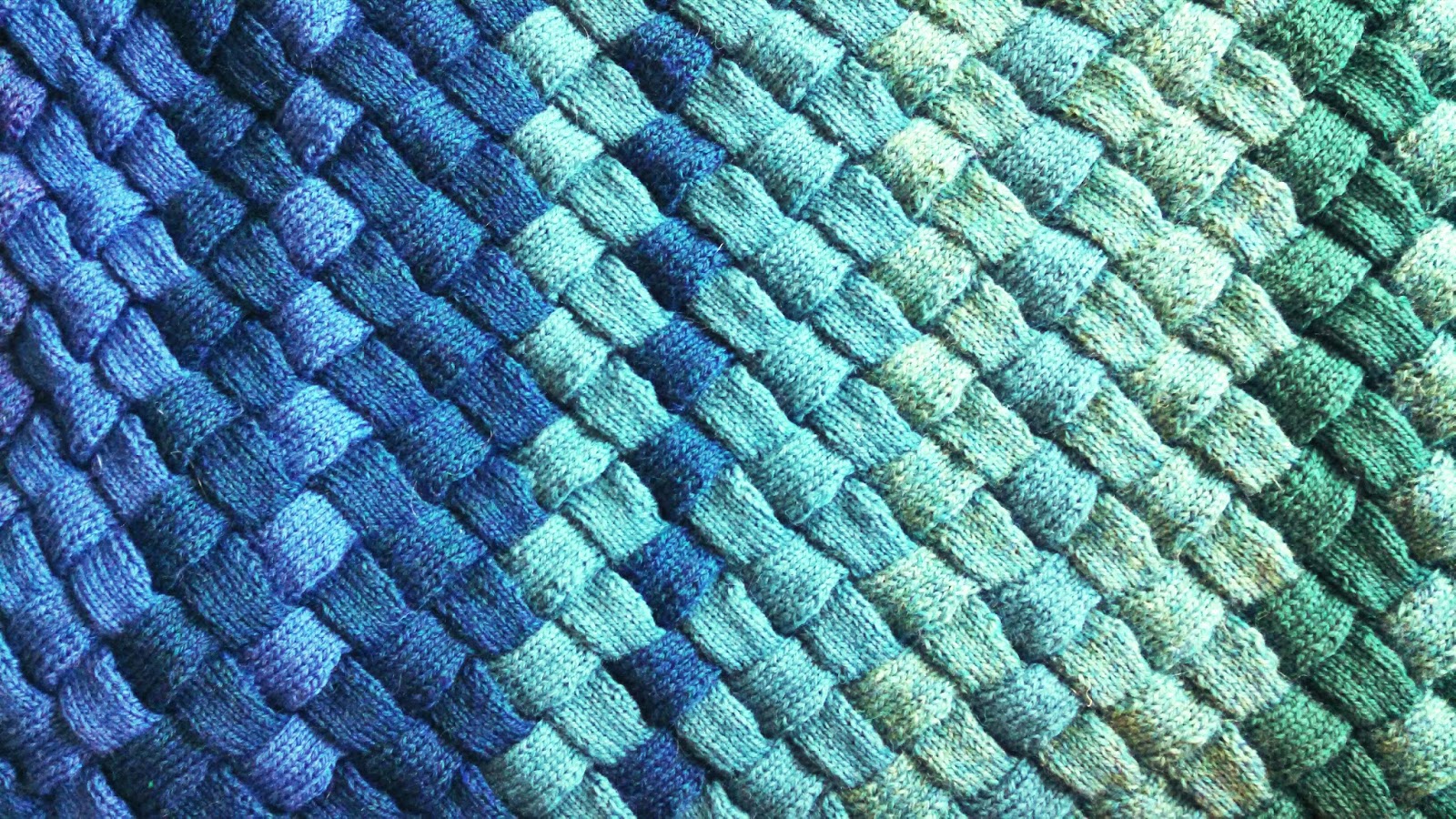
In the in-between, I've slept more than I usually do, and I've watched as much baseball as I can, and I've knit. I'm reaching the point on a project I've been working on for more than a year where it is actually becoming itself. For all of my various organizational obsessions, I'm a poorly organized knitter. I don't plan yarn purchases for specific projects. I have a Ravelry queue of more than a hundred patterns, and I can safely say I'm not really intending to knit most of them. So when I began the Virelai Ancien wrap, it was mostly an experiment in ridiculousness, and I more or less accepted that it was going to pattern on in shifting shades of blue and green forever. But I've finally reached the end of the colors I had put aside for it, and I'm very nearly ready to begin the border. I'm still trying to decide on what I'll do around the edge—surely black—but it's reaching that point where the edging is becoming a reality. It's something I'll need to do soon. And like the process of finishing a novel draft, once the end came into sight, I felt this barreling feeling. I couldn't stop.

an entrelac blanket in various shades of blue and green
Entrelac. All of the entrelac.
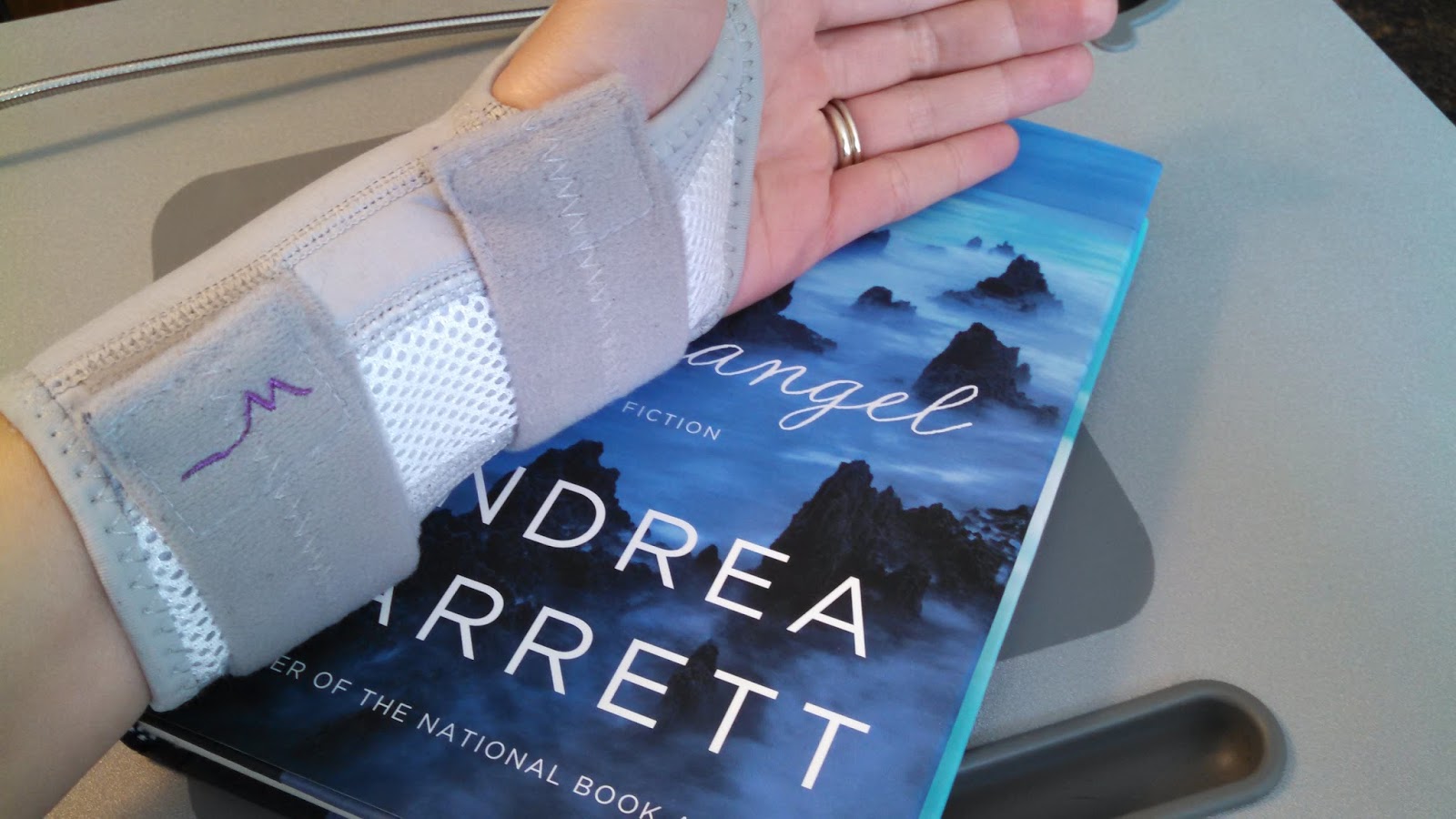
Which meant that I've probably spent something close to thirty hours knitting since I came home on Friday, which is roughly 1000% more knitting than I usually do in a given three-day span. Which has precipitated me needing to dig out the wrist braces I bought back in the dissertation days.

hand in a wrist brace atop a book
Andrea Barrett's story collection, Archangel, is pretty great, though.
I'm wearing them now, and I wore them as I graded this morning, fully anticipating that I will spend all of the night's MLB playoff action knitting. I will do that even though I know it's going to hurt—
(Read this by Kyle Beachy wherein he talks about pain and acknowledgement far more gracefully and pointedly than I do here.)
—and tomorrow, when I have another morning of typing and grading ahead of me. At night, I will put my hand under my pillow because the weight of my head holds my wrist flat, and the eventual warmth will feel good. And I will probably knit more tomorrow because I'm close to the end and I'm excited, and the project isn't of such a complex nature that I'd screw it up by continuing to work on it.

The barreling feeling gets me in trouble at the end of writing projects. I finished a draft of a short story today, and I wasn't even out of the shower before I figured out that I'd rushed the ending. I made myself spend longer on breakfast, making a Fancy Coffee in my own kitchen (because leftover salted caramel and some frothed milk never hurt anyone) and eating my toast before I went back to the computer. I fixed it then, and there was still that heady little buzz of finished finished! when I closed the file and got on with today's grading.

The story is short by my usual standards, just over 3,000 words, and I'm doing my best to wait at least a day before looking at it again. Wisdom says I should wait longer. If a story is a small wound—and for me, they usually are, painful in so many ways—I should let the whole thing heal, wait for the work's edges to become whole before I look again. Then I'll see what's gone right and what might need to be opened again, where the stitches went awry.


16 June 2014

connecte(d)isconnected

I think I watched six minutes of Game Four of the Stanley Cup Final, and that was the balance of the end of hockey for me. And that hurts me, somewhere in my hockey heart (damaged goods at the moment, thanks to Pittsburgh's fizzled season and off-season travail).  It's unsettling, too, that I can't quite remember what I've seen. I know, at the end of May, I watched some of Kings-Blackhawks because I was in a small, dark, Dickensianly damp hotel room for a week, but I know also that I fell asleep before any of the games were over. It's all half-memory, scores and highlights and Twitter reactions and forgetting what is first-hand and what is second. It's the same with baseball, though it's a long season and what I'm missing isn't the last firework burst for months.

But I have been seeing a lot. With two weeks of my fellowship now complete, I can say I don't lack for what Annie Dillard calls eye-food. The days are all about diving deep, about filling both lungs with air and fixing a light on the brain, between the eyes, and plunging. Coming up for breath at the end of the day has actually been difficult; the first week, I couldn't. After the archive closed at five (eight p.m. on Wednesdays), I spent nights reading PDFs, something both charming and uncanny in electronic versions of documents three hundred years old. (And painstaking: I discovered that I would much rather turn physical pages than execute the several clicks it requires to advance to the next page and size it to readability, even if that means re-typing large passages of notes instead of digitally highlights or annotating them.)

There have been books, too:

This book, Seamanship, Both in Theory and Practice, has been immensely valuable (not to mention immensely beautiful).

The diagrams are consistently excellent, including this primer on knots (one of several), and it includes written explanations both of the physics of sailing (why sail A on mast X drives the ship in N direction when the wind strikes from Q direction at H force) and how to execute specific maneuvers on-board (like the very particular process of dropping the anchor on a ship of any particular size). If you are going to be time-traveling and expect you may end up in the Age of Sail, or if you are the sort of person who may be marooned on an island where an eighteenth century ship is moored, take David Steel's book with you.

I am very much adrift in the contemporary world right now. There are some lunchtime snippets of World Cup, and President Obama spoke here in Worcester last week and that precipitated some conversation about this city on that particular day, but there is otherwise little talk of here, of now. But everything in this project I am researching feels anchored well, encompassing, whole. It is hard to cope with that sometimes--there are many conversations happening in the places I usually spend my time (both online and in Wyoming and in Pennsylvania) that I know I'm missing and feel I shouldn't--but there are also many conversations here (with actual human beings and texts and the funny writerly place inside my skull) that I would not miss for the world.

***

And a little plug: my short essay, Final Mica and Final Mare, is the second piece in Narratively's Tales from the Pitch folio in The Beautiful Game feature, in which I wrote about an intercollegiate soccer tournament in Sibiu, Romania.

02 June 2014

Panic early and often.

I've done that thing where I get incredibly precious about posting and thus do not post for months. Working on it. Feeling like I've got something to actually share helps, and all at once, I'm brimming with things.

One, let's start with some excellent, conflicting, perfectly apt advice I've received today. Exhibit A:
"Panic early and often."
Exhibit A was given to me this morning during orientation at the American Antiquarian Society. The person who delivered it was spot on: fellows have an entire month to research; fellows have only a month to research. (The archive, of course, isn't going anywhere, but the point is to do what needs doing now.) That means that one has to be well-organized and pro-active. Don't wait to wade into something--you may need to go deeper than you think. "Panic" here reads as urgency: don't wait. Look now. 

In true and marvelous Madame Clairevoyant fashion, though, my favorite purveyor of horoscopes (and the only one I read because they always contain something I need to hear) offered up Exhibit B: 
Aries: It’s going to be easy to feel like everything is urgent, this week. It’s going to be easy to feel rushed. The world will pick up its pace around you, maybe, and it’s going to require a specific kind of bravery, a strange quiet kind of courage, to move at your own speed, to move slowly and intentionally through even the strangest of days. Try not to let the world chase you off your own path. Try not to let the world make you panic. There’s plenty of time, there’s so much time, there’s all the time you need. ~The Rumpus 
I don't believe in horoscopes in the sense of expecting anything in them to actually come true, but Madame Clairevoyant's whimsical and lovely work strikes the ideal advice-giving balance between koan and fortune cookie: the brush is broad enough, soft enough, to fill in the background behind whatever I'm doing.

And this one is just right. Everything is urgent--but it's up to me to control the rush of it. Nothing has to be rushed. Nothing, dear hobbits, need be hasty. But there is so much: there's this marvelous, overwhelming, exciting residency I've really just begun. I'm working on The Pirate Novel while at the American Antiquarian Society, and there's just so wonderfully much to dive into. But my process is well-organized. The librarians/curators/staff/archive genies/microfilm fae/periodical wizards/map magi are rockstars. All will be well.

And all will be well in time to move. Because I am moving in July, back to green Pennsylvania, to Lebanon Valley College, where I've accepted a position as Assistant Professor of English. It's slightly old news if you follow me anywhere else online, but that's adding to the urgency: I've come to the residency directly from a week spent looking for a place to live in Pennsylvania, and I will leave the residency to finish packing and then do an about-face and drive across the country again. 

There's so much happening--so much good--and everything's so green. There's time.


Lebanon Valley College's McGill Field.

09 March 2014

I Learn All My Best Lessons From Baseball: Revision Edition

A year ago, I was on my way to Scottsdale, AZ, to spend my one-week spring break watching baseball and finishing a revision of my novel. It was a week of heaven.
groundskeepers getting the infield ready
I'm here in my mind.
This spring break, I'm still watching baseball, but it's from my desk, and I'm still working on that novel. This morning, I sketched out all of the things I have to finish this week. The list includes an academic paper revision, a review I promised to do, two grant applications for the Equality State Book Festival, and innumerable small tasks related to said Book Festival. There are other things (remembering how to cook actual food, finishing reading any of the six books I am halfway through, finishing some gifts I am in the process of knitting) that I would certainly like to do, but the others are non-negotiable. March 16 cannot slip past without the first set complete because this life is full of deadlines and some of them actually matter.

This morning, too, I took something off of that list, something that had been on my Spring-Break-Absolutes since last fall. I took "finish the novel revision" off of that list. It's the same novel I was working on last spring break, though it's changed a lot since then (for the better), and idealistic me thought that I'd surely be done with it by now (wherein done means "ready to send it out," really, really ready, not only kind-of-ready like I was last spring and still tried three times, stupidly).

I didn't take it off the list because I don't want to work on it. The opposite is true. I've spent most mornings since January sitting with the manuscript, re-reading, re-considering, understanding the big changes that I've been avoiding. I am getting closer to really understanding it. And I've revised it on self-imposed deadlines twice before. Rushing it at the end is not the thing this book needs. It only took a year to understand that, but understanding it doesn't make it easier to swallow.

Back in February, when I was certainly at the height of the now now now feeling this novel has been causing, someone on Twitter linked a post by Sonya Huber that begins
Your book is taking a long time to write. You see updates on social media about the release of other books, and you get a racing hopeless feeling inside, as if your little book with its million little legs were trying to climb up a mudslide. You have been through this draft so many times. You have been asked how many drafts it takes you to write a book, and you want to say that the answer is really the number of times you thought you were finished, plus one. (read more)
Huber's post gets at what I've been feeling for a year. It's agonizing, feeling like I'm very close to being done, but not being done, and realizing more and more with each revisiting of the manuscript that it deserves better than hurrying. There's a piece of feedback that I need, and there's a slowness that the book needs, a consideration and a deep thinking. Neither of those are going to appear according to a schedule. The week since AWP drove that home.

On Monday morning, I woke up and spent my writing hours organizing my notes and my revision plan. I was doing that in preparation of this week: my plan of attack. How would I approach the revision in a way that would let me get it finished while also finishing the necessary tasks I mentioned earlier? What happened was that, while I was puttering about in Evernote, making checkboxes beside planned edits (so when I made them I could put that little mark in the box--it is so incredibly satisfying and so indicative of why my scheduled process has its pitfalls), I figured out something I hadn't figured out yet about the ending. I did the same thing on Tuesday, just slowly puttering and shifting notes from one file to another, and I understood something else. It happened again on Wednesday. In two hours of slow thinking--not even writing at all--I made more real progress than I had in the two weeks before, at least as far as substantial work goes. Sure, I line-edited and tweaked, but I hadn't learned anything. When I had three mornings to think about the project, clarity came. When I had long days in airports and that post-AWP muteness that makes it hard to say anything, I could hear it. (And I could hear the answer to the hard question I've been asking about a chapter for eighteen months. I've known the answer for six, but I didn't want to listen.)

Writing this novel has taught me more about writing than I was ready to learn, most notably that my process has always been about drafting. I'm only now understanding that my process has to change when it comes to revision. Being goal-oriented is great--when it's time to get the draft out, when the point is to make the words happen in the first place--but it's not the answer for finishing anything.

So maybe, actually, it's good to have last year's trip to Scottsdale on my mind.
Peoria ballpark outfield grass
It wasn't possible to stress out during those games.
Sit in the grass. Take a nap. It's just a game.
Everything about the baseball on that trip was about taking time, seeing how it goes. Yes, there's an end to Spring Training and hard decisions have to be made, but they can't be made before we understand what we have. Don't rush this: it's going somewhere. Watch. Wait. That's part of the process, too.

22 February 2014

Where will you be? (At AWP)

'Tis the season and all.

Find me on Thursday morning here:

Redwood Room, Sheraton Seattle, 2nd Floor
Thursday, February 27, 2014
10:30 a.m. to 11:45 a.m.
This interdisciplinary panel features five writers whose work puts significant distance between speaker and writer—whether by writing across gender, setting, historical time, or conventions of language—to reimagine, challenge, and expand the writer’s or narrator’s persona. Each panelist will provide a short rhetorical and practical framework that focuses on crafting these voices before presenting representative work.
I'll be reading a little excerpt from Heading North and talking about character grammar and syntax. Even more exciting is the part where I get to be part of a panel with these excellent writers!

I'll also be reading at Lucid as part of the Festival of Language's 'a reading eXperiment,' on Thursday afternoon from 4:30-6:00 p.m.
The Festival of Language’s a reading eXperiment is an experiment in the reading of original creative works as juxtaposed against expectations, perceptions, other creative works, and audience members. With new and exciting compositions and configurations, this reading eXperiment will be a one-of-a-kind experience for readers and audience members. 
Come say hello! I don't have blue hair anymore, but if you drop a conspicuous hockey or baseball or Beowulf reference within earshot, I'll be the one with her head on a swivel, trying to find the source. 

24 January 2014

read and recommended: "The Old Ways of Defeat" by Chris Collision

Half of this post is months later than I intended it to be, but I'm not often a timely writer, and when I am, usually the coincidence works against me. But maybe it's timely in a different fashion because this week, word hit the hockey streets that the ECHL's San Francisco Bulls are in some dire financial straits. This makes me incredibly sad because I hate to see any team (anything, really) struggling, but I was really hoping the Bulls were going to thrive. I was rooting for them. I mean, the whole team released a You Can Play video, not just a few token players from a variety of teams put together, but a seemingly unified voice, which is still something of a rarity at the professional level. The team has been playing for two seasons, and they've held two LGBT nights (with these pretty excellent jerseys). A team like that makes me want to love them. Back in August, in Classical Magazine Issue Four, Chris Collision, writer of many fine things, wrote an essay I have to talk about, an essay I've been meaning to talk about since it came out, and two San Francisco Bulls playoff games create one of the essay's hinge points. So, here we are.

"The Old Ways of Defeat" is, for detail junkies like me, a joy. The ambient sounds of the minor league sporting event--perhaps in their most Platonic guise at a hockey game played in a place called the Cow Palace--are everywhere, and sharp, and right. The situation of the team, the league, and the circumstances of these particular games are clear and purposefully placed, rounding out a personal experience with knowledge that is effortlessly conversational--"the ECHL will, for example, teach you things like 'there is an Ontario in California'"--and self-aware in a traditionally (and I mean this as a compliment of the highest order) Montaigne-like fashion.

How easily this essay communicates is one of its strengths and ironies, as the piece starts in a moment of isolation, the alone-in-a-crowd feeling that is so difficult to handle--on the page and in person--as it's eroded here and there by the strange charms of the minor leagues, the fans, the trappings, the unlikely Bulls-versus-Alaska-Aces playoff matchup. In this essay, the erosion is only partial, so much in the way that the verve of these particular games are: highs, lows, no definitive Moment, a point best illustrated in an incredibly brief, mostly elided hockey fight that means essentially nothing in the course of a lopsided game and the Bulls' season's imminent close. The fight gets no glamor on the page, a writerly restraint I admire, and it's also an illustration, I think, of a final separation: "There is watching it, and there is doing it." We're just watching, most of us.

But there's something arresting in that, too, and I have to give you the whole final paragraph because I can't bring myself to carve it into anything but itself:
And then there are these live events—moments shared and unrepeatable, in all these shabby but life-full places that pull a poorer and more diverse crowd. They are not glamorous or even particularly beautiful, and there are whole buried rivers of disappointment running under all of it. But these can all be a step towards a life that's less lonely, less canalized through phones and less inert in front of a screen. It's a fight. But Kris Belan fought B.J. Crum, held him accountable for a smallish transgression in an essentially meaningless AA game. He fought harder for less.
***

My interest in the San Francisco Bulls is bandwagon-y at best, due mostly to "The Old Ways of Defeat" and their work with You Can Play. I can't name a player on the team without going back to Collision's essay or Googling something, and I've never seen them play. I wanted to, and I almost had the chance: in October of 2012, my husband and I made a mad weekend scramble to San Francisco over my fall break so that he could see his beloved 49ers play in Candlestick before they moved on to what will be their new, shiny stadium in Santa Clara. It was not a good trip to San Francisco. The point of being there was only the football game, all of it already an extravagance, so we were staying cheaply, far away from any of the San Francisco I'd seen the year before (the piers, Golden Gate Bridge, great food) while road-tripping with a friend. It didn't feel at all like being any place anyone would want to go--just a chain hotel, chain restaurants, and a sense of rushed alienation: not quite thirty-six hours in the city, all told.

Twenty-four hours after we arrived, it would be clear that the trip was a disappointment in many ways. At the top of the list was the fact that the San Francisco 49ers got shellacked by the Giants. It should have been a good game, in terms of 2012 competitiveness, one the Niners had a good chance to win. The Niners did not win, and the experience itself wasn't pleasant. We got the only tickets we could get: in the endzone, in the very top row, at Candlestick Park, where the giant concrete bowl gathers only the coldest air from the bay and slings it back around the rim. The sheer size of an NFL stadium and the distance from the game--something I'd not experienced before--made me want a ridiculous jumbotron uglying up the place, if only so I could see what was really happening. My reading glasses weren't cutting it. The one-sided game drained all of the live-sports-experience out of it, too; the Bay was quiet. The Niners Noise drum line was basically the only life in the place, and they stood in our endzone far too little. But that would come later.

We arrived in San Francisco on Saturday evening, and the San Francisco Bulls were due to play the second game of their inaugural season against the Bakersfield Condors that night, too. But there was no permutation of flights that would get us from Wyoming to California in time to make the game. The BART train we took from the airport toward our hotel actually passed the Cow Palace, probably sometime early in the first period, and had we not also been toting our suitcases, I would have lobbied that we go, anyway. Then the train ride was long, and we walked a long ways afterward to actually get to where we were staying. Even if we'd simply dropped our bags, turned around, and headed back to Daly City, the game would be over before we arrived. Still, as we ate our burgers from In-N-Out, I ended up following the third period from my phone for no other reason than being more near to that game than anything else familiar, which was one version of being connected, in some small way, to everything happening there.

Here's hoping the San Francisco Bulls can hang on.

You can get Classical Magazine at iTunes and in PDF/epub/mobi format as a monthly subscription or by the individual issue.

21 January 2014

the start of another semester, plus some fiction

Today was the first day of classes for Casper College students, which means it's well nigh time to get back on all of the horses. Part of me protests I never got off the horse, didn't have much time out to pasture over the break, so to speak, because winter break is always a flurry of final grades and airports and preparing to tackle new things. This winter break, it was preparing to teach a compressed video/distance education course for the University of Wyoming. Teaching Middle English Literature using brand new technology in a brand new building is both peculiar and perfectly fitting. It also means slipping into old favorites and re-reading texts I haven't looked at since graduate school, and that reminds me so much of why I'm in this profession.

This afternoon, after from doing a little Beowulf prep (which mostly consists of me writing hard time limits on my class outline because I know myself), I settled down with Richard Waswo's article "The History That Literature Makes" (New Literary History 19.3). Waswo's article looks most particularly at the legendary history of Britain, its hunger for ties back to Troy and an older, more civilized civilization.

Aside from reminding me how much I simply enjoy this article, Waswo's work got me thinking about that reaching desire to see oneself as part of something larger, something older, something lasting. And of course I thought about writing, but also reading, and also American literature and culture, and I was again struck at the way my writing projects inevitably intersect:

One thing that happened while I was away from the blog was that I was awarded a Robert and Charlotte Baron Creative and Performing Artist Fellowship at the American Antiquarian Society. I'll be there in June, working on the pirate book. As a 18th century transatlantic narrative, seeking and also resisting ties--to religion, family, nation, and even narrative itself--are certainly at the forefront.

And because I just wrote that last sentence, which is unrelentingly academic, let me make it up to you with a baseball story: To the Wall, appeared in the inaugural issue of The Rappahannock Review in December, and it offers up rookie-level minor league baseball in Casper, Wyoming, with a side of painkiller addiction and Justice League references.

This post is not a great post, but it does serve some purposes, including making those two pointers about my own writing that I'm pretty excited about. But more importantly, it's pulling the Band-aid off on the blog-drought. I've been thinking about what kind of post I could make after more than two months that could justify the absence, and I didn't have one. I have this, which is a post, after which another can be written, more easily.

02 November 2013

now what?: on writing I don't know how to share

On Wednesday, October 30, at 10:15 a.m., I received the new issue of The Classical Magazine (issue six) in my inbox (as a PDF because the only iDevice I own is an iPod so old that it can sing along with most of the music on it). The premise of this issue is econo, short pieces of prose and poetry and the things between, and it is full of work by writers I enjoy and admire. But I haven't read any of it yet.

I have work in this issue, too, a short nonfiction piece called "First Star," my first published hockey-writing, a piece woven around Sidney Crosby's broken jaw, a Predators-Avalanche game I went to last season, and Lokomotiv Yaroslavl. A piece hinging, in many ways, on Semyon Varlamov and his play with both Colorado and Yaroslavl. I wrote the piece in the first third of October, about events from last season.

On Wednesday night, I was having a Twitter conversation about Varlamov, his kickass season so far, his apparently affable nature. Half an hour after that, the news broke that Varlamov had turned himself in to Denver police and was arrested on domestic violence and kidnapping charges. I turned my attention to the Penguins' game in-progress, I circled social media warily, I tried to focus on new writing tasks. Mostly, I felt sick to my stomach. Mostly, I didn't want to read anything, anywhere, at all.

***

It's been a few days since then. I don't want to think he's guilty, but I also refuse to assume he's not because already the crows are calling the alleged victim a liar. (Women are just like that, lying about terrifying and humiliating things for money and attention.) Already the heads are shaking and saying that it's just not possible that Varlamov could do such a thing. (Everyone knows nice guys don't do bad things.) Avalanche head coach Patrick Roy gave Varlamov the start last night in Dallas because he didn't see any reason not to. Varlamov has yet to be officially charged with any crime; he posted his bail; he is, legally, quite free to play. The slow unfurling of legal procedures proceeds apace, and it's unfair of me to assume guilt or innocence in any direction until that process is completed if I believe in this legal system.

I do. And I don't.

As someone who wants everyone, under all circumstances, to have the right to real due process, not just torches and pitchforks, I must believe in this legal system. As a general optimist and person who attaches affection easily to people, places, and things, I cling to that benefit of the doubt. I want this goalie whose play I appreciate and whose career took a path I found conveniently symbolic to be innocent. And I mean squeaky-clean, photographic-and-eye-witness-evidence-plus-retinal-scan-that-the-accused-was-instead-volunteering-at-a-trick-or-treating-event-for-at-risk-youth-at-the-time-of-the-events, evil-impostor-committing-crimes-in-my-stead innocent. Except not exactly that either because I also do not want, at any time, for anyone to be guilty of domestic violence. Of violent crime of any kind. Because I don't want people to commit acts of violence. Ever.

I want desperately for the system to work, too. If he's guilty, I want every possible book thrown at him, preferably by Aroldis Chapman (metaphorically, of course: the weight of guilt should feel like that fastball in the unprotected ribs).

As a human being who's walking around this world with eyes open, too, I know that the system often doesn't work. I know that many cases like this (domestic violence cases, cases involving high-profile, wealthy persons) don't reach trial stage. They can be settled out of court, charges can be dropped (and not because they were invented but because of a host of larger, frightening reasons), and the very idea of the system can be collapsed before one even gets to the part I think of as that proper due process. I know that due process doesn't necessarily lead to justice, either, and that more people want to believe that the victim is lying than to deal with the wages of a culture that excuses and masks violence.

I want an impossibility: I want Semyon Varlamov to be innocent and I want Evgenia Vavinyuk to be telling the truth.

***

This post was never anything I ever wanted to write, but I also couldn't say nothing, even if no one even noticed the connection: "Hey, you wrote that thing praising that guy who might have assaulted his girlfriend." It's most of what I've been thinking about since Wednesday, and even as it strikes me as egotistical that I am in fact thinking what about my writing? in this context, we are inextricably tied to our work. Better to acknowledge that than not.

I loved writing "First Star." I loved that Predators/Avalanche game I went to. How I feel about that piece of writing now--I don't know. Rereading it doesn't make it more clear. What is clear is this: I don't know how the rest of this story plays out, and I know that it will absolutely matter to me when it does. I also don't know how to compartmentalize--hockey here, humanity there. There are enough talented and skillful people in this world that I don't think it's too much to ask that we be good at what we do and also simply good. Decent.

And if I'm feeling uncomfortable about my own work in the new issue, there's no reason that I should feel that way about the rest of Issue Six. So I'm going to go read that, and enjoy it, and wait.

01 November 2013

another not-NaNoWriMo post

It's the six a.m. hour, and I've decided that the short piece I drafted at the beginning of the week is finished. So before I had a second cup of tea, I submitted it to two places, and it doesn't feel as unwise as maybe it should. (Of course, I trust my decision-making at this time of the morning far better than I trust it at two in the afternoon.)

At the same time, all over the world, NaNo'ers are leaping into beginnings, including my friend and colleague Jill. She came to dinner last night with notebook in hand, and it made me so happy to see that. Last night, at midnight (when I'd been soundly asleep for two hours), a local writing group had a NaNoWriMo kickoff write-in. I envy them. I envy their fresh starts sorely. I have never done NaNo, not in any way that is "correct," though I have made attempts of varying kinds to keep in the spirit. There is a buzz in the air about it, and anything that spurs one forward in any writerly way is a marvelous thing.

This, I suppose, is another of those keeping-in-the-spirit posts, though the last thing I can/should do this month is start anything new. My goal is more now in line with my 2010 November: do something that I need to do as a writer every day. Sure, that means sending out work, but more importantly, it means finishing.

I have folders of unfinished things, fully drafted short stories that don't quite work; half-written things that I'd forgotten I'd even thought of, let alone written; two-and-three word ideas that still blister and crackle no matter that I tossed them into a file years ago. I have kernels of pieces that can only become poems. I have a novel to be written, all furled potential; I have a full, old, old draft of another whose re-vision I'm starting to be able to see. More importantly, I have the novel I'm still working on, the manuscript I keep thinking is finished and keep understanding is not and the only right thing to do by that book that I love, the book that made me completely forget that there was a November last year, is keep working until it's right. Until it's as good as it deserves to be. And that is terrifying. It takes a kind of patience I don't have, that I have to make, and maybe I'm doing that kind of stepping back that Michael P. Nye wrote about earlier this week. I know good work takes time. I spent big chunks of my summer taking that time, considering things, and the revision I did in August did leave me with a better book than I had in July. I'm now understanding that "better" is no substitute for "right."

It's not right yet. I'm not sure what "right" is for it yet, but I know it deserves to be right.

So I will try to be patient and listen and if I can't do either of those things gracefully and contentedly (and I can't), I'll finish smaller works. They've been waiting longer still, and they deserve to at least get where they were going. I won't set another artificial deadline to finish another revision by a date or a time: I understand that my problem is not getting myself to work. It's not about spurring forward this time.

I do want it to be, though. I want to be part of the dash. I'm good at the dash--even elementary school gym class showed me that.

I loved gym class. The period was never more than forty minutes long, and in forty minutes, there was never enough time to get into the things I couldn't do. The longest we ever ran was a mile and a quarter. More often we sprinted. More often we dove after a ball, the goals quite clear, the scores clearer.

Novel writing is not gym class. Even my own process is not the one-size-fits-all yellow mesh pinnie, appropriate for all activities, no matter how much I want it to be. But there's something to learn from thinking about gym class--about exertion, in particular, because what is writing except exertion of one kind or another--no matter what shape I'm in, no matter what shape this novel or those drafted stories or those little poem seeds are in, I can do something. And so I must.


14 August 2013

Re-entry

My Jentel residency has come to an end, and the upcoming days are my re-entry into the usual world. Given the presence of the Perseid meteor shower and that we spent our final two nights at Jentel sitting on folding chairs in the driveway, heads tipped back as we watched these clusters of dust and ice immolate in atmosphere, the idea of re-entry feels appropriate. It's been a summer of overwhelming good fortune, but there's no getting away from the overwhelming part; it's hard to really understand the imminence of the semester and so on.

Before the meteor shower, too, the summer sky shed its usual measure of stars. It’s not that I’ve been particularly attentive to that—I tend to be asleep well before the interesting astronomical features take place—but there’s so much sky, so much night that even I can’t miss it all. 
 
That’s been the feeling over the whole month: there’s so much good here that some of it must stick, well past the end of our tenure at Jentel. The work was good, the scenery was good, my lovely, lovely fellow residents were more than good, and this is all following in the Jentel tradition of understatement.

Have some pictures:
Like it says on the sign. 
Just a few days into our time together, we thought it was a good idea to take a 4-mile round trip hike to a fire tower none of us had been to on a trail that is not marked at all. (No one will be surprised that it was my idea. I wanted to research something. How hard could it be?) The hike had its challenges (including a need to be a little inclined toward mountain goatishness to get to the actual lookout), but it was worth that much and more. And we stopped to get ice cream together on the way home. That's how you know you've bonded: passing around your order to let five people you just met taste the chocolate malt or rootbeer float or butter pecan milkshake. 

Shadow portrait of the residents, Big Horn Mountains in the distance.

And in Big Horn, Wyoming, Holly discovered she loves watching polo. Because everyone expects polo in northern Wyoming, right?
I had four weekends in the greater Sheridan area. I went to four polo matches, and that was an experience that will get its own writing project of some sort. In the meantime, visit Flying H Polo and Big Horn Polo Club. Also, read Alyson Hagy's spare, beautiful novel, Boleto. I read Boleto last summer, actually, in Montreal, and I will read it again, now, knowing a little more about the backdrop to Hagy's fiction. 

This sky, you know?
Wyoming sunsets. They're all right.
A thousand thanks to the Jentel Foundation. A word I kept using while I wrote postcards to folks was transformative, and it's true. This residency changed the way I think about my work (in some very practical, tangible ways and some not-so-tangible ways) and about myself. At Jentel, where art and the artists that make it are so clearly valued and honored, there was so much burning brightly, sky and self. I'm taking that with me.

18 July 2013

it's dangerous to go alone--


I'm not Link, but if I were (and I kind of wish I were, because honestly), this is the point at which the old man offers me a wooden sword.


Instead, because I'm not a small, green-clad adventurer in an 8-bit RPG but rather a small, Crosby shirsey-clad writer in the fourth day of a writing residency at the utterly gorgeous Jentel Foundation, I've taken these:


They're as good as swords--or better, really, since I'm doing a lot more reading than slaying bats in caves--and they are excellent company (and my fellow residents are good company, as well). These are books and chapbooks and zines by people I know or that have been gifts from folks I know. In order, from left to right: Deborah Poe's the last will be stone, too, Vanessa Stauffer's Cosmology, Kim Barnes's Finding Caruso, Chris Collision's Queen City Fall, Sean Thomas Dougherty's Sunset by the Chain Link Fence & The Blue City, and shortandqueer #10, The reawakening of my baseball fandom. 

I've also brought a ton of reading for research purposes, some directly related to projects, some indirectly. If you want to carve yourself open while an author carves herself open on the page, pick up A. L. Kennedy's On Bullfighting. A. L. Kennedy is always brilliant in the fiction I've read & her regular column for The Guardian, but this book is hard and beautiful and bleak, and also contains one of the most powerful meditations on Lorca I've ever read. Melissa Montgomery, wherever you are, this was the conversation on duende that your Lycoming College honors project wanted.

Here at Jentel, I have a room of my own and a studio in which to work, as well as gorgeous common spaces for absolutely everything else.

My studio, before I decorated it with piles of books, three separate & full travel mugs, and a plush stegosaurus.
There's much to say about Virginia Woolf and rooms of one's own and that's something that I believe in desperately. Space is such a necessity and a privilege, and the Jentel Foundation has provided truly superlative space in the way everything has been planned. But to have this space as well--even with a first-night rainbow over these prairie swells, the not-quite-foothills of the Bighorns--is something particularly moving.

On Tuesday, in those hills, I also got to see my first rattlesnake in the wild. It was lying beneath a clump of sage I was intending to step past, and my preceding rustle gave us both twenty-four inches of warning. I didn't have a sword, but I didn't feel much of a need to have one, either. The snake moved slowly and silently in its direction (without shaking its tail--I'm a little disappointed not to have heard it, but glad too I didn't vex it to that point), and maybe I decided to change mine, but that's all right. I had friends waiting at my desk.

01 July 2013

space and time

The second and third legs of my travels, which took me to the Maritimes & Quebec and San Diego, respectively, have come to a close. Have a few photos of some of the highlights from the first few days of the east coast excursion:
Waves at Acadia National Park, Maine
Bowsprit of the Tall Ship Mar, Halifax, NS
The lighthouse on Cap Gaspe, Forillon National Park, QC
Another view of Cap Gaspe, from the Mont Saint-Alban lookout tower
There are quite literally hundreds more photos from everywhere that I've been in the past six weeks and thousands of miles (also literal: my friend Heather & I put more than three thousand miles on her car in our New England/Canadian adventure). I'm looking forward to sifting through them more carefully in the future. Just now, I'd like to pause a moment on how strangely productive all of this travel has been. 

I certainly don't mean in terms of production, any finished project. I've been a shameless and capricious dilettante, starting a dozen different pieces in three genres and finishing none of them since I set out on May 16. I blame some of this on the fact that I was working almost exclusively in my notebook, with a pen, and it's much easier to do the big organizing/re-writing/overhauling that I need with a keyboard than without, so instead of crashing things out, I took notes and then moved on to whatever was next, returning to make more notes as necessary. (I will say that Evernote may be revolutionizing that annotation process in a really easy and useful way, and it was incredibly helpful even when I didn't have actual network or wireless access with my phone, which was incredibly often through the Maritimes and the Gaspe Peninsula.) But while I still have my many, many pages of notes and scraps and snippets to actually type up and organize, the overarching sense of it all is that much of what I started deserves finishing. I don't often feel that way, and my folders are a hive of the unfinished. But all of these things feel quietly, calmly alive in a way that says Take your time. We will be here when you're ready. This is good. This is important. Because there's no way, of course, to finish all of these things at once, and it's madness to try. It's madness enough to be still at work on a novel's revisions (more on that in a moment), preparing to start drafting the next, and having some non-fiction planned that really does need to be finished. But this is good madness (I think). At least the back of my writing brain thinks so. It must think so because it's finally let me think some useful things about the novel I "finished" over spring break. 

That was the first substantial revision. It was a revision that needed to happen, but when I put the files away for the end of the semester, I knew there were some things that weren't quite right, and, in early May, trying to think about those things made me feel frantic, panicked, and riddled with failure, even though I know that excellent novels do not come about on one-and-a-half drafts. A novel is work, but, in May, it didn't feel like work, which is familiar, which is what one does, which is strangely comforting in its way. In May, it felt like just one more thing I couldn't get right. 

So, an ocean, then most of a continent, then the spine of the Rockies and wide deserts between me and it. Up to nine timezones. More than a dozen new students and a host of wonderful new people and a wealth of new landscapes and climates and a lot of delicious food and miles passed beneath my sneaker-soles. A jumble of new ideas. The constant smell of sugar in the air in Sibiu, the pine freshness of Gaspe, everywhere marine salt from Maine to Montreal and then in San Diego. All this distance, all this stimulus. And in small, quiet moments--under the rain-wet tent in Maine, on a silent, red beach on Prince Edward Island, on yet another lookout over Gaspe Bay, with coffee in hand in the Quarter of Spectacles in Montreal--things became clearer. Some small changes, adjustments to scenes and moods, and some cuts, of course, and then, last night, as the last flight started its descent into Casper, the thing I probably needed to know most about the book crept in. I had to write my notes on my actual boarding pass, given the timing, and there are scrawls in all of the white spaces, in the bigger block of white following my name, in the smaller white rectangle beneath the large DEN-CPR, on the back around the advertisement for United's Mileage Plus credit card. The ideas filled themselves in, wherever there was space. All I had to do was find that space. 

In fourteen days, I leave for my residency at the Jentel Foundation. I'll have four weeks of space, too, to listen and to work, thanks to the fantastic people at Jentel. In the meantime, there are smaller things to manage, a semester to prepare for, and some finishing to do. But I know where I stand, and the footing is good, and for now, the listening is easy.